




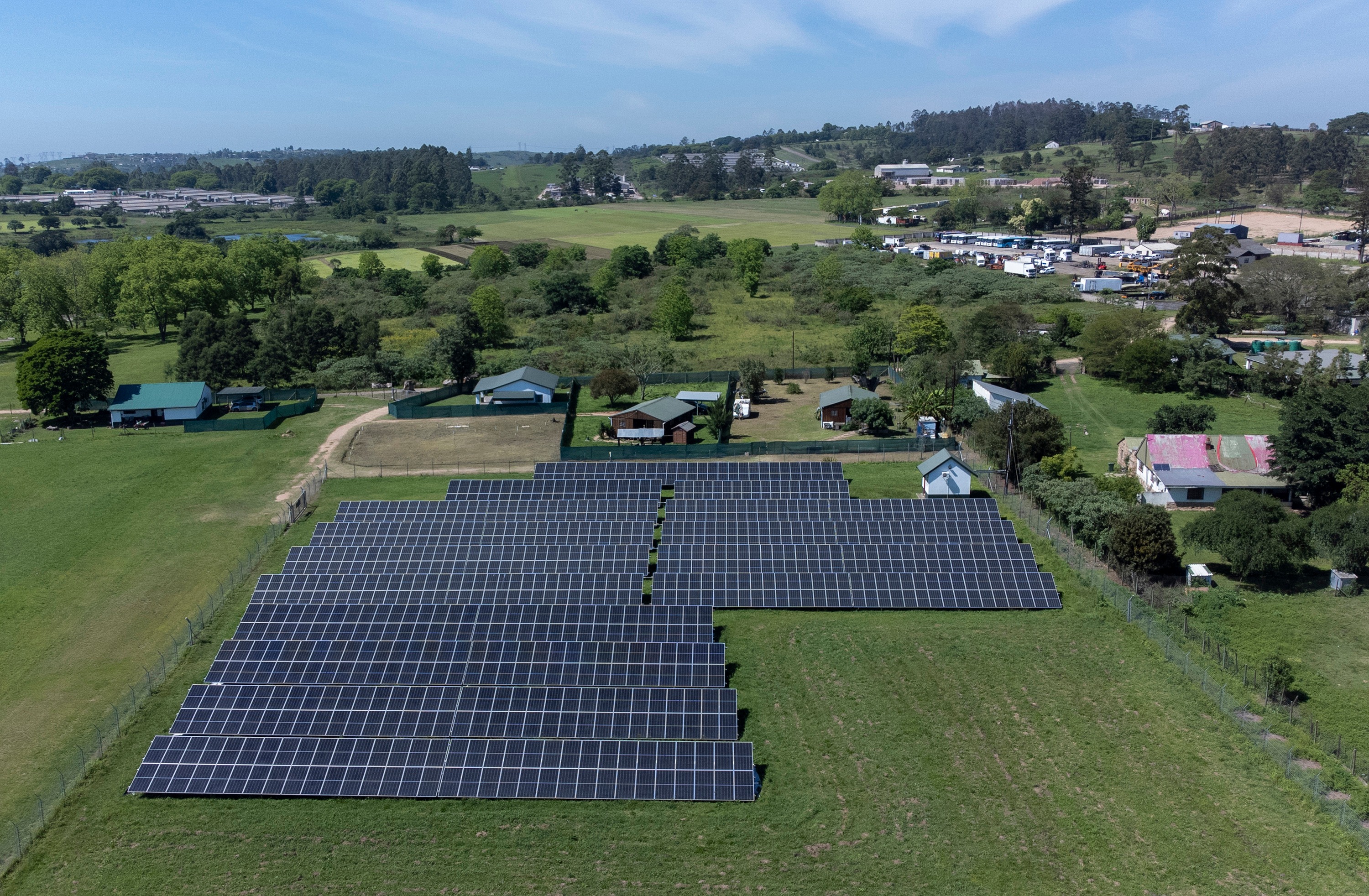
 Solar panels at Forest Mushrooms, a mushroom farm in Cato Ridge near Durban on 31 October 2026. (Photo: Rogan Ward / HNF)
Former local content compliance official Gerald Nienaber has identified R17-billion worth of foreign renewable energy hardware entering the country over 13 months, from late 2023 into 2024.
There are strong indications that project developers are using customs loopholes to bypass local content rules.
If so, they would be undermining plans to use the transition to create jobs and build local industry.
The figures, covering three major energy developers, come from Nienaber’s analysis of South African Revenue Service (SARS) import data. Nienaber is the founder of ModeTech Services.
The controversy reached the highest levels of government when the Department of Trade, Industry and Competition (DTIC) confirmed in a written parliamentary reply that industry representatives had raised allegations of customs abuse. Local manufacturers met the DTIC and SARS on 7 October 2025 to present evidence that importers were exploiting a “staged consignment” provision to bring foreign components into the country under single, duty-free tariff codes.
SARS undertook to investigate the allegations.

Nienaber alleges that components used in renewable energy projects entered the country duty-free under staged consignment arrangements, while other goods were imported under tariff classifications that did not accurately describe them. He argues that these practices allowed project developers to import components that could otherwise have been sourced from South African manufacturers.
Tariff classifications and staged consignments
Staged consignment arrangements allow qualifying large equipment, such as wind turbines and industrial machinery, to be imported in separate shipments, with different components arriving at different times. The components can be treated under a common customs classification, provided the applicable conditions are met.
Nienaber argues that the arrangements are being used to import components that should be sourced from South African manufacturers under the government’s local procurement policy.
He also raised concerns about the tariff classifications used for some imported goods. Tariff codes determine the duties that apply. Nienaber said his analysis identified goods being imported under codes that did not correspond with the products concerned, potentially affecting the duties collected.
“Transformers have their own tariff classifications, but we identified imports that appeared to have been recorded under a different code,” he said.
He cited examples in the import data, including paint, ladders, electrical equipment, steel brackets and tanker bolts, which he believed had been declared under classifications that did not accurately describe the goods.
Nienaber said he had submitted reports to SARS setting out his concerns. “In our view, the existing arrangements are undermining local manufacturing.”
He also questioned how exemptions and waivers under staged consignment arrangements were authorised and whether adequate records were kept. “SARS doesn’t enforce,” he said. “Its risk management system is out of tune. It’s got loopholes.”

Nienaber said letters calling for changes to the staged consignment policy had been submitted to SARS, and the proposals had been with its legal department for about eight months.
Nienaber also referred to an International Trade Administration Commission (Itac) review of the tariff structure for renewable energy imports, which he said recommended changes to staged consignment arrangements. He argued that the arrangements were being applied in ways that disadvantaged local manufacturers.
Itac said that it initiated a review of the tariff structure for input materials, components and finished goods used for renewable energy in a notice published in the Government Gazette on 17 April 2025.
Following submissions from interested parties, Itac published preliminary findings on 27 March 2026. These included a proposal to exclude certain products from qualifying for staged consignment arrangements and to consider certain products for designation under the new Public Procurement Act.
The commission said it had since made its final determination, but its findings would be made public only once the Minister of Trade, Industry and Competition had approved the report.
Domestic manufacturing
The South African Renewable Energy Masterplan (Sarem), published in April 2025, aims to increase manufacturing jobs in the local renewable energy sector from a baseline of 2,500 to 25,000 full-time-equivalent jobs by 2030. It also sets a target of increasing cumulative manufacturing investment from R2.5-billion to R15-billion.
Sarem sets targets for expanding domestic manufacturing. These include 15% local content for laminated solar modules, 65% for module frames and 90% for mounting structures and electrical cables and varying targets for transformers.
The targets do not apply to every renewable energy project, depending on the procurement round, designation and project conditions.
South Africa’s manufacturers face a difficult market in which overseas suppliers, particularly large-scale producers in China, are often able to offer solar panels and other equipment at prices local factories struggle to match.
Nienaber said companies had to complete social and economic development documentation to demonstrate compliance with project requirements. He questioned whether the paperwork always reflected what happened on the ground.
A company could approach a local manufacturer to produce 10% of a project’s components while importing the remaining 90%, yet subsequently document that the goods were manufactured entirely in South Africa, he said.
He also questioned whether assembling imported components at a project site should count as local manufacturing. Site assembly could involve only a small number of workers, whereas domestic manufacturing could support jobs and a wider local supply chain, he said.
“Importing components and assembling them on a project site does not necessarily generate the same employment or industrial benefits as manufacturing those components locally,” he said.
Nienaber said local manufacturers had been told by clients that orders for renewable energy project components had already been placed with suppliers in China. He also alleged that some smaller manufacturers had been asked by their clients to provide letters stating they could not supply particular products, and these would be used to support claims that those products were unavailable locally.
Court challenge
Durban-based solar panel manufacturer ARTSolar, which had to retrench 220 permanent and 40 contract employees in 2016 and invested millions of rands in machinery in anticipation of unfulfilled orders, has challenged government departments and renewable energy developers over alleged failures to comply with local content requirements for publicly procured solar projects.
Oxpeckers reported on the landmark court challenge, Court case tackles not-so-proudly South Africa solar power, in November 2025.
In December 2025, acting Judge John Mullins ordered the Department of Mineral Resources and Energy to provide records relating to local content decisions. The order gave access to records, rather than a determination of whether developers had complied with the requirements. To protect trade secrets, the court established a strict confidentiality regime where sensitive documents would be accessible only to legal teams and independent experts. (Find the judgment here.)
ARTSolar subsequently began receiving documents through the legal process, and its legal team has been reviewing the records to establish how the relevant procurement and localisation decisions were made.
Developers named in the proceedings disputed ARTSolar’s allegations. They argued that the company had failed to meet their specifications, delivery schedules and due diligence requirements. The court has not yet made a finding on the compliance allegations.
Promised orders that never materialised
ARTSolar’s experience, according to cofounder and shareholder Eshu Seevnarayan, began with promises of work that failed to translate into sustained orders. In an interview, he described how the company kept its factory operating while waiting for orders, only to find that some of the work did not materialise or was substantially reduced.
ARTSolar began operations in June 2010. Seevnarayan said the company approached the Department of Trade and Industry, as it was then known, and independent power producers (IPPs), which he said had promised work.
He cited a deal involving a Chinese manufacturer and a South African IPP that failed to produce the expected orders. After several meetings, ARTSolar was told that work would be sent to the factory, along with bills of materials needed to manufacture the panels.
About six to eight weeks later, about 37 containers arrived at the factory, and they discovered that the panels had been imported instead of being manufactured at the local IPP’s factory.
Seevnarayan said ARTSolar raised the matter with the office of the then trade and industry minister Dipuo Peters, but the intervention did not lead to further work. The episode, he said, was the company’s first major setback.
ARTSolar’s general manager, Viren Gosai, described the company’s manufacturing capacity and the consequences of an uncertain pipeline of work. ARTSolar manufactured half of a project awarded under the third bid window of the REIPPPP.
“We had 220 permanent employees, and we had 40 contracted employees,” Gosai said. The production run ended in February 2016, leaving the company without further work lined up. “We had to retrench everyone because there was no pipeline going forward.”
Gosai also described the challenges of competing for manufacturing work when local suppliers are questioned about their prices, quality and ability to produce at scale – including that they had not produced panels before, or had not demonstrated that they could manufacture at volume.
Two further deals had failed to deliver the expected business for ARTSolar, Seevnarayan said. The company had invested more than R200-million in machinery and related costs after expecting orders for 189MW of solar panels, but ultimately received an order for only 7MW.
In a separate deal, it invested more than R30-million in preparation for an expected 100MW production run. He said production stopped before the expected run was completed, leaving the company with debt of about R26-million.
Why imported panels are cheaper
Renewable energy expert and South African Photovoltaic Industry Association (Sapvia) spokesperson Frank Spencer said South African solar module manufacturers face structural disadvantages when competing with established overseas producers, particularly in China.
Spencer said solar module prices had fallen from about US$3.50 per watt in 2002 to roughly 10 US cents per watt today – a decline of about 97%. Prices bottomed at around eight US cents during the 2024-25 price war. China accounts for more than 80% of global solar module manufacturing, benefiting from large-scale production, automation and substantial investment.
South African manufacturers mainly assemble modules using imported components. Spencer said smaller production volumes, high overheads and the cost of keeping up with changing technology made it difficult for local producers to compete on price.

“When bidders approached local module manufacturers for quotations, the offers they received were not competitive with those available from China,” he said.
He said developers also considered technical specifications, delivery schedules and warranties when selecting suppliers. Banks financing projects need confidence that equipment will perform reliably over its expected lifespan.
Spencer said a 10% import duty on solar modules had not significantly improved local manufacturers’ competitiveness. Importers also sought tariff relief to access newer technologies unavailable locally, with some applications approved and others rejected.
However, he argued that South Africa should look beyond solar module manufacturing. Local businesses already produced components such as frames, trackers and cables, while battery assembly offered further opportunities for local production.
“There is a tendency to concentrate on solar modules and overlook the rest of the value chain, where South African companies are already active,” Spencer said.
He also pointed out the employment created by solar installation businesses serving commercial, industrial and residential customers. In his view, installation could create substantially more jobs than manufacturing components, while cheaper electricity could support employment across the wider economy.
“Where developers have made local content commitments, those should be honoured and properly verified – but future policy should focus on the parts of the value chain where South Africa can be competitive,” Spencer said.
SARS responds
In response to queries, SARS spokesperson Siphithi Sibeko said local content commitments attached to public procurement projects were set and monitored by the relevant state bodies, and were not part of customs clearance.
Its role was to process customs declarations under the legislation and apply the tariff, duties, rebates and permit conditions in force at the time of importation.
“SARS enforces customs legislation, while local content commitments are set and monitored by the relevant bodies. It does not determine trade or industrial policy or administer local content commitments in public procurement,” Sibeko said.
“Local content commitments attached to public procurement projects are set and monitored by the relevant organ(s) of state and are not part of the Customs clearance process.”
Itac said that SARS was responsible for tariff classifications and the administration of customs clearances, including the treatment of goods under staged consignment arrangements. Itac’s role was to set tariffs and customs duties on imported products, particularly where these measures were intended to support industrial policy, promote local manufacturing, create and preserve jobs, and encourage investment.
The commission said concerns raised by domestic industries about the alleged abuse of staged consignment arrangements, including in the renewable energy sector, had been considered as part of its tariff review.
In relation to tariff classifications, Sibeko said all data contained in a customs declaration, including those relating to the declared tariff, value and origin, were checked by the electronic SARS declaration processing system and customs risk engine during the processing of an import declaration.
“SARS applies risk-based compliance and enforcement interventions and takes appropriate action where goods are misdeclared, restricted, counterfeit or otherwise noncompliant. Where a potential risk is identified, the goods may be subjected to a documentary or physical inspection and, where warranted, selected for post-clearance audit,” he said. DM
This report has been produced by the Southern Africa Accountability Journalism Project (SA | AJP), an initiative of the Henry Nxumalo Foundation with the financial assistance of the European Union. It can under no circumstances be regarded as reflecting the position of the EU.
Comments
Scroll down to load comments...