




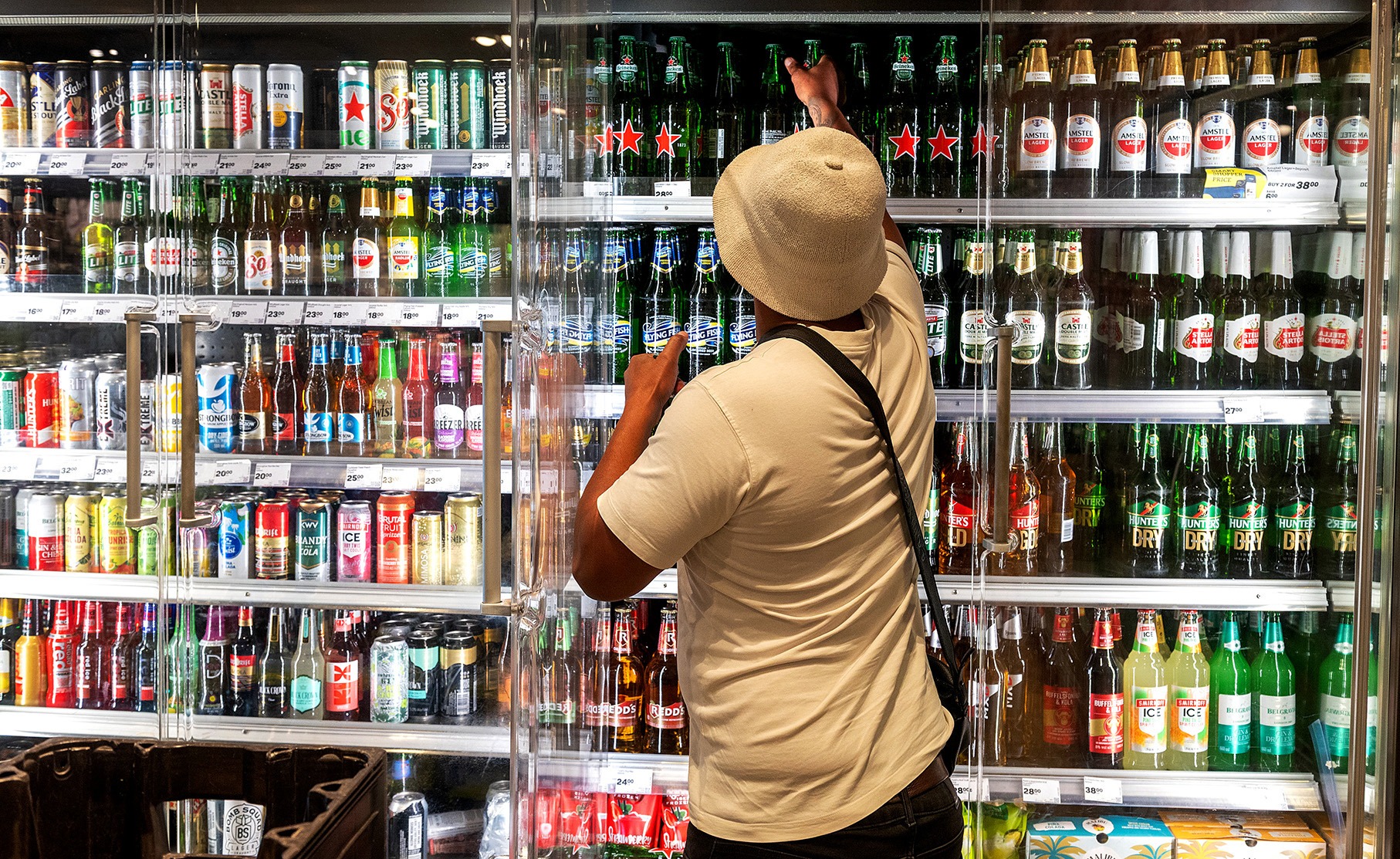
 A customer grabs a bottle of beer at a liquor store in Johannesburg. (Photo: Leon Sadiki / Bloomberg via Getty Images)
For decades, the South African government has been increasing taxes on alcoholic beverages to discourage harmful alcohol consumption. But higher taxes and prices do not necessarily mean beer is becoming less affordable.
What matters is not simply how much beer costs, but how its price changes relative to people’s incomes. For example, if beer prices increase by 5% while incomes grow by 8%, beer becomes more affordable, even though its price at the till has increased.
The National Treasury taxes beer based on the alcohol content of the beverage. These taxes are adjusted annually, using inflation or a tax incidence (i.e. the excise tax as a percentage of the average retail price) as the benchmark. Between 2008 and 2015, nominal beer tax increases broadly kept pace with inflation. From 2016 to 2021, however, beer taxes increased by an average of 3.6% a year above inflation. Since 2021, tax increases have moderated to an annual average of only 0.5% above inflation.
We, as academics at the University of Cape Town’s Research Unit on the Economics of Excisable Products (REEP), analysed more than 138,000 item-level price data collected by Statistics South Africa from 2001 to 2024. The findings reveal that beer has become more affordable since 2021, despite increases in beer taxes. To measure affordability, we calculated what percentage of per capita GDP was required to buy 160 litres of beer (the average consumption of a beer consumer) per year.

In the 2008–2015 period, beer prices increased more rapidly than incomes, despite the fact that excise taxes were rising only at the rate of inflation. As a result, beer became less affordable: the share of per capita GDP required to purchase 160 litres of beer a year rose from 4.5% in 2008 to 5.6% in 2015.
From 2016 onwards, things changed. Beer taxes increased faster than inflation, yet inflation-adjusted beer prices decreased. This suggests that producers changed their pricing strategies, absorbing some of the tax increases rather than passing them on to consumers in full. This practice is known as tax under-shifting.
From 2016 to 2024, inflation-adjusted beer prices declined by an average of 1.2% a year, while inflation-adjusted per capita GDP fell by 0.9% annually, which meant that beer became slightly more affordable: the share of per capita GDP required to purchase 160 litres of beer a year of beer decreased marginally from 5.7% in 2016 to around 5.5% for the period 2021–2024. To reduce consumption, beer needs to become less affordable over time. However, this did not happen over the 2016–2024 period.
One of the study’s more striking findings is that beer affordability varies considerably by container size (Figure 1). The amount consumers pay for the same quantity of beer differs substantially depending on container size. The 750ml bottle (red line), commonly known as a quart, is the most affordable option in South Africa. Over the 24-year study period, its average inflation-adjusted price remained virtually unchanged. Consumers of 750ml bottles needed to spend less than 4% of per capita GDP to purchase the equivalent of 160 litres of beer a year.
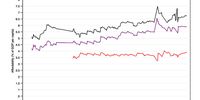
In 2008, buying beer in smaller 330–440ml container sizes (black line) required approximately 60% more income than buying the same quantity in 750ml bottles. By 2024, this gap had widened to around 74%. Put differently, buying 160 litres of beer in smaller cans would have cost around 6.8% of per capita GDP in 2024, compared with just 3.8% if purchased in 750ml bottles.
This suggests that beer in smaller container sizes has become considerably less affordable over time, while the affordability of 750ml bottles has remained relatively stable since 2008. Buying six-packs also became less affordable over time (purple line), but consistently more affordable than 330–440ml container sizes.
Beer taxes: what the Treasury can do

Our findings have important implications for South Africa’s alcohol tax policy. If the government’s objective is to reduce alcohol consumption and its associated harms, excise tax increases need to make beer less affordable over time. However, our analysis shows that past increases in the excise tax did not necessarily achieve this, particularly when producers absorb some of the tax increases rather than passing them on to consumers.
The National Treasury should, therefore, consider larger, sustained increases in beer excise taxes, while monitoring how these increases affect retail prices and affordability. Importantly, policymakers should pay particular attention to the cheapest beer products, especially 750ml containers, which have remained relatively affordable over the past two decades.
In November 2024, the National Treasury published its decadal review of alcohol taxes. In the review, and in subsequent discussions with stakeholders, it indicated that it is aiming for a substantial overhaul of the beer excise tax structure.
Specifically, it indicated that it wants to move away from the current principle of setting the excise tax such that the excise tax comprises a particular percentage of the average retail price. The current approach gives the beer industry substantial control over the quantum of the excise tax. Moving away from this “incidence approach” gives the National Treasury more autonomy in setting the excise tax.
Ultimately, the success of alcohol tax policy should not be judged simply by how much excise taxes increase, but by whether these increases translate into higher retail prices, reduced affordability and ultimately, lower alcohol consumption. DM
Mxolisi Zondi, Nicole Vellios and Corné van Walbeek are part of the Research Unit on the Economics of Excisable Products at the University of Cape Town
Comments
Scroll down to load comments...