



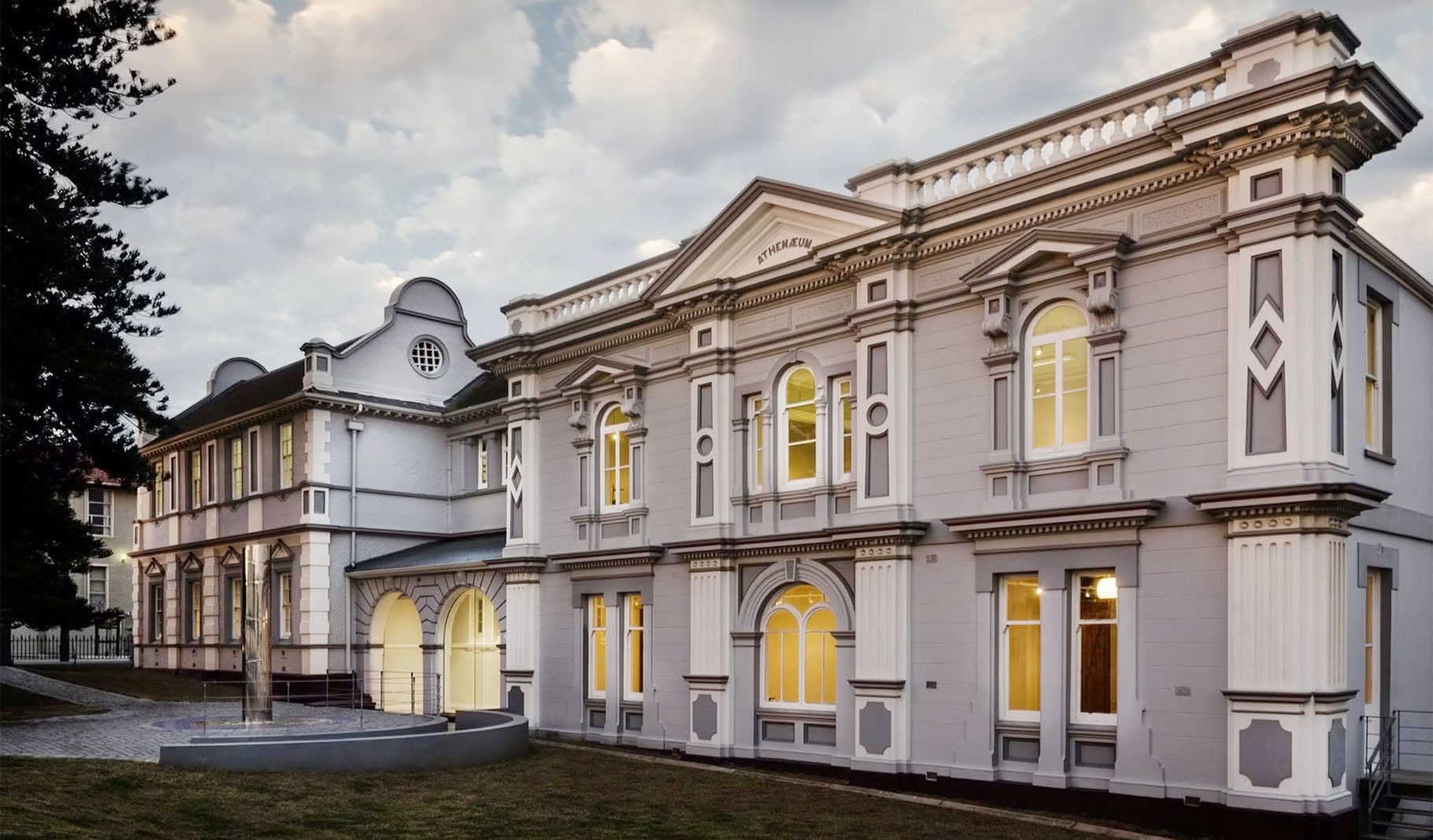
 Parts of The Athenaeum in Gqeberha are falling apart. However, the Mandela Bay Development Agency has secured funding to establish a film hub in the historic building. It is hoped that its rehabilitation will breathe new life into the property. (Photo: Facebook / Athenaeum Nelson Mandela Bay)
Abandoned and neglected buildings in central Gqeberha could be repurposed to support the city’s creative industries and help revitalise the inner city, according to the Mandela Bay Development Agency (MBDA).
The agency has for now identified the deteriorating historic Athenaeum building in Central as a starting point, with plans to rehabilitate the property and convert parts of it into a film hub.
Oyama Vanto, who leads the MBDA’s Creative Industry sector, said the film hub could favourably position Nelson Mandela Bay as a destination for film and television production, creating opportunities across the broader creative sector.
Speaking on Friday afternoon, following the conclusion of the Nelson Mandela Bay Film Festival, Vanto said the Athenaeum – which was previously managed by the MBDA – had fallen into disrepair, which “hurt” him.
The historic building served as a hub for the festival, which Vanto said he had “intentionally’ used to draw attention to its deteriorating condition. Part of the Athenaeum’s auditorium roof collapsed in late October.

‘Another building we used to have’
Vanto said the extent of the deterioration became clear during preparations for the festival and a subsequent visit to the Athenaeum.
“The gutters were growing trees, the roof was collapsing, the walls were collapsing. It broke my heart because I used to run projects there,” he said.
Vanto said he had persuaded the MBDA’s chief executive Pierre Voges to allocate funding to begin repairs to the building.
“If it’s left, not cared for, it is going to be another building that we used to have. So I took the idea of the Mandela Bay Film Festival, so that that can be something that pushes us forward,” he said.
“If you see the before picture, before the film festival and after, there’s a big difference. So I used it intentionally,” he said.

Give this man a building
Vanto, who is eyeing several abandoned buildings – some owned by state entities – for possible redevelopment, said visits to Newcastle in England had shown him how derelict properties could be transformed into vibrant shared spaces and creative hubs.
He said there was still a limited understanding of the creative sector and its potential, despite its economic benefits for other industries, including advertising, music, filmmaking and post-production.
Vanto has called on organisations and property owners with abandoned buildings to give the MBDA an opportunity to demonstrate how these spaces could be repurposed.
“Especially the buildings on the waterfront. Come on, guys. It’s a no-brainer at this stage. Give us one. Give me one. Let me show what I can do,” he said.
Vanto said greater investment in the creative sector could also help address youth unemployment by creating opportunities for young people seeking work in creative fields.
“The majority of young people who are struggling with employment and job opportunities fall into the creative industrial space, which I feel is underserved. So put effort in there and see what happens,” he said.

Hundreds of films submitted, 21 selected
Vanto said hundreds of films had been submitted to the festival, but only 21 had been selected for screening.
He described the quality of the submissions as “out of this world”, adding that many of the films came from the Eastern Cape, while others had been submitted from elsewhere.
Among the filmmakers whose work was showcased was 42-year-old Tobela Pemba. He believes Nelson Mandela Bay has the potential to become a thriving creative hub but needs greater investment in the sector.
Pemba’s film, Gateway, explores human trafficking. He said the Eastern Cape had no shortage of stories to tell, but lacked the infrastructure needed to bring them to the screen.
“The Eastern Cape is beautiful and has a lot of stories. There are so many stories that haven’t been told in the Eastern Cape.
“And I think the infrastructure just isn’t here to actually explore those stories and tell them, or to empower the filmmakers who could bring them to life,” he said.
While acknowledging the challenges facing the industry, including financial constraints, Pemba said the province needed to do more to support its creative talent.
“We can definitely do a lot better. But things like these festivals are a step in the right direction.
“And the fact that we had sponsorships from the MBDA, the National Film and Video Foundation and the Eastern Cape Development Corporation makes me feel hopeful that things might start to change,” Pemba said.
Documentary filmmaker Nolulamo Lulu Maquthu, 38, whose work was also screened at the festival, said the industry had made significant strides.
“I don’t want to complain about that because it is so much better than where we were,” said Maquthu, whose documentary, ‘AmaMpondro Documentary: Sixela NgesiMpondro’, was among the films showcased.

She said encouraging more people to explore filmmaking and increasing investment in the country’s creative sector, particularly in the Eastern Cape, were essential to growing the industry.
“We really need to change our mindset as a country and start valuing storytelling, start valuing our film industry. Because, honestly, there is something to value there.
“So, it is a very much-needed space in our democracy. And we are slowly seeing the change, but it is not enough.” DM
Comments
Scroll down to load comments...