



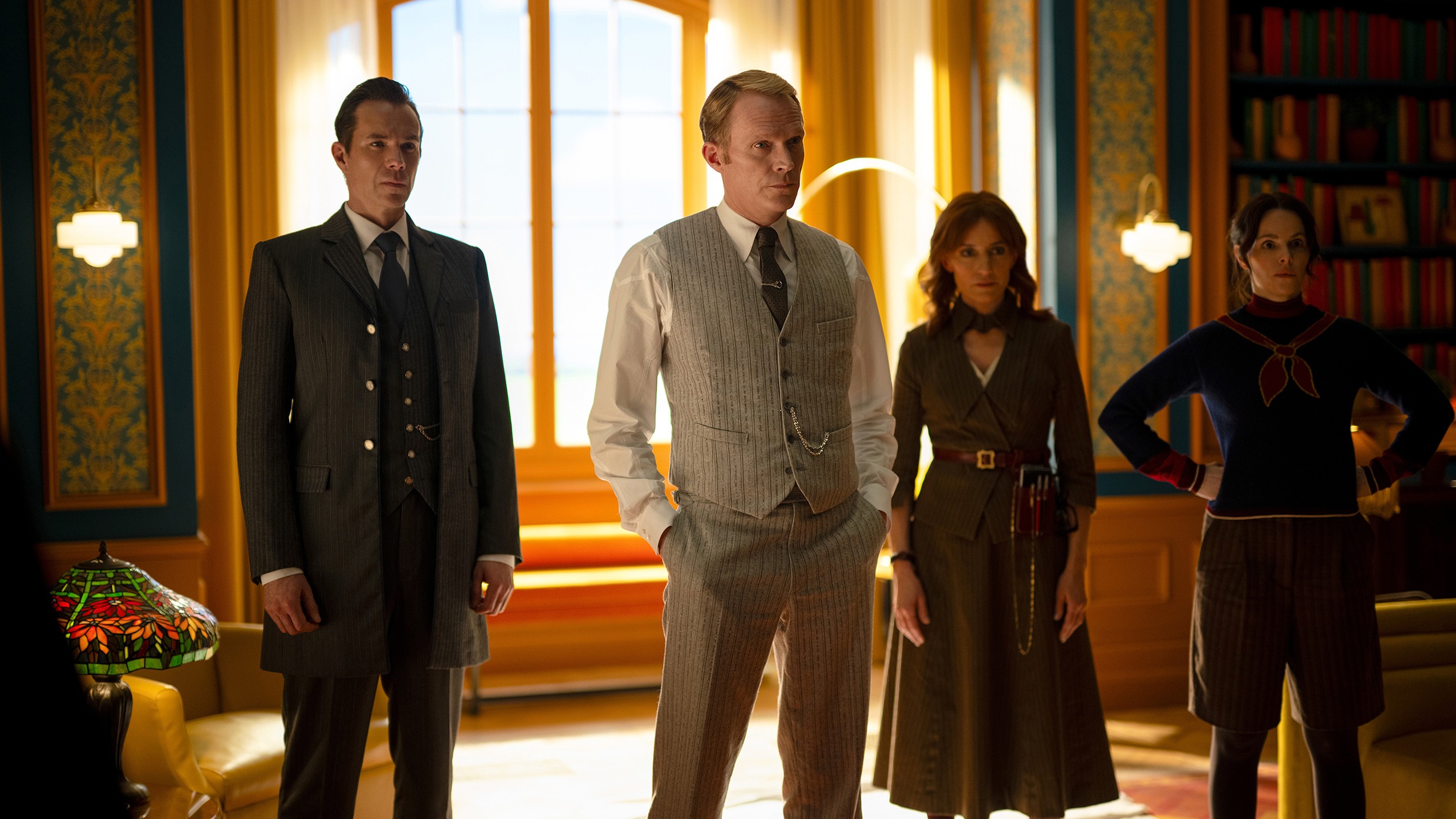
 Jarvis (James D’Arcy), Vision (Paul Bettany), Friday (Orla Brady), and Edith (Emily Hampshire) in VisionQuest. (Photo: Marvel)
I miss Jac Schaeffer. There, I said it. With Schaeffer as creator and showrunner, WandaVision (the first live-action series set in the Marvel Cinematic Universe) and Agatha All Along were elegant puzzle boxes, or nesting dolls, where each episode deepened the shows’ complexity, creating thematic links to events in previous instalments, and overall layering up these tales of painful grief avoidance.
So experimental and sophisticated were these series that they enticed viewers who wouldn’t normally be lining up for MCU costumed heroics. Anticipation is high then for new MCU series VisionQuest (on Disney+), which serves as a small-screen sequel to WandaVision, and picks up on important Agatha All Along revelations.
But Schaeffer isn’t leading VisionQuest; the baton has been passed to Terry Matalas, who previously spearheaded 12 Monkeys and later seasons of the award-winning Star Trek: Picard. And, honestly, it’s not the same.
Differences were to be expected, given the nature of VisionQuest’s protagonist. Wanda and Agatha are human witches, running hot with emotion. Vision (Paul Bettany) is a synthezoid, an advanced android out of touch with human feeling – especially since being pieced back together and reinstalled.
Even with his old memories, the Vision of VisionQuest considers his former Avengers self, murdered by Thanos, a different being. Grief and family are returning thematic motifs, entrenching VisionQuest as a trilogy capper following WandaVision and Agatha All Along. However, the more cerebral topic of identity, and its correlation to remembered experiences and feeling, plays a large role too.
VisionQuest sees its title character forced out of hiding by righteous bounty hunter Paladin (Todd Stashwick). Key to the latter’s efforts is using teenage grifter Thomas Shepherd (Ruaridh Mollica) as bait, as Tommy may or may not house the consciousness of Vision and Wanda’s conjured son from their time in Westview. Cue a globe-trotting chase that takes characters from the UK to Madripoor, and beyond.
While all this is going on, Vision is trying to reconcile who he is, and he does that by retreating from the real world into a digital Mind Space, which takes the form of an architecturally eccentric manor populated with anthropomorphic versions of various Tony Stark AI creations.
These include the original, J.A.R.V.I.S. (James D’Arcy); Thanos Era replacement F.R.I.D.A.Y. (Orla Brady); and E.D.I.T.H., (Emily Hampshire), who was inherited by Peter Parker. Also in the mix is Ultron (James Spader), the cynical AI that very nearly exterminated humanity, but who has developed an appreciation of human art during his time imprisoned in Vision’s code.
No matter what, you can’t fault the cast of VisionQuest, where everyone is set up to play to their strengths. The show even finds a suitable deadpan space for Philomena Cunk herself, Diane Morgan; and frequent Mike Flanagan collaborator, the always striking T’Nia Miller as deadly synthezoid Jocasta. There’s even a (wasted) cameo by Mary McDonnell.
For better or worse, VisionQuest also never feels rushed. Unlike most MCU series, episode length consistently sits around the 55-minute mark, with the finale breezing past one hour. The show has an unusual amount of breathing room.
The big problem is that – like a lot of AI practitioners, actually – VisionQuest presents itself as being smarter than it actually is. While Spader’s snarky Ultron occasionally jeers at the pretentiousness of Vision’s concerns, for the most part viewers are encouraged to be impressed as characters debate paradoxes like the Ship of Theseus.

As a side note, with Vision badly damaged for much of the series, there’s little else for him to do, as visceral robotic combat with flight and lasers is taken off the table early on.
For all the philosophical musings, however, if you pay attention, you’ll realise the show re-treads the same ground over and over. It feels like VisionQuest was written with the belief that audiences would be watching each episode a week apart, and in that time would forget everything that happened previously.
As a result, characters have the same conversations repeatedly, and Vision is subject to the same threats – typically an overheating core, memory leak or firewall breach – resulting in a series that is considerably more tell than show. Tech lingo gets thrown around a lot on top of this, but appears targeted at the lowest common denominator as it’s often followed by obvious, heavy-handed explanations.

While you do come to care for much of the cast, because they’re actually given space to reveal their vulnerabilities, there’s a lot that feels forced about VisionQuest.
Particularly evident is a strained quirkiness when the series sets out to apply real-world similes to computer concepts, like slipping past digital security measures. In one case, Vision and companion Ultron masquerade as detectives to infiltrate a police station full of armed officers representing code.
That’s not to say there aren’t moments of brilliance in VisionQuest, and the show delivers a major surprise as it brings a largely forgotten Golden Age hero into the MCU – which should have comic fans in Leonardo DiCaprio meme mode, pointing at the screen in delight.
It’s just that VisionQuest is never able to escape the sense that it’s trying too hard to deliver its own spin on the formula that Jac Schaeffer delivered with such elegance in the original WandaVision and Agatha All Along.
Inspired instances aside, the result here is clunky, like a generative AI creation that has been trained on real human art, but emerges with a too-glossy finish, seven fingers and a melted ear. DM
The eight-part VisionQuest is streaming on Disney+. This review was first published on Pfangirl and is based on all eight episodes of VisionQuest, with early access provided by Disney.
Comments
Scroll down to load comments...