


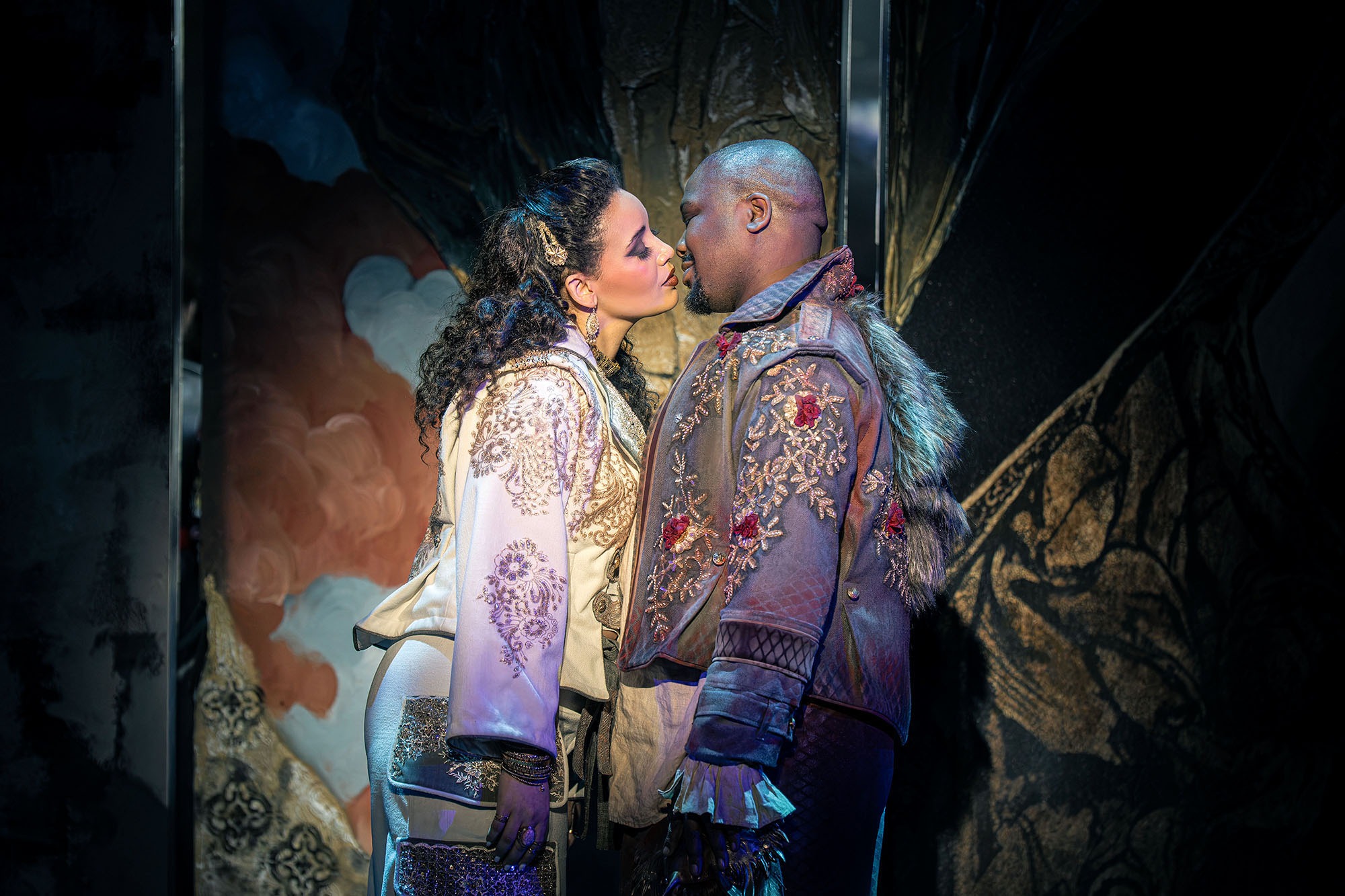
 Brittany Smith as Juliette and Lukhanyo Moyake as Roméo in the Cape Town Opera production of Roméo et Juliette. (Photo: Daniel Rutland Manners)
In the shadow of an ancient and pestilent family feud comes the naiveté of love-at-first-sight romantic innocence, the impatience of youthful desire and a desperate deception involving a sleeping potion.
Add a deadly poison and a dagger, and you have a whirlwind romance turned inside out, perfect fodder for a generous French opera that seems determined to hit every imaginable emotional beat.
Charles Gounod’s Roméo et Juliette is grand opera on a grand scale. Not only is the music grand, but the Cape Town Opera voices are grand, the Cape Town Philharmonic Orchestra (slightly reduced in scale but by no means diminished) under maestro Kamal Khan is grand, and – my God! – the scale of the emotions is off-the-charts grand.
The love duets, the sweeping arias and breezy waltzes, the inevitable drawn-out tragedy… Plus, of course, the thrilling clash between the sacred and the profane as a familiar tale bends towards the terrible irony of its unavoidable finality, the patriarchy presumably forced to eat its shame as the hopes and dreams of the next generation lie dead in the Capulets’ family sepulchre.
By the time the curtain falls after the fifth act with its double suicide (right there, under the nose of God) and the last of four spectacularly romantic duets between the star-crossed lovers, the audience has been properly swept away by the rather majestic dimensions of music that buoys and breaks you in equal measure.
From young love to heartbreak, performers deliver
Since it’s a romantic tragedy, the vocal relationship between the lovers is pretty much existential and the company’s seasoned stars, soprano Brittany Smith and tenor Lukhanyo Moyake, do not disappoint. Throughout a vocally demanding show they just keep on delivering.
The four big numbers they sing together mark key moments in their short-lived, passionate love affair, commencing with their initial encounter at the masked ball (Ange adorable). They also sing their hearts out during their giddy mutual declaration of love on Juliette’s balcony and during their post-coital exchange in her bed chamber after their secret marriage.
It’s that heartbreaking final duet (Console-toi, pauvre âme), though, that drives home the extraordinary depth of their shared passion, elevating their ostensibly impetuous romantic fling to something that’s meant to endure across the ages.
There are exquisite solos, too, including Smith’s Juliette vocally ascending to heaven as she beautifully belts out her famous waltz aria, Je veux vivre, with its scintillating high notes and such an incredible sense of lightness, you can almost feel yourself lifting out of your seat.
Later, hearing Smith vocalise Juliette’s anguish and fears during the so-called “poison aria” (Amour, ranime mon courage) is simply one of opera’s truly great moments, a mighty, rollicking journey across a vast emotional and psychological landscape as she convinces herself to drink the sleeping elixir given to her by the well-meaning Frère Laurent.
Stand-out moments for supporting cast
While the most intense emotions are reserved for Roméo and Juliette, there are plenty of stand-out moments for secondary characters to wrap their vocal cords around. Mongezi Mosoaka, with his nifty mullet and lively tenor voice, perfectly captures Tybalt’s instinct for trouble and his aggrieved-for-no-reason bottled-up fury. Nica Reinke does fine work in the trouser role as Stéphano, and Riaan Hunter is a lively, mercurial Mercutio.

Conroy Scott, as Juliette’s father, monsieur Capulet, is a firecracker, swaggering on to stage ready to party up a storm, then setting the house on fire with his downright jolly signature solo, Allons, jeunes gens! Allons, belles dames, in which he welcomes his guests to the ball and urges them to dance.
And dance they do, albeit quite weirdly, the guests performing what might even be described as an anti-waltz – taking their cue from contemporary clubs, they duck and weave and spin, but “waltz” without ever touching. It’s among the many visual clues in this bold staging by director Marcus Desando that we are seeing the well-known story play out in a slightly altered, elevated reality.
Visually, there is a lot to take in, with Desando presumably interested in the opera as a cultural artefact hinging on an oft-repeated saga that, over centuries of literary and artistic iterations, has acquired multiple meanings.
There is, therefore, a veritable barrage of signifiers. Before any humans have set foot on stage, while Gounod’s overture and off-stage choral introduction establish the mood and set the emotional architecture for the ensuing five acts, there is already an onslaught of visual information as screens on stage suddenly fill with digital projections.
Somewhat awkwardly summarising the opera’s main themes and introducing its key characters, its intrigues are turned into visual candyfloss, a frankly unnecessary confection designed to reiterate what we almost certainly already know about the story that’s about to unfold.
This I experienced as the most uncomfortable part of the production, aesthetically unpleasant in a way that seemed suspiciously AI-generated – there were so many elements scrolling and interweaving and being digitally overlayed, it made the opening look like the title sequence for some kind of bizarre Mills & Boon romantasy adventure.
It was, for me, just too much, a kind of excruciating pastiche.
Layers of storytelling
Then again, it’s plausible that this over-the-top digital sequence is purposefully playing into the idea that the entire production is a kind of grand palimpsest, an endless layering of literal and figurative modes of storytelling echoing precisely the overwhelming, excessively saturated media landscape we humans now have to contend with.
Within that context, the video montage is a prologue for some of the other visual excesses that follow.
I’m thinking in particular of the use of photographic representations of Table Mountain, cityscapes and local neighbourhoods to emphasise the idea that this Verona is in fact grounded in the actuality of a very real and specific present-day Cape Town. Witnessing this compulsion to bring a kind of cinematic realism onto stage made me yearn for the simplicity of handmade, handcrafted, hand-painted human-scale stagecraft.
Here’s where Leopold Senekal’s visual design works more effectively to encode multiple meanings and provide clues to a kind of multi-generational layering. The physical textures – on the costumes and in the form of graffiti and artworks that cover the tall, narrow mobile flats used to create various spaces – suggest that we are observing a kind of retro-futurist world unable to escape its past, that history is always haunting the present.
This being a heightened reality, there’s plenty, particularly in the costumes, to suggest that this Roméo et Juliette is playing out in an imagined near-future, somewhere that has one foot in the real world, the other in a kind of digitised imaginary. Perhaps the design is intentionally (or unavoidably) alluding to a rapidly approaching future in which organic and digital planes of existence will presumably be indistinguishable.
For me, the most satisfying scene of all in visual terms is Juliette’s bedroom in the penultimate act. Tall slatted screens signify windows and there’s a large circular bed at the centre; visually stripped down, the stage gives way to the emotional tenderness and poignancy of the post-coital duet in which the love-intoxicated Roméo and Juliette express their mutual devotion, while hoping against hope that dawn – represented by the sweet song of a morning lark – will not intrude on their intimacy.
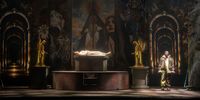
In the final act, the visual design of the Capulet sepulchre in which Juliette’s lifeless body has been interred is achieved through functional architectural set elements, emblematic statues and sacred Catholic iconography used in combination with a projected digital image used to create a kind of spiritual intensity that verges on the sublime.
This atmosphere, of course, is no accident. Visually, the production tracks the tonal progression of the music, from the sparkly, exuberant waltzes of the opening party to the terrible beauty of the final, tragic duet; by the end of it, we have been conveyed from the secular to the sacred.
From the beating hearts and raging hormones of two lovestruck teenagers to a heartbreaking love story that stretches into eternity; what’s incredible to witness is that this music and these songs, first performed in Paris in 1867, can still raise the roof in Cape Town in 2026.
It’s a beaut of a show – if only the world would catch up and listen more carefully to its message. DM
Playing at the Artscape Theatre in Cape Town until 29 November, Roméo et Juliette is a five-act French opera by Charles Gounod, with a libretto by Jules Barbier and Michel Carré based on Shakespeare’s play.
Comments
Scroll down to load comments...