



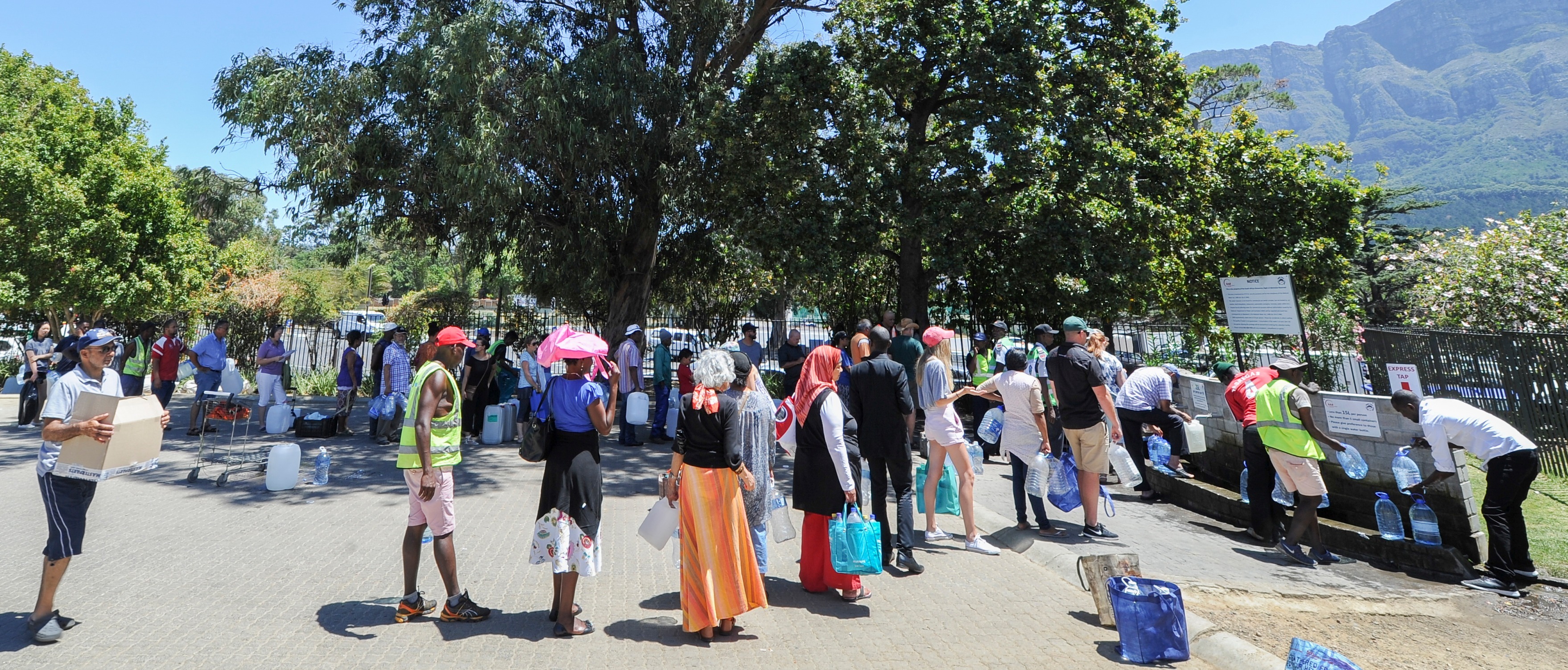
 Newlands residents collect water during the start of 6B water restrictions on February 01, 2018 in Cape Town, South Africa. Under the new restrictions, water consumption is limited to 50 litres per person per day in the hope that Day Zero - the day the taps will be closed - can be avoided. (Photo: Gallo Images / Netwerk2 / Jaco Marais)
Agriculture Minister Willie Aucamp told this publication last month that he wanted to see proactive measures such as water restrictions in place to deal with the unfolding El Niño.
And lo and behold, it has come to pass: Tshwane, Johannesburg and Cape Town have all imposed restrictions on water use, and more are in the pipeline as this El Niño strengthens into a record-breaker. The Western Cape as a whole also faces curbs on use.
In its latest forecast released early this week, the US government’s Climate Prediction Centre (CPC) – which was spared the brunt of Elon Musk’s chainsaw – said, “El Niño continues to strengthen, with a strong-to-very strong El Niño likely through January-March 2027 (remaining greater than a 79% chance).”
The bottom line is that El Niño will haunt our increasingly parched landscape all summer, and will compound municipal water woes linked to the inability to maintain critical infrastructure.
Tipping point
It’s the tipping point where state failure, with the stench of corruption hanging over it, clashes head-on with an extreme weather event. At least there is R10-billion of funding available to confront this unfolding crisis – testimony to the National Treasury’s standing as an island of competence and accountability in a sea of incompetence and nepotism.
At first glance, there would appear to be no cause for alarm. Dam levels are not bad, thanks to the rain of the most recent La Niña, the polar opposite of El Niño. The first typically heralds good rains in this region, the latter drought.
The Department of Water and Sanitation’s latest weekly State of the Dams report shows that all provinces, with the exceptions of the Western Cape and KZN, have dam levels exceeding 90%, and five are above their levels this time last year.
The Eastern Cape is the star on this stage with dam levels at 93.1%, compared with 74.7% a year ago.
On a weekly comparative basis, a different picture emerges. All provinces except for the Northern Cape have lower dam levels than what obtained last week, but the declines are almost all in the 0.1 to 0.3 percentage point range.
Still, with El Niño beginning to bare its fangs here and with water demand surging, the government, it seems, is not taking any chances.
Johannesburg
The following activities using municipal drinking water are prohibited:
• Irrigating gardens, lawns, parks and public spaces at any time;
• Hosing down hard surfaces, including driveways, paved areas and sidewalks;
• Dampening building sand; and
• The irrigation prohibition applies throughout the day and replaces the limited watering hours applicable under Level 1 restrictions.
“Water conservation is no longer a temporary response to drought. It must become a permanent feature of how we manage this precious resource,” Water and Sanitation Minister Pemmy Majodina said on Monday at the conclusion of the Operating Analysis of the Western Cape Water Supply System (WCWSS) for the 2026/27 hydrological year.
“This region’s previous drought experiences and the El Niño that is currently upon us also mandate us further to continuously examine our water resources very closely.”
Cape Town, of course, narrowly avoided “Day Zero” in 2018, and that event was a catalyst for pre-emptive measures and enhanced monitoring of water supplies – even as much of South Africa’s H2O over the years since has gone down the drain of leaks, pipe bursts and other system malfunctions.
Cape Town
Level 1 restrictions kick in from 1 December and the City called on Capetonians to use 10% less water.
The City said residents should aim to use no more than 85 litres of water per person per day. This includes water for personal hygiene, cooking, cleaning and laundry.
The following measures for outdoor use will apply to municipal drinking water:
• Gardens: Sprinklers, handheld hosepipes fitted with trigger nozzles and drip irrigation systems may be used for a maximum of one hour per day, irrespective of the watering method, on Tuesdays and Saturdays. Watering is permitted only before 9am or after 6pm;
• Buckets and watering cans: Permitted for garden watering, subject to the same watering times and daily one-hour limit;
• Sports fields and public parks: Sprinkler irrigation is allowed for a maximum of one hour on Tuesdays and Fridays, before 9am or after 6pm;
• Paved areas and hard surfaces: Hosing down is not allowed;
• Swimming pools: Topping up and filling of swimming pools permitted, but pools must be covered when not in use to reduce evaporation. In addition, rainwater should be used for pool topping up and backwash water recovered where practically possible; and
• Car washing: Private and informal car washes may use buckets or high-pressure, low-volume equipment. Commercial car washes may operate, subject to best practice water conservation norms and the recycling of at least 50% of the water used.
The minister noted pointedly that water security at the national level was in “balance” and that there was no crisis regarding bulk water resources.
But for the Western Cape, she said the province was “... in a less favourable position than in recent years ... While the major dams remain at acceptable levels overall, some key components of the system have recorded significant declines compared to the previous year.”
Water storage in the province is below the preferred operational threshold of 80% and about 12 percentage points below the 10-year average.
Below-average rainfall during the 2026 winter wet season and the brewing extreme El Niño event had combined to create a need to strengthen current demand reduction measures, Majodina said.
To that end, she said that there would be a 7% reduction in the province’s domestic and industrial water allocations and irrigation allocations would be slashed by 15%.
In Tshwane, Level 2 restrictions were imposed on 12 November. The City said in an update this week that these were needed to prevent “the potential collapse” of the Rand Water system.
“Since September 2026, Tshwane has registered a week-on-week high water consumption from its Rand Water supply meters and has exceeded its permanent licence target by 34% and its temporary licence target by 19%,” a statement from the City said.
Tshwane
The City urged all customers to implement the following water saving measures under Level 2 restrictions:
• Avoid watering gardens and lawns using municipal drinking water;
• Do not wash vehicles using hosepipes. Use a bucket instead;
• Avoid filling swimming pools with municipal drinking water;
• Repair leaking taps, toilets, pipes and plumbing installations immediately;
• Avoid leaving taps running unnecessarily when brushing teeth, washing dishes or undertaking other household activities;
• Reduce showering time and avoid unnecessary water usage;
• Reuse greywater, where appropriate, for gardening and other non-drinking purposes;
• Report visible water leaks and bursts to the City through its official reporting channels; and
• Businesses and institutions must implement internal water conservation measures to reduce their daily consumption.
This was followed by Johannesburg’s announcement on Wednesday of Level 2 restrictions from 21 November 2026 in a bid to reduce demand by 200 million litres per day. They will remain in force until withdrawn by a further public notice – which could mean the rest of the summer and beyond.
“Johannesburg’s water supply system remains under pressure as high water demand places strain on the available treated bulk water supply from Rand Water,” Johannesburg Water said.
Curiously, no mention was made of El Niño in the Joburg announcement. But it looms large in the background and portends a summer of restrictions. DM
Comments
Scroll down to load comments...