


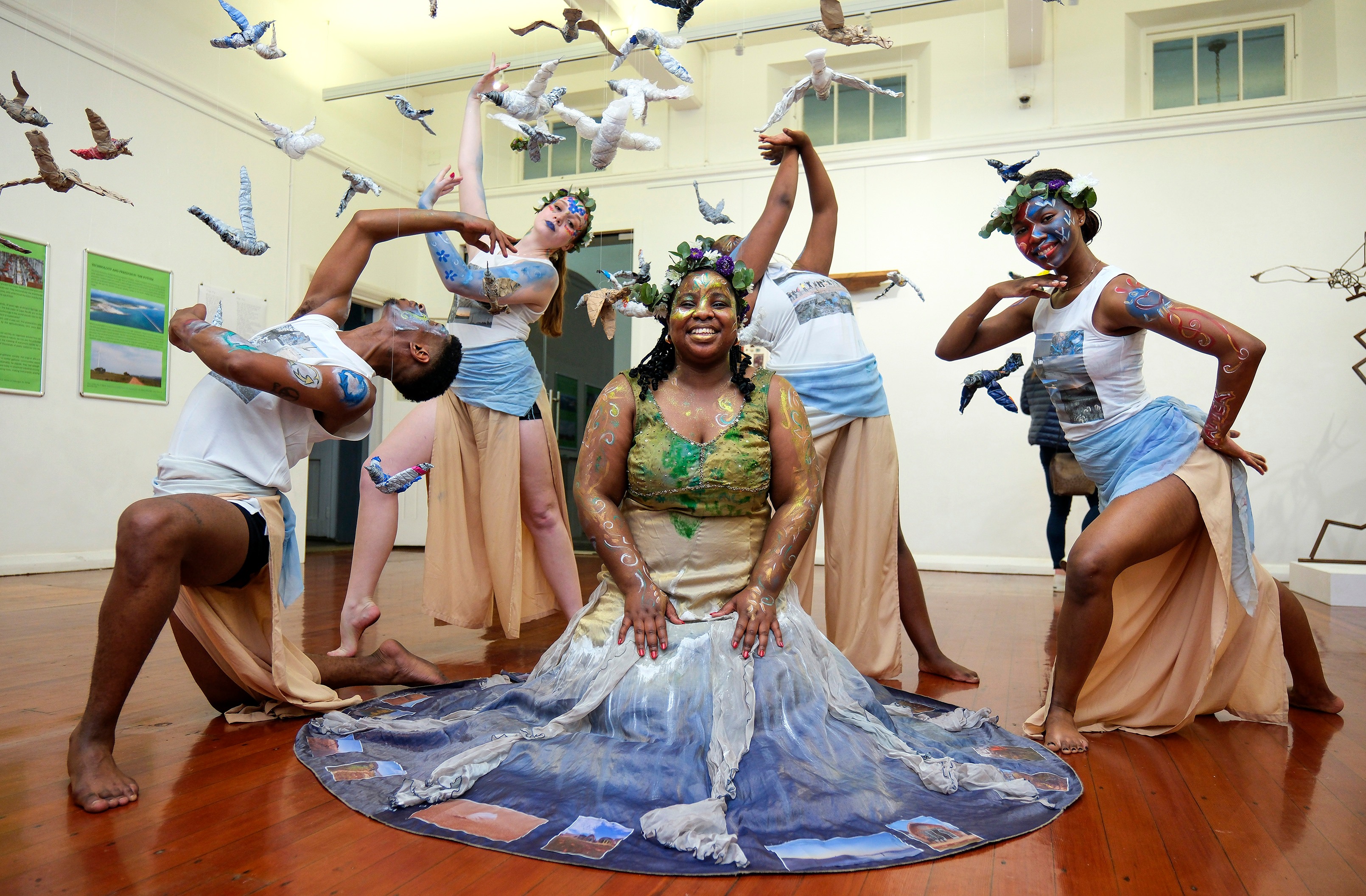
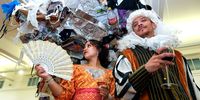
 Lindokuhle Gushu as Mother GQ with dancers from Nicki Rayepen’s The Last Call of Mother GQ, beneath the bird installation Hope-ish by Beatrice van Wyk and Danica Ridgway. (Photo: Bruce Gordan / Nelson Mandela University)
When Victoria Flowers moved from Gqeberha to Vietnam to teach graphic design, she found a familiar sight. Food waste, broken furniture and recyclables were dumped together on pavements and empty lots, eventually washing through stormwater drains and into the sea.
It was “eerily similar”, she wrote, to what she had seen at the Motherwell canal on a three-day exploration of her home city in 2025. Her first-year students at the University of Greenwich Danang Campus in Vietnam now make art from recyclable materials, an exercise she hopes will change “the way they think about dirt”.

Flowers was one of 41 participants in Horizon 2055, a Nelson Mandela University project that asked what Gqeberha could become over the next 30 years. Last month it won the engagement excellence project award for the social sciences and humanities at the university’s Vice-Chancellor’s Excellence Awards.
Run by the university’s research chair in Identities and Social Cohesion in Africa, led by philosopher Professor Andrea Hurst and funded through the National Research Foundation’s South African Research Chairs Initiative, the project combined 20 weekly online seminars with three “City (E)scapes” journeys in 2025.
Each journey took about a dozen people to places that shape the city, from Brighton Beach and the Fish Water Flats wastewater works to the Motherwell canal, the Volkswagen plant, Coega and the Van Stadens flower reserve.
Participants turned what they saw into paintings, sculpture, music, poetry and academic papers, shown at the university’s Bird Street Gallery at the end of 2025.
“I was delighted that Horizon 2055 brought the chair’s central idea to life: when we loosen rigid ideas about who we are and come together around a shared concern, in this case for our city’s future, we foster social cohesion,” said Hurst.
From the gallery to the community
Tshiamo Gumbu joined the journey as a first-year student. After visiting the LoveLife Y-Centre in KwaNobuhle, he partnered with LoveLife and led a team of students from several faculties to speak to matric learners at Marymount High School about university study, while LoveLife spoke about wellbeing.
“Speaking to learners motivated me,” Gumbu wrote. “We may be facing challenges in life, but we have a dedicated future ahead.”
Artist Erin Smith got to know the Friends of Van Stadens, a citizen group that supports the wild flower reserve, during the project. She has since partnered with it on Art in the Arboretum, an art programme in the reserve, and curated the group’s first exhibition for its annual Flower Festival in October.
(Photo: Bruce Gordan / Nelson Mandela University)
Tessa McLeod Wattam now helps with the garden and creative activities at the Motherwell Community and Enviro Hub, while her master’s research focuses on the Swartkops estuary. For World Oceans Day, she helped organise a children’s art activity using waste materials.
The group has also been building an outdoor seating area using a traditional Xhosa building method that combines locally sourced clay, sand and organic matter, alongside eco-bricks made from plastic bottles densely packed with waste plastic.
Art as a form of resistance
Choreographer Nicki Rayepen’s performance, The Last Call of Mother GQ, opened the 2025 exhibition. Her company, Nicki Ray Productions, went on to win best dance production for 2025 at the Eastern Cape Arts, Culture and Heritage Excellence Awards, for work that included Mother GQ. Lead vocalist Lindokuhle Gushu – who played Mother GQ – is now a music PhD candidate under the Identities and Social Cohesion in Africa chair.
Mandela Rhodes Scholar (2024-2025) Simphiwe Zondani’s poem about pollution in the Swartkops River, Wemk’ umlambo Magwalandini!, was selected for the Writing Climate Resilience 2026 anthology of the International Human Rights Art Movement. The poem set him thinking about “how I could encourage Eastern Cape writers to fight with the pen”.
Zondani has since founded a literary platform, Usiba, and presented at a Stellenbosch University symposium, linking poetry as resistance to the tradition of iimbongi, or praise poets.
For student Thembelihle Ngece, the project encouraged “a more critical and solution-oriented mindset rather than simply focusing on challenges”. Concerned about youth unemployment, she organised a five-day webinar series on student entrepreneurship, which led to a Creatives Launchpad Programme for students in the creative industries, to be hosted by Identities and Social Cohesion in Africa in 2027.
The next horizon
For those involved, the exhibition was a beginning rather than an end. The work continues in classrooms, community spaces, research and creative collaborations.
A catalogue of more than 400 pages is due early in 2027, in print and digital form. Professor Hurst and Dr Gary Koekemoer leave for Durham University in the UK on 23 November to present and teach, through a partnership with Professor Brian Castellani, now a visiting professor at Nelson Mandela University.
Flowers, meanwhile, has carried one lesson from Motherwell to Da Nang.
“When people become autonomous and take ownership over space,” she wrote, “it has a ripple effect on the people and spaces around them.” DM
Comments
Scroll down to load comments...