


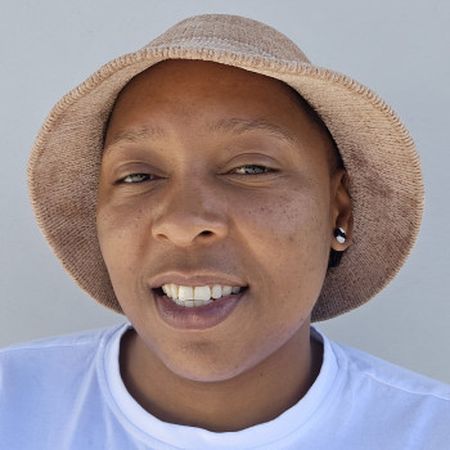
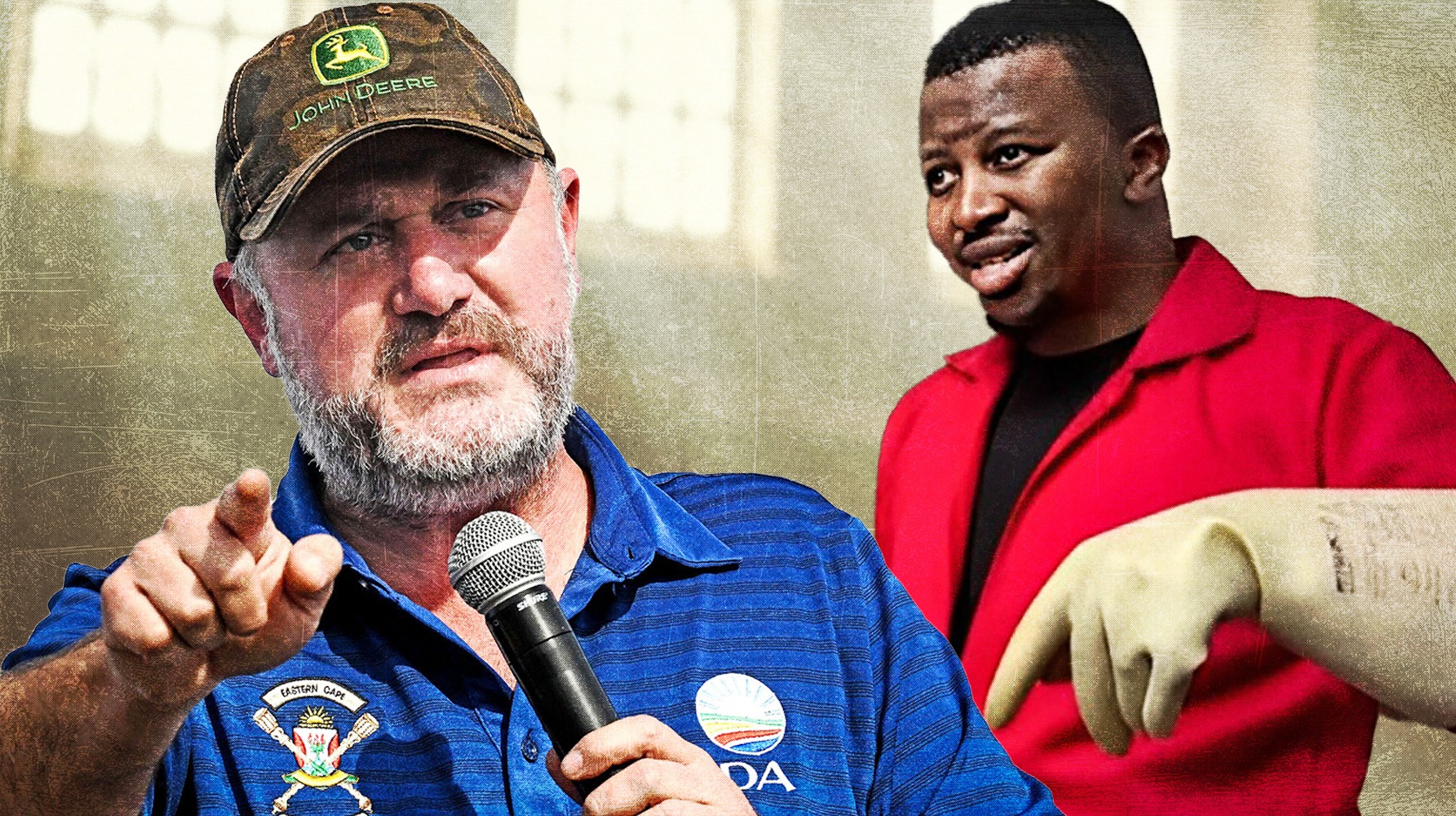
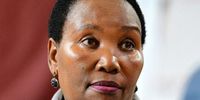
 Illustrative image (from left): DA mayoral candidate for Nelson Mandela Bay Retief Odendaal. (Photo: Gallo Images / Die Burger / Lulama Zenzile) | EFF councillor Khanya Ngqisha. (Photo: X)
As political parties in Nelson Mandela Bay enter the final stages of coalition negotiations ahead of Tuesday’s inaugural council meeting, the incoming administration faces a daunting task: stabilising a dysfunctional municipality and restoring failing services.
The incoming council will comprise mostly first-time councillors, some of whom may be appointed to the mayoral committee to oversee key municipal portfolios.
Politics commentator Mcebisi Ndletyana said that, given the failures of previous administrations, restoring the municipality would require leaders with integrity who were not implicated in wrongdoing.
Ndletyana said the City needed strong individuals with integrity both politically and administratively.
“The previous coalitions collapsed because there was always an alternative; currently the balance of power has become lopsided and the DA is in a much stronger position. So any small party will have to think hard about who they want to govern with.”
Service delivery woes
The coalition will inherit several urgent issues that include:
Major electricity losses;
4,700km of ageing water pipes needing replacement;
Vacancies in critical positions;
Revolving door of the city manager’s office; and
Addressing more than R25-billion in unauthorised, irregular, fruitless and wasteful expenditure.
The metro’s electricity and energy directorate lost R1.7-billion in the previous financial year, and the figure is expected to increase in the current financial year as electricity revenue losses continue.

Among the issues that contribute to the losses are vandalism, electricity theft, billing failures and infrastructure problems within the municipal electricity directorate.
While the City’s supply dams are almost full, there are communities that face water outages for weeks on end, while fresh water is wasted through leaks in the pipeline.
The broken infrastructure has worsened the issue, with 4,700km of the water pipes, some 40 years old, requiring urgent replacement to stop the wastage.
In the 2025/26 financial year, water losses surged to a record 60.39%.
Revolving door of city managers and vacancies
The revolving door in the city manager’s office has contributed to the metro’s administrative instability. Incumbent city manager Noxolo Nqwazi was placed on precautionary suspension in 2023.
Nqwazi was arrested by the Hawks in September 2022 in connection with the alleged unlawful approval of a R24-million tender for toilets in informal settlements. The case is before the Gqeberha high court.
The metro is also struggling to fill executive director posts across its seven directorates, as well as the chief financial officer position, which became vacant following the death of incumbent Jackson Ngcelwane.
The incoming administration will also inherit a substantial financial accountability task. The municipal public accounts committee (MPAC) must work through more than R25-billion in unauthorised, irregular, fruitless and wasteful expenditure (UIFWE), examining each item to determine whether value was received, whether further investigation is warranted and whether consequence management is necessary.
The City initially wanted to write off about R10-billion without an investigation, but was stopped in its tracks by the National Treasury, which outlined the legislation on how to write off the UIFWE.
Ndletyana suggested that the city manager issue remained unresolved because the Nqwazi case could implicate several people, including municipal officials and politicians.
“The fact that the disciplinary hearing for Nqwazi was not convened tells you that there was a great reluctance internally because they would have to come up with a finding. The preferred result is for her to leave the institution, and that’s one of the reasons she was not paid out by National Treasury.”
Constituting the coalition
The DA came out ahead in the local government elections, securing 53 seats, making it the largest party in the metro’s 120-seat council.
The party requires a partnership with at least eight more councillors to reach the 61 seats needed for a majority government.
Talks on the ground indicate that the DA is in coalition talks with the Freedom Front Plus (3), UDM (3), Action SA (2) and ACDP (1).
With the ANC reduced to 32 seats, discussions have emerged about forming a so-called black caucus involving black and coloured political parties to keep the DA out of power.
But the proposal has exposed divisions within the ANC itself. The Sunday Times reported on 12 November that an ANC faction, reportedly led by NEC member Andile Lungisa, favoured pursuing such an arrangement, while another faction, believed to be supported by outgoing mayor Babalwa Lobishe, preferred negotiating with the DA or moving into opposition.
The divisions have added another layer of uncertainty to the coalition negotiations. Meanwhile, EFF provincial treasurer and former MMC for budget and treasury Khanya Ngqisha has publicly championed the black caucus idea, calling for the DA to be isolated while what he described as the “progressive forces of the left” unite.
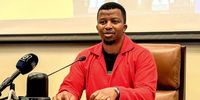
In another post, Ngqisha questioned how residents could be expected to accept that a DA mayor who had never lived in the townships should lead a municipality whose majority population had its own distinct historical experiences, economic struggles and aspirations.
“Nelson Mandela Bay is a municipality whose population is overwhelmingly black African and coloured. Let me be clear, this is not an argument that white people have no place in government. South Africa belongs to all who live in it.
“But political leadership cannot be separated from the history of this country. We cannot pretend that apartheid never happened, that economic exclusion never happened and that the consequences of centuries of racial oppression have somehow disappeared.”
Ngqisha said DA mayoral candidate Retief Odendaal presented himself as someone who understood the struggles of township communities.
“But understanding poverty is not the same as occasionally visiting poor communities during election campaigns. Understanding unemployment is not the same as taking photographs with unemployed young people. Understanding the humiliation of apartheid is not something one acquires through a social media campaign.”
ANC would need more than 10 smaller parties
Ndletyana said the mooted black caucus would require the ANC to form a coalition government with more than 10 smaller parties.
He said UDM president Bantu Holomisa had distanced himself from the proposed black caucus over concerns about ethics and principles.
“Holomisa decided that some in the caucus are rotten. This is more than just words; it has to do with character. People don’t join the black caucus because it’s black, they want to know who those black people are because they don’t want to work with black thieves. I wouldn’t bet on the black caucus. The issue of character is quite important. The people are looking to see which coalition is likely to be stable.”
Ndletyana said a DA-led coalition involving about five parties was less likely to collapse, provided smaller partners such as the UDM were treated as equal partners.
“I would suggest a new leadership that excludes the ANC. It will have a greater chance of cleaning up and getting the executive directors appointed. The DA has previously shown little appetite to intrude in the administration; they have respected the boundaries for the most part,” he said.
Flood of problems
Political analyst Ongama Mtimka said the municipality was in a state of chaos, characterised by intractable problems.

He said the more complex the political arrangement, the more difficult it would be to turn the municipality around.
“With that said, if the coalition [is] able to produce credible, competent individual leaders with a vision, who will practice ethical management, they will be able to navigate the murky coalition waters to at least stabilise the metro.
On the revolving door at the city manager’s office, Mtimka said the city must stabilise the office.
“[If] you have an administrator who has authority and confidence to make decisions, then you’ll have a stable municipal council.
“The metro has to find a desirable city manager who will not target specific people [for] nefarious reasons. We don’t want a city manager who will be chosen by certain people who want to be part of patronage and to be in control. We need someone who will make decisions in good faith for the betterment of the communities of the Bay.” DM
Comments
Scroll down to load comments...