



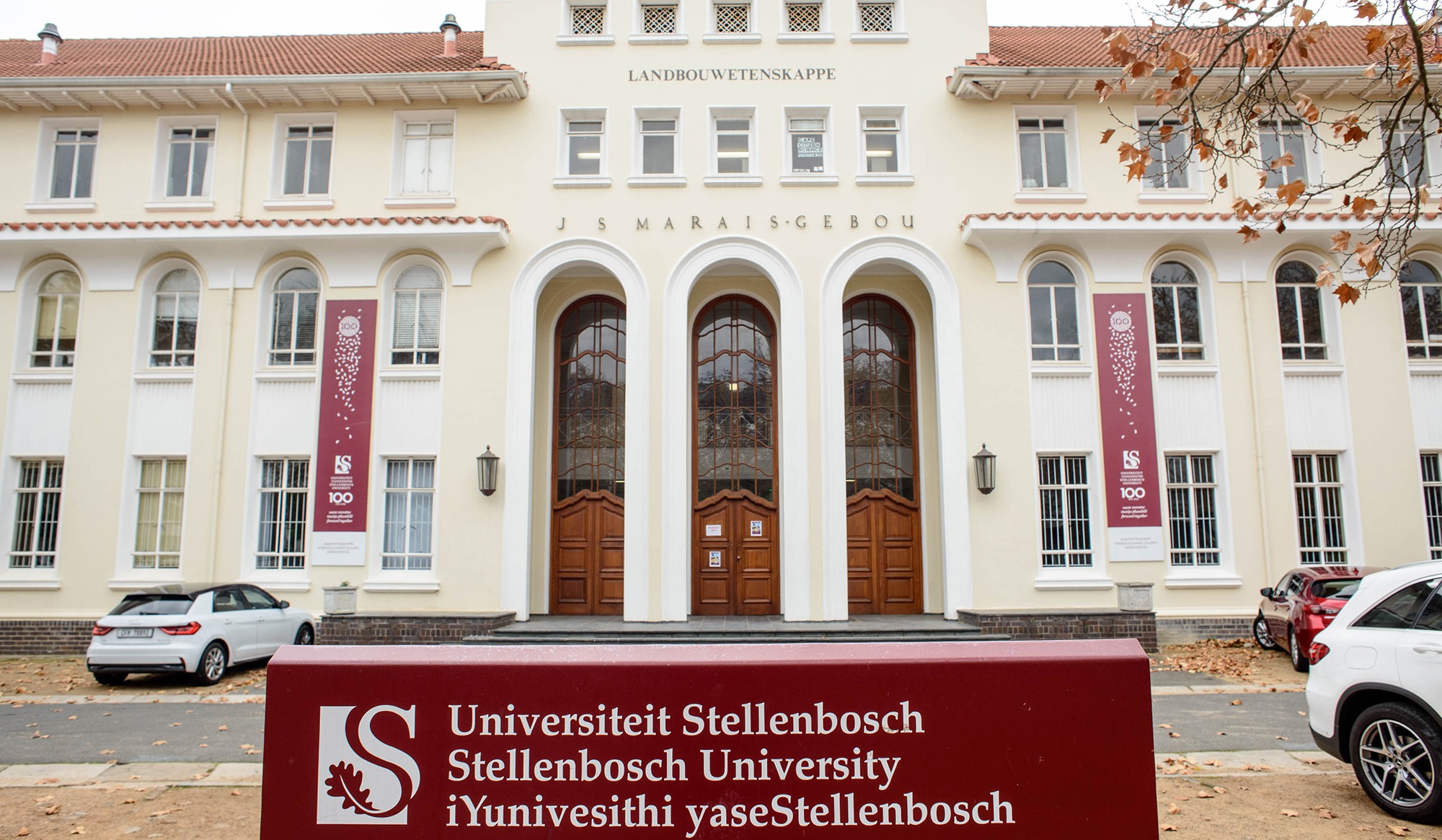
 The University of Stellenbosch said its institutional approach was guided by its AI Roadmap 2026-2030. (Photo: Gallo Images / ER Lombard)
While President Cyril Ramaphosa and a delegation of government officials, academics, researchers and students are in Silicon Valley, California, to learn about artificial intelligence, South African universities are already ahead in trying to understand AI and how policies can be implemented in higher education.
Meanwhile the Department of Higher Education and Training (DHET) is yet to draft its own AI policies.

The delay raises questions about who should set the rules for AI in higher education, particularly as students increasingly use tools such as ChatGPT and Google Gemini for assignments, research and creative work.
Universities on AI policies
North-West University (NWU) has had an institutional AI policy in place for more than a year. Daily Maverick asked the university how the policy was created and used, and whether it should provide a national policy guiding universities. The director at NWU’s AI Hub, Professor Anné H Verhoef, said their AI policy is distinctive in promoting AI use that is ethical, responsible and human-centred.
He explained that the university applies a five-level scale to undergraduate modules and assessments. Depending on the learning requirements, lecturers can prohibit AI use, allow it for brainstorming or final editing, incorporate it into an assignment, or permit full use. At postgraduate level, students may use AI as prescribed by their supervisors and must submit a Senate-approved AI Declaration Form.
“The policy allows faculties, lecturers and disciplines to interpret and apply its AI provisions in ways that suit their fields. For example, languages have less scope for AI-assisted editing than engineering does,” Verhoef said.

The University of Stellenbosch (SU) said its institutional approach was guided by its AI Roadmap 2026-2030. This was supported by its 2024 Ethical Position Statement, guidance on AI use in postgraduate research and interim guidelines for generative AI in teaching, learning and assessment. The latter are being revised through consultation with faculties.
Deputy Vice-Chancellor Academic, Professor Liezl van Dyk, said that rather than treating AI use as inherently problematic, SU adopts a principled, context-sensitive stance where lecturers determine, and make explicit, the conditions under which AI use is appropriate.
“Across Stellenbosch University, academics are responding to AI in different but complementary ways. Some are reconsidering assessment practices to create stronger opportunities for students to develop and demonstrate independent thinking, writing, research and problem-solving capabilities. Others are deliberately incorporating AI into teaching and learning,” Van Dyk said.
She continued: “AI may enable students to produce sophisticated outputs without developing the knowledge or capabilities those outputs appear to demonstrate. Assessment design therefore needs to consider not only what students produce, but also what intellectual work they undertake and what they can demonstrate independently.”
Several universities have issued guidance on AI use instead of waiting for a national framework. The University of Cape Town’s June 2025 AI in Education Framework emphasises responsible use, literacy and assessment integrity. Wits University has an institutional policy with faculty guidelines, while the University of Johannesburg (UJ) and Nelson Mandela University (NMU) have also published AI guidance and position statements.
Policy delay
Portfolio Committee on Higher Education and Training chairperson Tebogo Letsie said the committee was concerned that the DHET had not yet developed an AI policy at departmental level. The department had attributed the delay to capacity constraints, particularly within its legal services component.

“The committee is concerned that the department responsible for the country’s skills development has not yet developed an AI policy at departmental level. Artificial intelligence is already part of daily life in our universities and colleges. The department indicated that capacity constraints, particularly in its legal services component, have delayed the process. The committee will be requesting a clear timeline for when a draft framework will be tabled,” Letsie said.
He welcomed the progress made by UCT, Wits, Stellenbosch and UJ, but said universities should not be left to carry the responsibility alone. Without national guidance, he warned, students and academics moving between institutions could encounter different rules, creating uncertainty and making academic integrity harder to uphold.
What is the department doing on AI?
The department’s AI strategy includes tech partnerships, such as a two-year memorandum of understanding signed with Google South Africa on 30 March 2026 to advance digital skills and AI integration across public universities, TVET colleges and community education institutions. The deal provides teacher training, curriculum support, access to Google AI products, and 10,000 Google Career Certificate scholarships. However, despite promised expanded digital access, it prompts questions about equitable institutional benefits and technology oversight.
The national AI policy process has also hit setbacks. In April 2026, the minister of communications and digital technologies withdrew the draft policy over fictitious references.

DHET must play a role, say universities and experts
Daily Maverick spoke to experts who said a national framework is needed to guide universities. Education expert and full professor of curriculum studies at the University of KwaZulu-Natal, Professor Nyna Amin, warned that leaving institutions to manage the transition alone “could widen existing inequalities”.
“Universities with more resources may be better placed to purchase tools, train staff and establish oversight. Students also need clarity about acceptable use and protection for their personal information, wherever they study,” Amin said.
She also noted the Google partnership, saying these agreements differ in scope. “In my view, such partnerships should operate within rules that establish who determines educational priorities, how products are selected and how student information is handled.”
A senior lecturer and educational technology specialist at Rhodes University, Dr Nicola Pallitt, said: “The extent to which higher education institutions are adapting their teaching, learning and assessment practices to the evolving AI landscape has been uneven, largely due to historical inequalities and unequal capacity among our institutions. As a result, some are better prepared than others. While many have developed AI guidelines and alternative approaches to assessment, the extent to which these are implemented varies across and within institutions.”
She said the success of a national framework would depend on its purpose, content and the extent to which universities and private higher education institutions were consulted. Although the government was behind institutions that had already developed guidance, Pallitt said the DHET still had an important role in supporting universities with unequal capacity and infrastructure.
Students on using AI

For students, the debate is already part of everyday academic life. Retablie Bottoman, an honours student in public administration at the University of Fort Hare, said she uses Canva, ChatGPT and QuillBot in her studies. She tries to avoid plagiarism by paraphrasing material and citing other people’s work.
“We always rely too much on AI that our brain has become lazy to think and understand. We are embarking on the Fourth Industrial Revolution where artificial intelligence is improving and excelling to take over humanised work. Therefore, having policy ensures that students understand the use of AI without depending on it academically,” Bottoman said.
LLB student Onelitha Mbonana said she is not a fan of AI but does use Microsoft Copilot, which was already on her laptop. “If it was up to me, students would not use AI at all. However, it’s clear that AI is here to stay, so universities are correct to create policies on how students should use the AI tools. Because without those policies, students would entirely rely on AI while the brain is rotting and losing the ability to think and solve problems on their own.”
Daily Maverick sent questions to the DHET, which said it would be able to respond after the Silicon Valley visit. DM
Comments
Scroll down to load comments...