



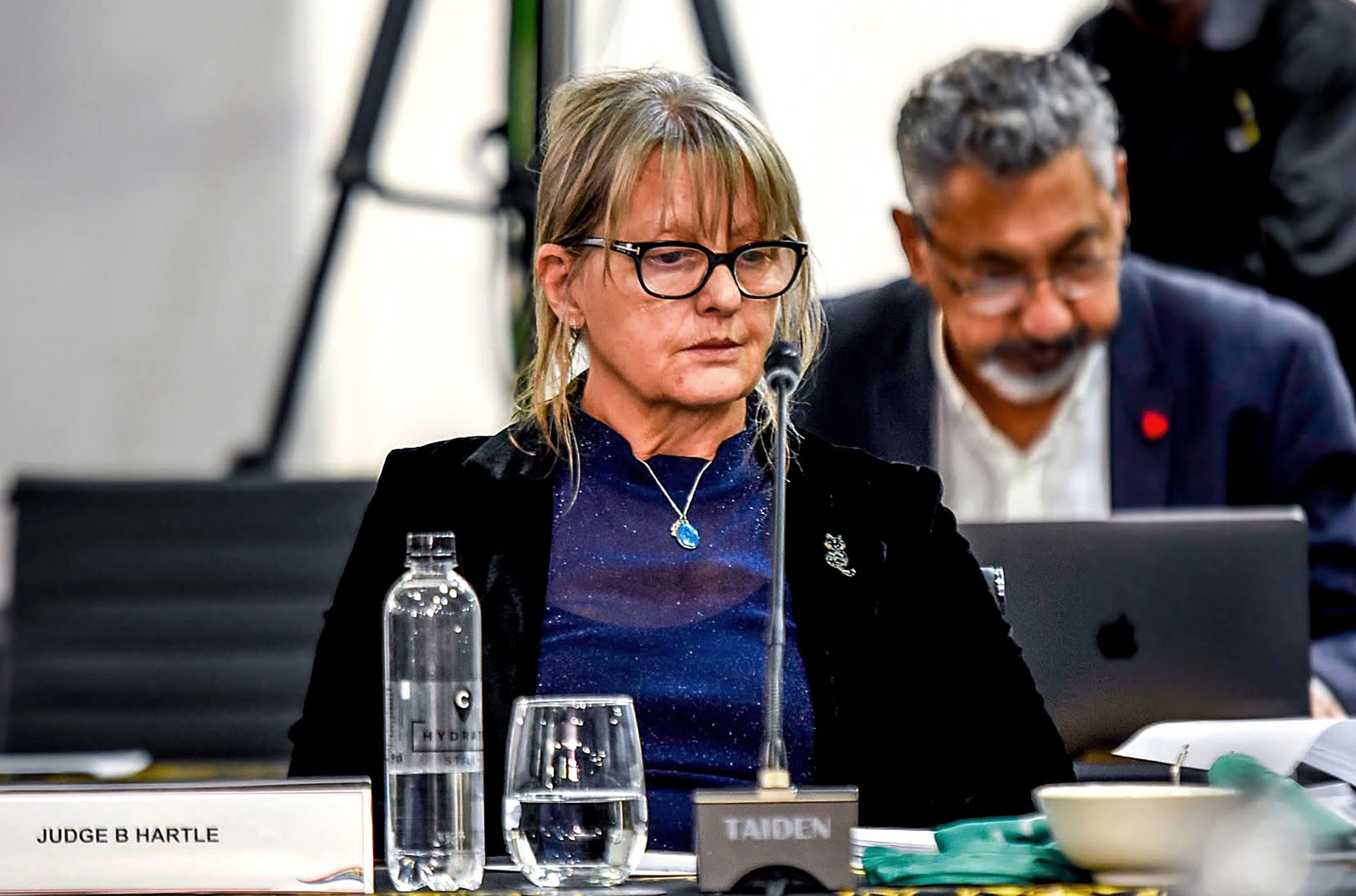
 Eastern Cape High Court Judge Belinda Hartle at the Judicial Conduct Tribunal investigating allegations of gross misconduct against her. (Photo: The South African Judiciary / Facebook)
Eastern Cape High Court Judge Belinda Hartle’s legal team has signalled it may apply to have a misconduct complaint against her dismissed. Three witnesses have now testified that court clerk Thozamile Semekazi initially complained only of being shouted at and insulted, without mentioning the racial slur he later accused her of using.
On Wednesday, 18 November 2026, Hartle’s lawyer, advocate Jan Heunis SC, told the Judicial Conduct Tribunal investigating the allegations against the judge that her legal team was considering bringing an application to have the case dismissed when proceedings resume in March 2027.
“We may – and we haven’t decided yet – when we reconvene, bring an application that the case be dismissed,” said Heunis.

The suggestion appeared to catch tribunal president, retired Supreme Court of Appeal judge BH Mbha, by surprise as he sought clarity on the nature of the proposed application, asking whether it would be similar to an application in terms of section 174 of the Criminal Procedure Act, which allows an accused person in a criminal trial to apply for a discharge at the close of the prosecution’s case if there is insufficient evidence.
Heunis confirmed that this was the type of application the defence was considering and would prepare the necessary arguments.
Judge Mbha responded: “We will cross that bridge when we get there; of course we will deal with it properly.”
The tribunal is investigating allegations that Hartle used racist and derogatory language towards Semekazi on 15 May 2025, specifically the k-word and f-word, allegedly after becoming frustrated with delays in the delivery of court case files at the high court.
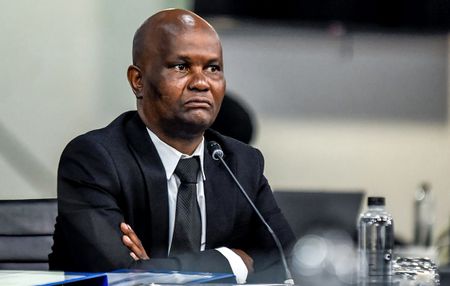
Hartle has denied using the racial slur, but through her legal team admitted to using the f-word, which she said was not necessarily directed at Semekazi but at the office handling the files.
Taking the stand on Wednesday, Semekazi’s supervisor, Thabisa Mafalala, the chief registrar of the Eastern Cape High Court in Bhisho and East London, blamed Semekazi for repeated delays in delivering court files.
Questions over the alleged racial slur
During cross-examination, Hartle’s counsel questioned Mafalala on why Semekazi had not immediately told her of the alleged racial abuse, despite the two being in regular communication.
Mafalala testified that Semekazi frequently contacted her by phone and WhatsApp about his work and had spoken to her on the morning of 15 May, the day of the alleged incident.
The following day, Semekazi sent her a WhatsApp message informing her that he had been booked off sick by a doctor. She confirmed that Semekazi had not told her about the alleged racial abuse. “He never informed me,” said Mafalala.
Hartle’s counsel asked why Semekazi had notified his supervisor of his sick leave without mentioning the allegations against the judge, saying: “I find that rather peculiar with this open line of communication as to why Mr Semekazi would not inform you of these racist allegations.”
She maintained that she only learnt of the allegations in June, after Semekazi lodged a formal grievance.

Complaints about delays
Apart from the questions surrounding the alleged racial slur, Mafalala’s testimony also focused on Semekazi’s performance and his responsibility for preparing case flow management files.
She told the tribunal that Semekazi began working independently on the files in April 2025, after receiving practical training from her in March.
According to Mafalala, complaints about late files began shortly after Semekazi took over responsibility for them. Asked whether there had been similar problems beforehand, Mafalala said there had not.
Judge Mbha questioned whether the delays could be attributed only to Semekazi. “So the problem of the lateness of the files was, can I say, solely focused on Mr Semekazi?” Mbha asked.
“I could say so, Chair,” replied Mafalala.
Under cross-examination, she acknowledged that Semekazi had never received formal training in case flow management.

Mafalala explained that she did not believe the Department of Justice had a formal training programme for case flow management because procedures differed according to the directives applicable in each province.
Hartle’s defence questioned why someone who had worked for the department for more than 20 years would need formal training to arrange court files: “It blows my mind, as it’s a simple process.”
The tribunal heard that Semekazi had been given the case roll on Friday, 9 May, and had until midday on Wednesday, 14 May, to prepare the files.
Mafalala said Semekazi had not completed the work by the deadline and that she subsequently instructed another registrar’s clerk, Nadia Ntsunguzi, to assist him.
Conflicting versions over assistance
While Mafalala maintained that she initiated the instruction and noted that Ntsunguzi’s affidavit supported her version, Semekazi previously testified that he had asked Ntsunguzi for help on his own initiative.
“So, with you and Nadia’s evidence aligning, I can only assume that Mr Semekazi lied to the tribunal,” Hartle’s counsel put to Mafalala.
Throughout the hearings, Hartle’s defence has repeatedly questioned why the alleged racial slur was not mentioned in the initial accounts given to court officials who dealt with Semekazi shortly after the incident.
Last week, the tribunal heard evidence from Denim Kroqwana, the director of court operations in the Eastern Cape Office of the Chief Justice, who testified that Semekazi approached him in tears after allegedly being insulted by Hartle. However, his account of what Semekazi reported to him also made no mention of the alleged racial slur.
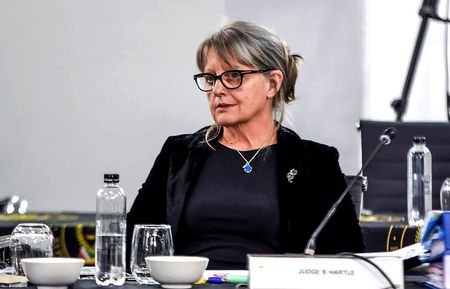
Although Mafalala blamed Semekazi for the repeated delays, the tribunal also heard that Hartle may not have known who was responsible for the files arriving late.
Hartle’s counsel put it to Mafalala that the judge had not been aware that Semekazi was responsible for the delays before the alleged incident.
The defence also put it to Mafalala that Hartle’s secretary, Shakira Frost, would normally collect the files from the general office and that Semekazi had personally taken them to Frost’s office on 15 May to apologise for the delay.
Mafalala was not present during the alleged confrontation and could not testify about what was said. She did, however, confirm that she had apologised to Hartle on WhatsApp after the files were delivered late.
The tribunal will resume in March next year, when Hartle’s defence is expected to decide whether to apply for the complaint to be dismissed. DM
Comments
Scroll down to load comments...