



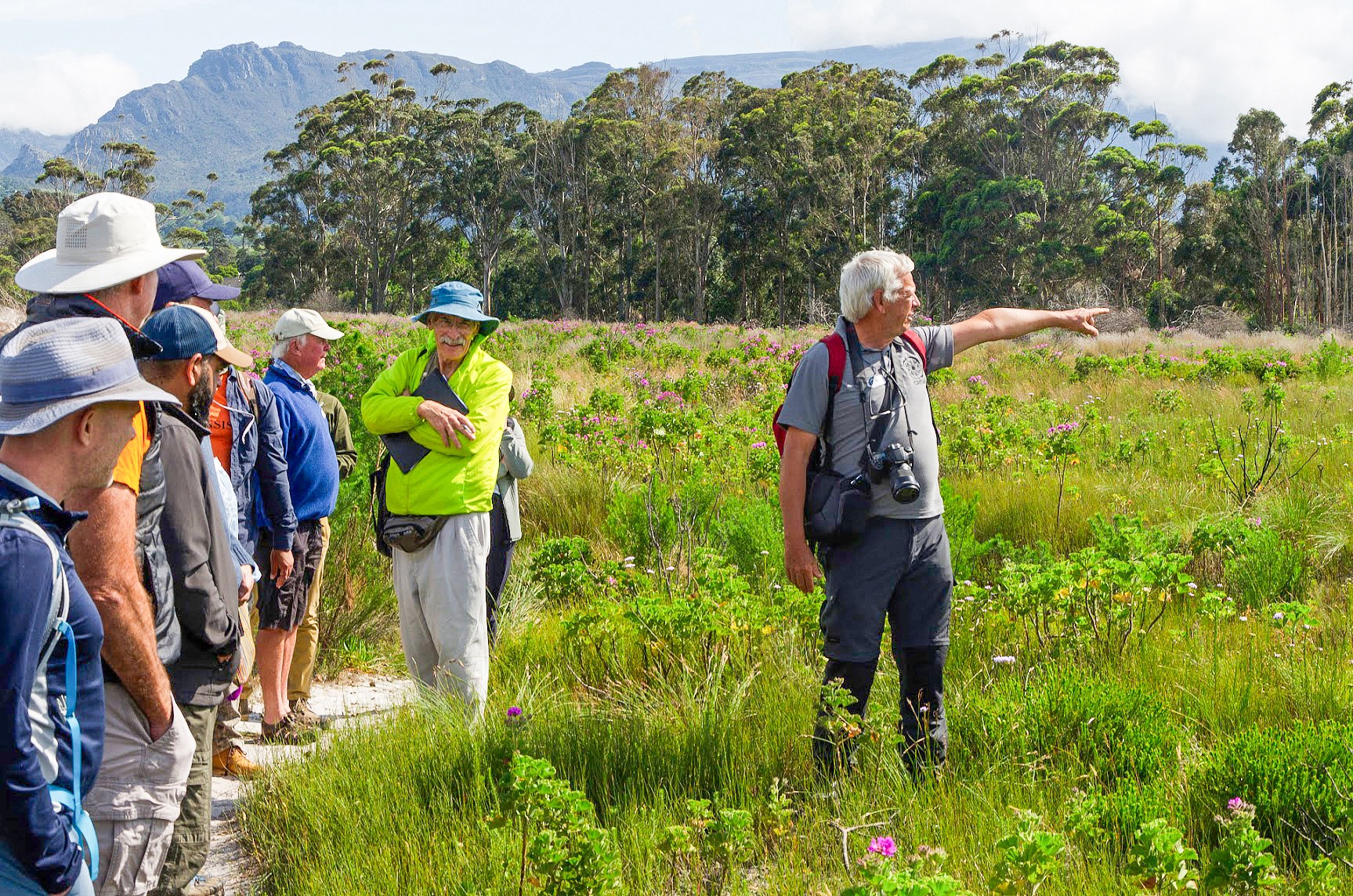
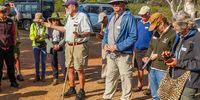
 Botanist Dr Tony Rebelo makes a point about fynbos restoration in the area cleared of pine trees in Lower Tokai Park. Listening is event coordinator Dr Guy Preston, (yellow jacket).
(Photo: Mike Golby)
A “who’s who” group of 20 specialist fynbos botanists and restoration ecologists have all agreed that restoration of original Cape Flats Sand Fynbos (CFSF) vegetation – now critically endangered with less than 1% formally conserved – can be achieved in Lower Tokai Park.
This is despite this area having been under pine trees for 130 years.
The science is now settled, say these specialists who are considered to have appropriate experience and expertise to answer key questions about this aspect of the future management of Lower Tokai Park.
They were among 38 people who attended a recent invitation-only workshop – the “Tokai Fynbos Restoration Visit and Dialogue” – where they (the specialists) also overwhelmingly agreed that soil enrichment from previous human activity, including afforestation, is not a barrier to fynbos restoration – a claim that had been promoted by some during the heated public debate that has raged over years.
However, the specialists had some differences of opinion about the time frame for CFSF restoration at the site and on what is meant scientifically by “full restoration”.
Twelve (60%) of the group of 20 considered the CFSF at Lower Tokai Park to be already restored, while four (20%) said it was already partially restored.
Overall, 19 (95%) of these specialists expected restoration to be achievable within another 30 to 50 years (or more than two fire cycles).
One lone specialist argued that restoration would take 200 years or more.
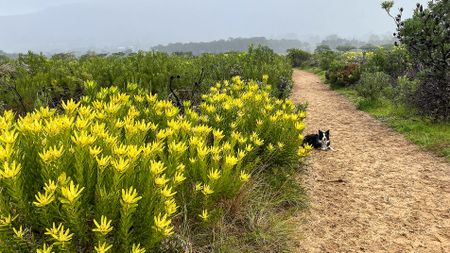
The specialists unanimously endorsed the removal of the remaining Dennendal pine plantation on ecological grounds, with 19 (95%) of them also confirming their belief that the plantation constitutes a serious fire risk to neighbouring residential properties and 15 (75%) agreeing that these pines constitute a safety risk through falling branches and the uprooting of ageing trees.
Tokai is part of the Table Mountain National Park which is in turn (arguably) the flagship component of the Cape Floral Region Protected Areas World Heritage Site proclaimed by Unesco.
The dialogue and the protagonists
The dialogue event was suggested by Professor Dave Richardson, a distinguished professor in Stellenbosch University’s Department of Botany and Zoology, during his recent media clash with Emeritus Professor Eugene Moll, a retired plant ecologist and honorary member of the University of the Western Cape’s Department of Biodiversity and Conservation Biology.

Moll has long been fiercely critical of restoration efforts in Lower Tokai Park, and has argued that CFSF here is ecologically doomed because of compromised soil and/or depleted seedbanks. Richardson strongly disagrees, but told Moll he was convinced that the debate over the issue would be best served by a facilitated workshop and field trip to the area for all parties, rather than “via email exchanges, Facebook threads, or media postings”.
A third major protagonist in this debate is biodiversity and restoration ecology expert Dr Tony Rebelo, now retired from the SA National Biodiversity Institute, who has also clashed with Moll – notably over differences of opinion about CFSF restoration successes at Tokai.

Richardson’s suggestion for a workshop was taken up by Dr Guy Preston, a retired deputy director-general in the national Department of Forestry, Fisheries and the Environment who convened last month’s event.
Invitees were principally nominated by the three main protagonists (Moll, Rebelo and Richardson) and included many of the top names in fynbos research and management.
Among them were 20 botanists and/or restoration ecologists – dubbed “Specialists” in the final report on the workshop – and a further 18 people who mostly work professionally as “Conservationists”, including for SANParks and the City of Cape Town.

(Photo: Mike Golby)
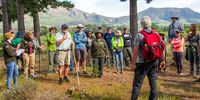
The event started with Moll leading the first part of a two-hour field visit to Lower Tokai Park, followed by Rebelo leading the second part. Each also gave brief presentations during the subsequent facilitated discussion.
Of the 38 attendees, all bar one subsequently completed a questionnaire capturing their full responses to a series of questions about the CFSF restoration issue, as discussed during the workshop.
An additional eight conservationists were unable to attend but each submitted a completed questionnaire.
Preston administered the questionnaire and analysed the results in a full report: Lower Tokai Park and the Dennendal Plantation: Experts’ Views on the Restoration of Cape Flats Sand Fynbos.
Apart from Richardson, Moll and Rebelo, the report does not identify individual respondents or attendees. This was in terms of a commitment given in the invitation, the executive summary explains. But all their comments were captured in an appendix, “for transparency”.
Agree or disagree
The questionnaire was based on six statements to which the respondents replied with their ranked agreement or disagreement:
Restoration of Cape Flats Sand Fynbos (CFSF) at Lower Tokai Park is achievable:
All 20 specialists agreed that CFSF can be restored on land that has been under pines for about 130 years.
The Dennnedal pine plantation should be removed:
All 20 specialists supported this.
The Dennendal plantation area should be restored to Cape Flats Sand Fynbos:
A very strong majority (17, or 85%) of specialists felt that the area should be restored to CFSF. Two said “Don’t Know”. The lone specialist who said “No” felt that the pines should be removed but then totally replaced by a selection of hardwood tree species.
Soil enrichment is not a major barrier:
Seventeen (85%) of the 20 specialists said soil enrichment is not a barrier to CFSF restoration at Lower Tokai Park, and one said “Don’t know”.
The Dennendal pine plantation is a fire risk:
Nineteen specialists (95%) agreed with this statement.
The pine trees in the Dennendal plantation pose a risk in terms of shedding branches and/or falling down:
A significant majority of specialists (15, or 75%) felt that the trees in the plantation were a safety risk.
The questionnaire included two supplementary issues that also lie close to the heart of the vigorous debate about Lower Tokai Park: the proposal to plant a shaded walkway of trees along the periphery of the Dennendal plantation land once the pines are removed, and the need for additional security for recreational users here.
According to the executive summary of the workshop report, there was clear majority support for the walkway, although not as strong as that expressed for the six core suggestions. About 30 of all respondents (68%) answered “Yes” to endorse the proposal for a shaded walkway, with 13 (32%) saying “No” and two (5%) “Don’t Know”.
Assumptions about the walkway included:
Trees used for this purpose would be non-indigenous to the area but also non-invasive, not fire-prone, not prone to dropping branches or falling over, and not allelopathic [producing biochemicals such as phenols, that affect neighbouring plants];
The trees would require artificial watering until they are properly established; and
Additional security would be required in the form of security cameras and/or safety monitors.
However, the report noted that answers to questions about who should be responsible for the capital and operational costs of creating a shaded walkway and for additional safety measures, were deemed “inconclusive”.
‘Remarkable scientific consensus’
Asked to comment after the workshop, Richardson said he had suggested the field trip and workshop because he felt that inspecting the evidence together on site would be the best way to move past divergent opinions.
“Everything I observed at Lower Tokai Park and heard in the round-table [discussion afterwards] confirmed that restoration efforts have delivered strong results, putting the vegetation on a clear trajectory to recovery toward Cape Flats Sand Fynbos,” he said.
“The meeting produced remarkable scientific consensus… This outcome provides a clear, evidence-based path forward for conservation in the area.”
In his response to Daily Maverick, a defiant Moll said his view remained unchanged, despite his agreeing with the questionnaire statement that “Restoration of Cape Flats Sand Fynbos (CFSF) at Lower Tokai Park is achievable”.
“I do not believe that Cape Flats Sand Fynbos (heathland) can be restored at Lower Tokai in at least ~200 years and maybe more. Time alone will tell.
“Most, if not all, of the group disagreed [with me], but I saw no convincing evidence of restoration of floristic and/or structural/functional heathland communities. What little ‘restoration’ there was is spotty at best, and possibly [occurs] on old firebreaks, along roadsides or in areas too wet for pines to grow.
“Clearly what I see as Cape Flats Sand Fynbos (heathland) – a fynbos species post-fire ‘weedscape’ – is not what others perceive it to be.”
Preston told Daily Maverick that the report has settled the argument that played out in the media as to whether CFSF could be restored on land that has been under pines for such a long time.
“The answer is an unequivocal ‘Yes’. This critically endangered fynbos type – currently with only 1% of its former range in formal protection – can be restored,” he said.
The report would be submitted to SANParks to aid them in addressing what should happen after the Dennendal pines are removed, Preston added. DM


Comments
Scroll down to load comments...