



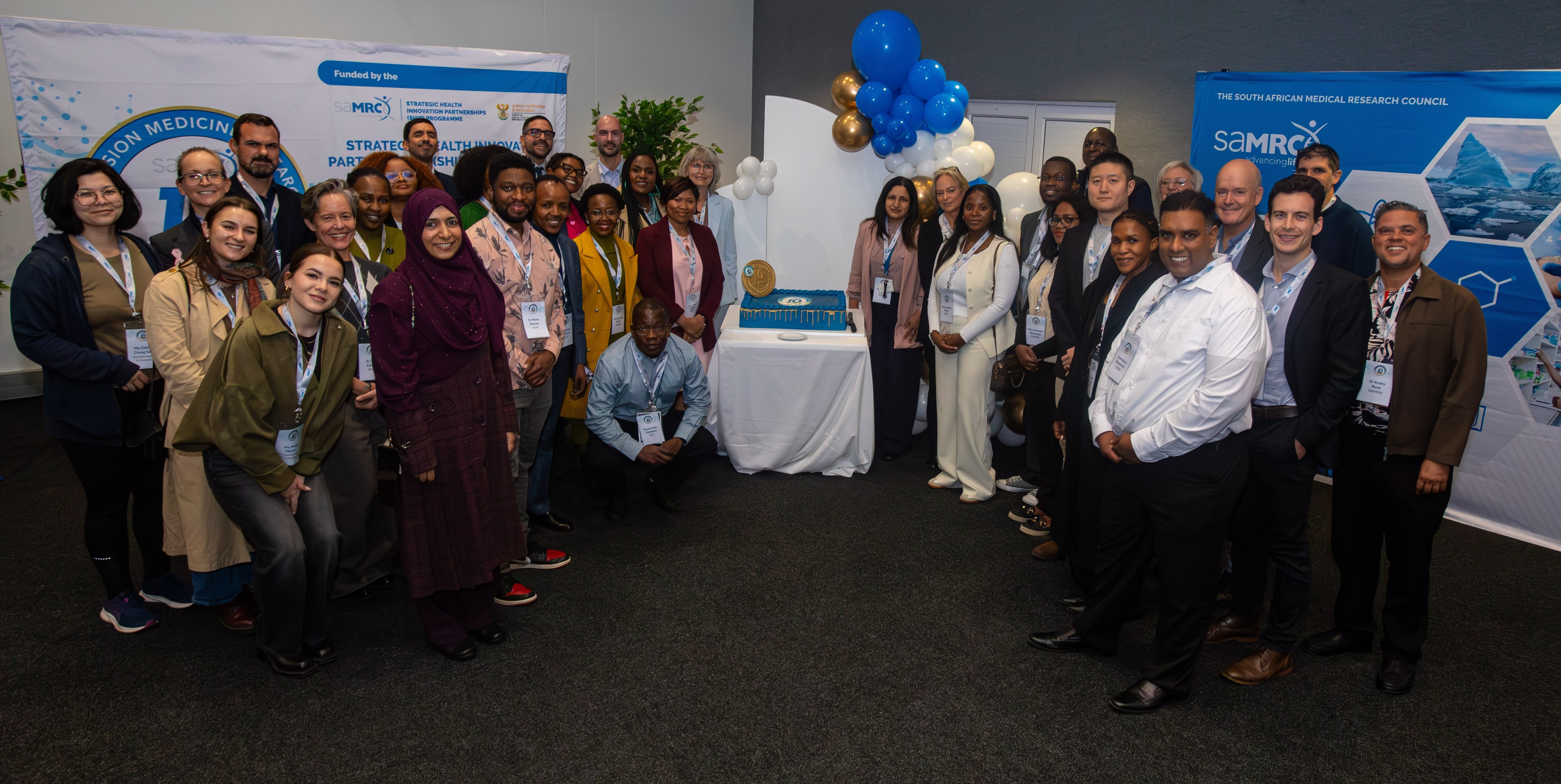
 The SAMRC Precision Medicine Program team from the Grants Innovation & Product Development Unit and core stakeholders Celebrate 10 years of Precision Medicine Research & Innovation.
Clinical decisions have long assumed that patients with the same diagnosis can be treated alike, yet responses differ markedly: some benefit substantially, others little, and some suffer harmful side effects. Precision medicine recognises that health and disease are shaped by a unique combination of genetic, environmental, behavioural and social factors, and aims to provide the right intervention for the right person at the right time.
Globally, precision medicine is already influencing how cancers are diagnosed and treated, how rare diseases are identified, how medicines are prescribed and how disease risk is predicted. Yet despite these advances, much of the science underpinning precision medicine has been generated from population data outside Africa, meaning that these data often hold no relevance for South African patients.
If the data used to develop genomic tools, diagnostic tests and predictive algorithms do not adequately represent our population, the benefits of precision medicine may not be shared equally and equitably. Africa contains the greatest human genetic diversity on earth.
That diversity is not simply a scientific curiosity; it holds vital clues to understanding health, disease susceptibility, treatment response and resilience. For South Africa, precision medicine is therefore not about following a global trend, but rather about generating the evidence needed to improve healthcare for our own population.
Building the foundations: A decade of investment and partnership
Over the past decade, much of the infrastructure needed to move precision medicine from aspiration to implementation has been built, driven by the strategic partnership between the SAMRC and the Department of Science, Technology and Innovation (DSTI) through the Strategic Health Innovation Partnerships (SHIP) Program. Sustained investment in genomics, bioinformatics, pharmacogenomics and public health genomics, and in skills, laboratory infrastructure and data systems, now positions South Africa as a continental leader.
Key milestones include the establishment of the DSTI Precision Medicine Platform- giving rise to a spin out company Mosaic Pty Ltd and of the SAMRC Genomics Centre through a partnership with the Beijing Genomics Institute (BGI), which provided the first high-throughput facility offering scaled next-generation sequencing capacity to African scientists at lower costs. These initiatives did more than fund individual research projects; they created an ecosystem capable of supporting precision medicine at scale. With core infrastructure supported, this followed, a focused investment into a Pharmacogenomics portfolio to address the complexity of adverse effects of essential drugs prescribed within the public health system. The outcomes initiated a research foundation that is continually built for understanding population public health treatment dynamics.
The COVID-19 pandemic further demonstrated the value of these investments. The Network for Genomic Surveillance in South Africa (NGS-SA), funded by the SAMRC, showed how local genomic infrastructure and expertise could provide critical intelligence during a global public health emergency. Genomics proved to be a practical public health capability, not merely a research tool and contributed significantly to the fight against a global pandemic. This initiative gave rise to the establishment of the Centre for Epidemic Research and Innovation (CERI).
International co-funding has been central to the program’s progress, with the United Kingdom, the SAMRC and Innovate UK co-funded the Newton Fund precision medicine programme, supporting affordable gene-based diagnostics which gave rise to products and technology transfer for local manufacturing of PARADNA products, as well as a epilepsy monitoring mobile application and gene panel test. With Europe, the SAMRC co-funded the ERA PerMed Joint Transnational Call (JTC) 2022, funding the OPTIMA Project consortium. Currently the SAMRC is a full beneficiary member of the European Partnership for Personalised Medicine (EP PerMed), co-funding within several joint calls such as the, JTC2025-Pharmacogenomics, JTC 2026 -CARMEN and RITC2026 Multimodal-Data.
A 2024 joint call by the SAMRC and the Japan Agency for Medical Research and Development (AMED) funded genomics projects on cancer and infectious diseases. This active collaborative program portfolio has been able to address the development of precision medicine diagnostics and treatment evaluations toward understanding NCDs within the African population. Some solutions have been taken through the Health Technology Assessment phase and lessons learnt have helped inform the strategic research and innovation agenda toward development of a sustainable precision medicine ecosystem for the country.
In parallel, the policy engagement has advanced, from 2021 to 2025, the SAMRC was a prominent African partner in the EU Horizon 2020 funded EU-Africa PerMed project, which aimed to build links between Europe and Africa in personalised medicine. The SAMRC led and co-developed core project's outputs, including the African continent’s personalised medicine landscape analysis feeding into the EU-Africa PerMed Action Plan and the DAKAR Declaration for personalised medicine. The SAMRC participated in several policy platform discussions at the EU-African Union level, a Spanish presidency meeting on personalised medicine, the International Consortium for Genomics (ICG) and at the United Nations General Assembly (UNGA) Science summit. The SAMRC joined ICPerMed in July 2022 as the first African executive member and now holds a Vice-Chair position, providing sub-Saharan African leadership on this international policy platform. Together, these engagements mark South Africa's shift from recipient engagement to co-leadership and advocacy in personalised and precision medicine within the continent.
Multimorbidity and integrated care
A further challenge is that illness rarely occurs in isolation. Many people in low-middle income countries live with multiple chronic conditions, such as HIV alongside NCDs including hypertension, diabetes or mental illness. Yet research and healthcare are often organised around individual diseases, leaving clinicians to manage interacting conditions, treatments and care needs across separate pathways.
Understanding these patterns requires looking beyond single diagnoses. Linked, longitudinal data can help researchers examine how conditions develop together, identify treatment interactions and reveal where existing care pathways fall short. Genomic information may add useful insight for particular conditions or treatment decisions, within this broader picture.
This work could help guide more integrated care for people with multiple conditions and identify opportunities to prevent complications or avoid harmful treatment combinations. It also highlights a key implementation priority: ensuring that precision medicine informs care pathways and clinical decisions across the health system, rather than remaining confined to isolated tests or specialist settings.
The pathway to implementation: SA110K-HGP and beyond
The South African 110 000 Human Genome Programme (SA110K-HGP) is the natural next step, addressing the underrepresentation of African populations in global genomic datasets, which limits the interpretation of genetic data and the accuracy of prediction models.
Its goal is not merely to generate genomic data, but to make genomic information clinically useful and improve health outcomes for patients.
At the heart of the SA110K-HGP Pilot Phase are ten cohorts, selected through a competitive process, representing some of the country's most pressing health priorities, from HIV and tuberculosis to cardiovascular disease, kidney disease, maternal health, mental health and rare genetic disorders. By bringing together thousands of participants from well-established cohorts with years of linked clinical, laboratory and outcome data, SA110K-HGP creates a national genome- phenome archive a resource for discovery and translation with insights that are scientifically robust, clinically relevant and uniquely African. It offers an opportunity to uncover how genetic, environmental, clinical and social factors combine to influence health and disease in South Africans, providing the evidence needed to move from one-size-fits-all medicine approaches towards more precise, equitable and effective healthcare.
A future within reach
The past decade was about building foundations: infrastructure, partnerships, skills, governance frameworks and scientific capability. The next decade must focus on unpacking the African human diversity, implementation, translation and impact.
Precision medicine should not be viewed as a luxury reserved for wealthier countries or a future technology that remains decades away. Much of the required capability already exists.
The country's extraordinary genetic diversity, complex disease burden and growing research capacity create a unique opportunity to redefine how healthcare is delivered and understood. For South Africa, precision medicine is no longer merely an aspiration; it is becoming an achievable component of a modern, responsive healthcare system.
If implemented thoughtfully and equitably, precision medicine will not only improve the health of current generations but also ensure that Africa's genetic diversity, scientific leadership and lived realities help shape the future of medicine itself. DM
Authors: Rizwana Mia, Ebrahim Samodien & Prof Ntobeko Ntusi

Rizwana Mia is a Senior Programme Manager within the Grants, Innovation and Product Development Unit at the South African Medical Research Council (SAMRC) and Vice-Chair of International Consortium for Personalised Medicine (ICPerMed). She has been has been directing and leading the South African Precision Medicine Research & Innovation program since 2016.

Ebrahim Samodien is a Research Manager in the Office of the SAMRC Vice-President and Research Translation Portfolio lead at Cochrane South Africa.

Prof Ntobeko Ntusi is the CEO and President of the SAMRC and a Professor of Medicine at the University of Cape Town. He leads a pan-African registry aiming to understand the genetic determinants of cardiomyopathy in Africans. He also leads the UCT/SAMRC Extramural Unit on the Intersection of Infectious Diseases and Noncommunicable Diseases as well as the ARUA/Guild Cluster of Research Excellence on Noncommunicable Disease Multimorbidity.