



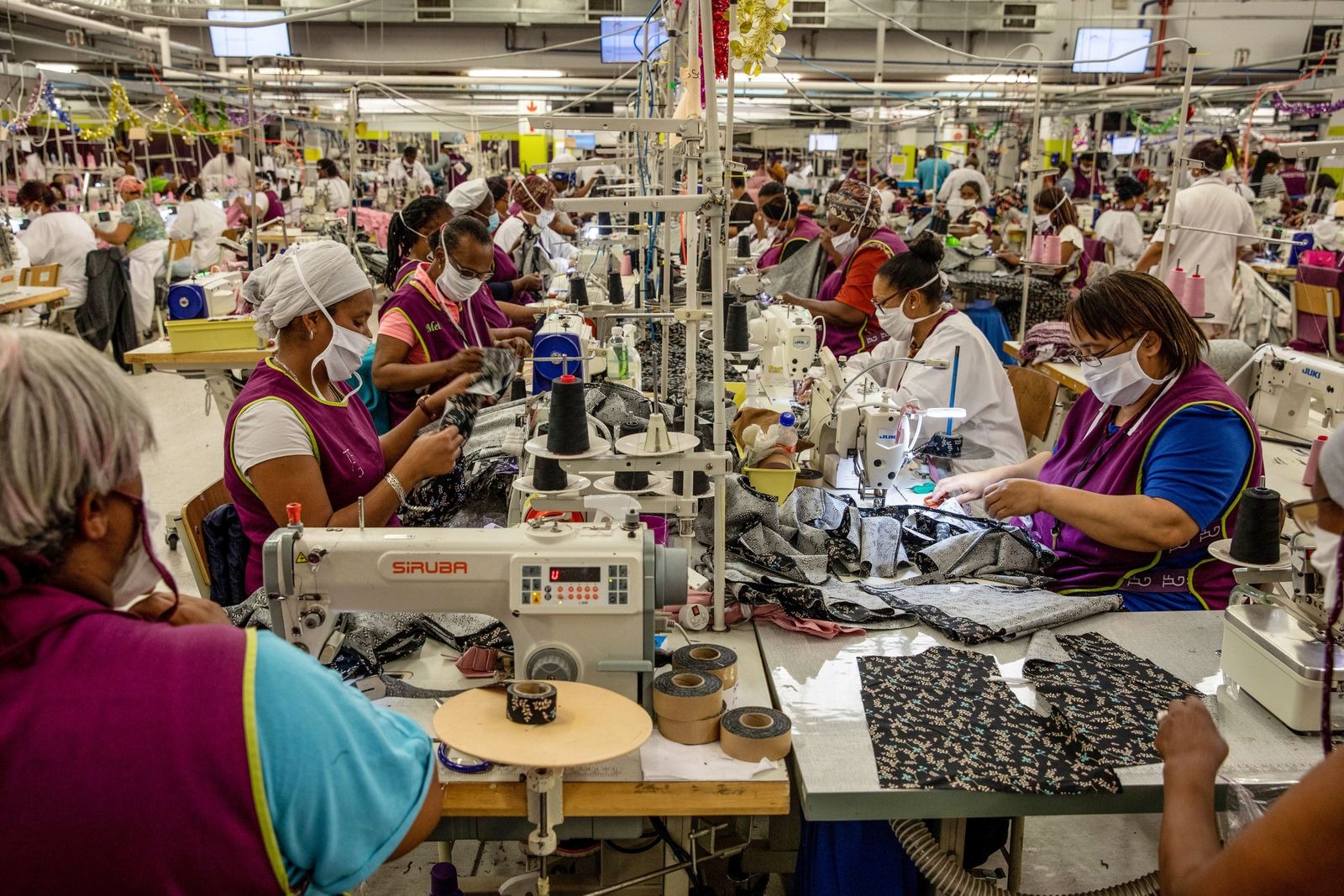
 Workers sew garments at the Prestige Clothing textile factory, operated by The Foschini Group in the Maitland district of Cape Town on 10 December 2020. (File photo: Dwayne Senior / Bloomberg via Getty Images)
“Go into the most desolate part of our country,” said Graham Choice, chairperson of the Cape Clothing and Textile Cluster, arguing that if one opened a clothing factory, one would open a world of employment opportunity. It’s an industry with great potential to provide steady income, but it only makes up about 2.5% of South Africa’s total manufacturing output.
According to the Localisation Support Fund, South African retailers signalled a willingness “to source up to 81 million additional garments per year locally by 2030, [which could] support up to 34,000 additional jobs”. Realising this potential is not straightforward, but it’s worth a shot.
The fund’s CEO, Irshaad Kathrada, sees the decline in local manufacturing as a significant contributor to South Africa’s economic woes over the past two decades. This is partly due to manufacturing’s job-multiplying potential.
“For every one manufacturing job you create, you create four other jobs throughout the economy,” Kathrada said.
The clothing, textile, footwear and leather sector has its own advantages as “a type of manufacturing that can allow you to pull someone who may only have a matric or even less in some cases, and put them through an intensive training programme.
“Within a few months, they’re able to hit the manufacturing floor and operate at a level that can make that factory sustainable and competitive. So it’s got a very short journey to skill people up.”
He added that the sector also gave women more opportunities: “Where most of manufacturing is quite male-dominated, clothing is different. More than two-thirds of the people working in clothing manufacturing are women.”
Producing more clothing locally is not just an issue of empowerment. It also helps retailers by shortening supply chains.
“It has exchange rate benefits, it reduces your working capital requirements, it reduces the risk of ageing stock,” said Courtney Grant, chief facilitator of the Cape and KwaZulu-Natal Clothing and Textile Clusters.
Turnaround times matter when a trend-sensitive commodity like clothing is being sold, and any delay creates problems.
“We currently have port delays of up to three weeks in Durban, which is one of the main hubs of moving fabric into the country,” said Grant.

A key challenge for local clothing factories is fabric supply.
“We have some capability in technical fabrics [used in all sorts of garments, including sport and outdoor leisure wear], but not a huge amount of capability. And part of that is because… it requires big investment in machinery,” said Kathrada.
On top of that, Michael Lawrence, executive director of the National Clothing Retail Federation, noted: “We make almost zero natural fibre fabrics in this country. I cannot buy a suit made with a natural fibre that has been produced in this country.”
Global competition
Ultimately, local supply needed to be “globally competitive”, said Grant. “We can’t ask for handouts from retail to buy from us because they can’t pass that on to the customer.”
South Africa is certainly not the only country grappling with a decline in its domestic clothing, textile, footwear and leather industry, though it has become more attractive to import these goods since tariff liberalisation in the 1990s.
“You had the rise of manufacturing in the East… A lot of sourcing then shifted to an outsourced model. And price really did drive that,” Kathrada explained.
When discount e-commerce platforms Shein and Temu entered South Africa in the 2020s, they seriously dialled up the pressure. In 2024, the two platforms gobbled up a combined 3.6% share of the South African clothing, textile, footwear and leather market.
Although these e-tailers had initially been able to take advantage of tax loopholes to keep prices down, the South African Revenue Service tightened regulation at the end of 2024.
Trade union federation Cosatu backed a motion from the Southern African Clothing and Textile Workers Union (Sactwu) calling for a ban on Shein and Temu, which it sees as a threat to local jobs. It cited the Localisation Support Fund study, which indicates that up to 34,000 jobs may be lost by 2030 as a result of these platforms.

“The formal clothing, textile, footwear and leather manufacturing sector employs about 80,000 workers across roughly 1,000 factories – so the damage will be substantial and it will grow larger beyond 2030,” wrote Sactwu researcher Simon Eppel.
Sactwu is gunning for a ban in the long term, but in the short term it said: “The government must ensure they [Shein and Temu] pay the proper tax; ensure that they abide by consumer protection laws and data privacy laws; and better control and reduce their overwhelming dominance of online advertising spaces to allow other market players a better chance to be seen.”
Compliance complications
Extremely cheap imports are problematic because they teach customers to expect extremely low prices, with knock-on effects for South African garment workers.
“Local factories that comply with the law are squeezed, lose orders, find themselves struggling and cannot easily absorb higher costs,” Eppel explained. South African clothing sweatshops “did not start with Shein and Temu’s entry into our market”.
“But over the last six years, as these platforms have taken more market share domestically and as local retailers have pushed down prices to compete, the sweatshop problem has definitely become worse,” Eppel said.
Lawrence noted a growing trend over the past decade of “operators trying to cut corners” and called on the Department of Employment and Labour to spend more of the money it receives in taxes from retailers on “cleaning up” the value chain.
Grant said South Africa needed to focus on solutions – not simply “continuing to do the same carrot and stick approach that we’ve done for the last 20 years. We need to look at this differently. There’s something broken here.”
She added: “At the very least, we need to be getting to a position where every firm is minimum wage compliant.”

Besides holding retailers accountable, Eppel said South African consumers must call on the government to boost local, compliant public procurement. This would give manufacturers “a demand base” they currently lack, explained Grant, and scaling volumes would help to lower costs.
“It would really support compliant firms to have that sort of demand, and they need the opportunity to compete for it,” she added.
According to Sactwu, about R5-billion is flowing “offshore to buy clothing, textile, footwear and leather products made in other countries”. If this money was redirected to South Africa, it could create an estimated 40,000 direct and indirect jobs.
The Localisation Support Fund has found that only about 30% of publicly procured clothing, textiles and footwear came “from local, compliant manufacturers”, which does not look good for the government.
Lawrence noted: “My retailers are now over 45% local and that is simply a simple response with intentionality around a commercial transaction. The government has an obligation.”
If best practice is to prevail in the private sector, the state needs to play by the same rules. DM
This story first appeared in our weekly DM168 newspaper, available countrywide for R39. The e-edition of Daily Maverick’s weekly newspaper, DM168, is now free for readers who are signed into their Daily Maverick account. Click here to access the latest e-edition.

Comments
Scroll down to load comments...