


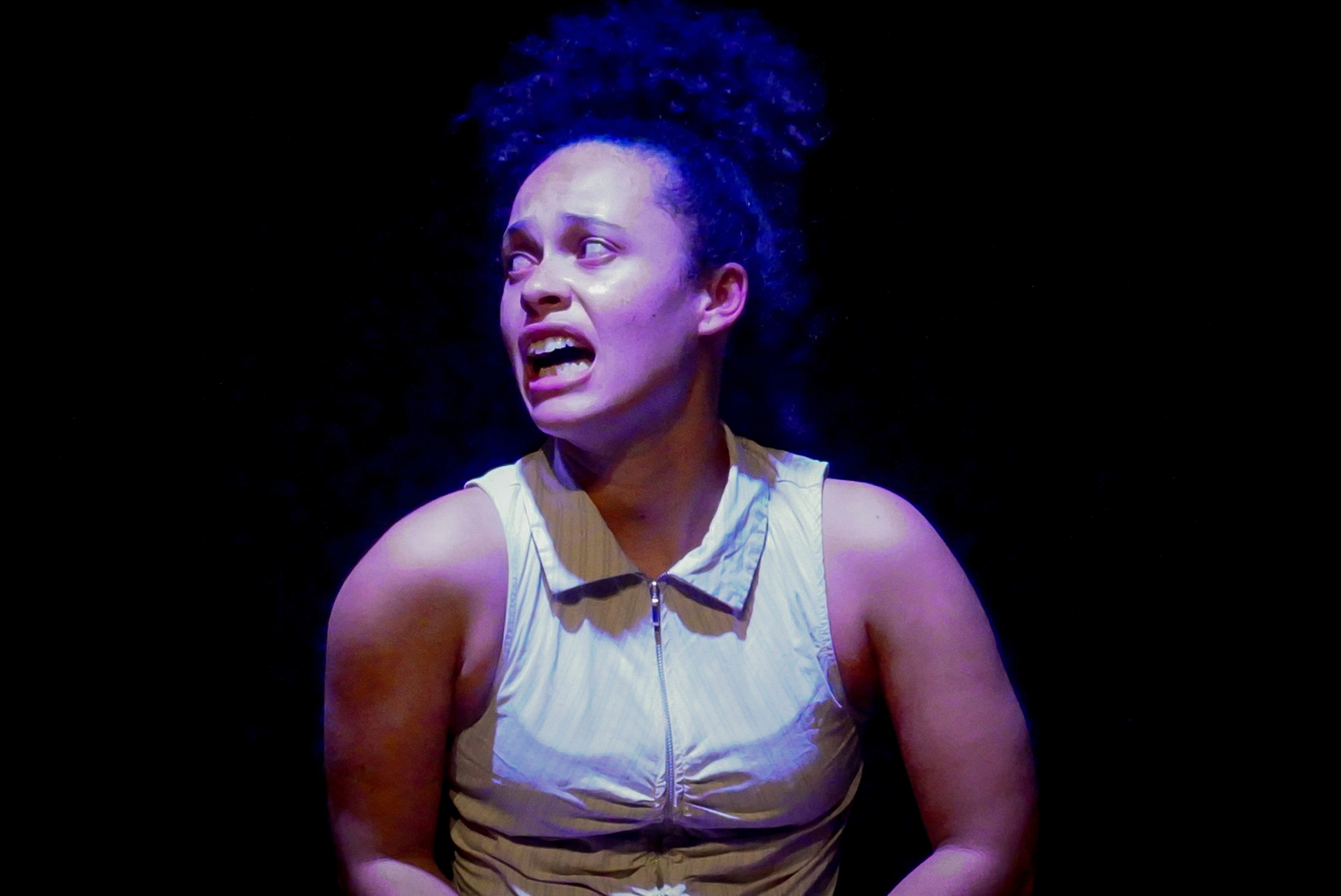
 Tshiamo Moretlwe in the one-woman show, Filled. (Photo: Shayne Joseph)
Tshiamo Moretlwe has one of those voices. There’s a clarity, a crispness, the way it sparkles.
It’s a voice that’s been honed over years of drama training and during performances on stage and in front of the camera. As an actor, Moretlwe knows how to wield that voice so that when she speaks you sit up and pay attention. She makes you want to keep listening, makes you curious about what she’s going to say next.
But Moretlwe has another voice, the voice of an activist. She not only wants you to pay attention, but to potentially change your perspective. That voice is expressed in her writing. Her latest play is a one-woman show called Filled, which she debuted at last year’s National Arts Festival and is at the Baxter this week for a short run.
Funny, off-beat, thoughtful and entertaining, Filled also takes no prisoners. It tackles in unexpected and inimitable ways Moretlwe’s beef with the epidemic of gender-based violence and the way in which the plague of abuse continues despite all that’s said.
She says violence against women is a disease she’s been aware of since she was a young girl.
Moretlwe remembers the moment, as a child, that she became aware of the sense of total helplessness and despair that so many women feel in the face of violence persistently perpetuated against them.
She recalls how, as a 13-year-old, it was a news report about a particularly horrific case that left her in tears, overwhelmed by the feeling that such violence not only happened, but was inevitable. “As a woman in South Africa, you can’t escape it, so it’s always in your psyche,” she says.
For years, she says hearing people talk about the statistics – that “one in three women get raped”, and that there’s an incident “every I-don’t-know-how-many seconds” – made her feel that she might be next.
“I hated feeling disempowered,” she says. “Feeling that I don’t have control of my life, that this thing is going to happen to me whether I like it or not.”
Having carried this feeling since she was a girl, she eventually made a conscious decision. “I decided, you know what? I’m in charge. I get to decide how I want things to be. I don’t have to accept the violence of this country as a fact. If I want to change things, I can.”
The play testifies to the fact that she is “not voiceless”, that she does in fact have “things to say”. Rather than speaking on behalf of the survivors of gender-based violence, she wants the play to help other women find their voice – help others reclaim their power.
She also wanted to make a play that deals not so much with the acts of explicit violence against women, but the aftermath of those acts. It examines the way survivors are treated after they’ve been through the physical horror of violence and sexual abuse: the victim-blaming and victim-shaming, the torrent of unsolicited advice, the awkward attempts to console, people unthinkingly saying “I know how you must feel”.
Never mind the implicit cruelty of being made to feel that they should perhaps share responsibility for what’s been done to them.
Moretlwe says she wanted to avoid the clichés and create a play that brings complexity into the conversation. “I want to complicate our ideas of what a survivor or a victim is, ask what it means if forgiveness isn’t on the cards, and explore what it means to want revenge against the perpetrators.”
She wanted to ask hard questions and at the same time humanise an issue that has in many ways been oversimplified in order to become a more palatable conversation for society.
“I want to make things complicated because sometimes the way we talk about gender-based violence is with quick, catchy phrases. But those slogans don’t always expose all the layers. Because the violence affects us in more ways than we know.”
Moretlwe says the spark for the play was an ancient San poem. “It’s about a woman who gets cut open and sewn back together again.”
In a sense, Filled situates in a modern context a woman who is figuratively torn apart and must contend with getting her life back on track.
“We often talk about the moment of violence,” Moretlwe says. “I was interested in discovering what happens next. There’s this awful incident, and then you have to get on with your life.
“But what do survivors encounter when they try to get on with their lives? What happens when we meet these people and say the wrong thing? And what does it mean to re-traumatise people? What comes next? We know women are getting hurt and abused – but then what?”
Moretlwe calls the play an allegory. “Rather than focusing explicitly on the subject, there’s a bit of an Animal Farm vibe,” she says.
She says her writing not only references other texts but borrows extensively from the real world. “It’s a collage of moments, from internet comments to witness statements, and it includes snatches stolen from actual conversations I’ve had. Sometimes people speak and my immediate thought is that it would be impossible to come up with something as insane as what just came out of their mouth.”
If the play is funny (which it is), it’s because so many ridiculous (and frankly unbelievable) things get said out loud – by real people in the real world. The comedy is unavoidable, because “if you turn the volume up on the crazy things that people say”, you’re struck by how genuinely absurd their ideas are.
She says humour also works to disarm the audience. “Laughter is a great tool for bringing people’s walls down, especially with issues that can feel polarising. Sometimes the only way to get through that wall and let people be open to hearing what needs to be heard is if you can laugh together.”
Apart from Moretlwe’s voice and her words on the page, the play uses elements of physical theatre and a form of puppetry in which objects, all made of paper, are imbued with life. Moretlwe also brings to life a cast of characters who interact with her protagonist who must face the inevitable gauntlet of “other people” after surviving an act of violence.
The play asks the audience to step into a surreal, heightened theatrical world that is quite different from our own. It’s from within this exaggerated reality that Moretlwe shows us that there’s something in our own world that urgently needs fixing. And that each of us has agency, and a voice that deserves to be heard. DM
Directed by Roshina Ratnam, Filled is on at the Baxter Studio in Cape Town from 17 to 21 November.
Comments
Scroll down to load comments...