



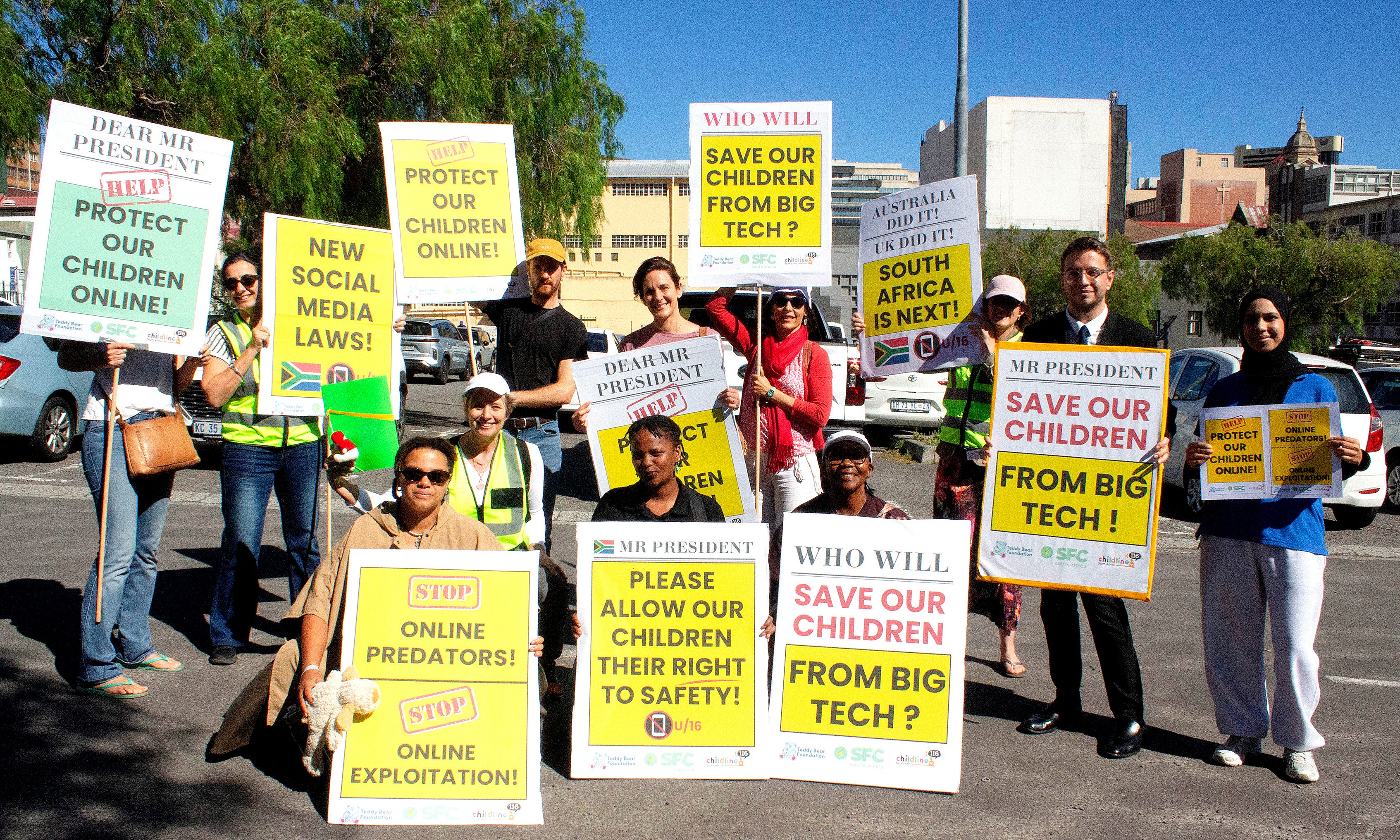
 Advocates from a coalition of child protection nonprofits, mental health bodies, researchers and legal experts gather on 16 November as they petition President Cyril Ramaphosa for urgent legislation to protect children from harmful online platforms. (Photo: Tamsin Metelerkamp)
A coalition of South African child protection nonprofits, mental health bodies, academic researchers and legal experts has petitioned President Cyril Ramaphosa to ban social media for children under the age of 16.
On Monday, 16 November, representatives of the movement went to the Union Buildings in Pretoria and Tuynhuys (the office of the President of South Africa) in Cape Town to deliver an open letter calling for urgent statutory intervention to safeguard children from social media and other harmful online platforms. The organisations involved were Smartphone Free Childhood SA, Childline South Africa and the Teddy Bear Foundation.

“Obviously, a social media ban for under-16s would be a big win, especially since there’s some examples from Australia and the UK. It’s not as if we are in completely uncharted waters,” said Nica Maree, co-founder of Smartphone Free Childhood SA.
“But our big awareness [drive] is to give parents, schools and caregivers support to delay access to smart devices, because children do not have the skills and tools to navigate that landscape. And if they do need to have access, it should be supervised and controlled.”

The open letter was also addressed to several ministers within Ramaphosa’s Cabinet, including Minister of Communications and Digital Technologies Solly Malatsi, Minister of Basic Education Siviwe Gwarube and Minister of Social Development Dina Pule.
Social media age bans
The letter cites the precedent for social media age bans set in other countries, including Australia, the UK and Indonesia. It argues that children and adolescents interact with commercial products engineered to maximise engagement, collect data and monetise attention, with global and South African psychiatric evidence confirming that excessive, passive and algorithm-driven screen use poses severe risks to child development.

The coalition has recommended leveraging the forthcoming Audio and Audiovisual Content Services and Online Safety Bill, alongside the Children’s Act framework, to enact mandatory, enforceable minimum age restrictions of 16 for account creation on algorithm-driven social media platforms.
Malatsi has spoken out against social media age bans, describing them as “unenforceable”. Instead, he has advocated combining mandatory device- or platform-linked age verification with a more holistic approach to digital literacy awareness among caregivers and schools.


However, Maree argued that there was value in making certain harmful activities, such as smoking or drinking, illegal for children, even if implementation of the law was not always perfect.
“I understand that [a social media age ban] must be quite a daunting and overwhelming thought. How do you police it? There are going to be some difficult situations, but surely because it is law, there will be some kids who gain from it,” she said.
“You can’t say, ‘It’s too hard to control the drug industry, so let’s just go with the flow.’ We are not so naive as to think it’s going to stop every kid having social media, but for sure a lot of children are going to gain from that. It’s not only for policing it physically, but also for getting the awareness out there. [If it’s illegal], then I think the severity of the problem will land.”
Christopher Gautschi, a lawyer from Biccari Bollo Mariano Inc representing the Teddy Bear Foundation at the march, noted that the foundation was established to assist children who had been sexually abused, providing medical assessments, preparation to be witnesses in criminal proceedings, and assistance with prevention or diversion of young offenders.
“It ties in very much with social media and the use of devices, because obviously, a lot of sexual predators are now online, and there need to be legislative measures in place that are going to prevent this [online abuse] from happening,” he said.

Harms of rapidly developing technologies
Apart from the demand for a social media age ban, the coalition has called on the Presidency, the Department of Communications and Digital Technologies (DCDT) and the Department of Basic Education (DBE) to take immediate, coordinated action to:
Form a national task team, including health, basic education, social development, the DCDT, the Information Regulator, the Film and Publication Board, civil society and clinical experts, to draft a comprehensive National Child Digital Wellbeing Framework.
Shift the legal burden of protection from parents and children onto the platform developers by mandating high-risk feature restrictions (off by default) for all minors under 18, including prohibition of targeted advertising, public discoverability, live-streaming to strangers, and addictive engagement loops.
Require social media and other harmful platforms to implement age-assurance systems compliant with the Protection of Personal Information Act that verify age without storing children’s biometric or personal data.
Formulate national DBE directives declaring schools smartphone-free zones during academic time, with reasonable accommodations for accessibility needs.
Puleng Stewart, a concerned parent, said she joined the march in Cape Town because she fears that South Africa has been too slow in legislating to address the harms of rapidly developing technologies.
“We’re not keeping up with the evidence base that’s coming out on how destructive this technology can be, specifically for children who are still developing their cognitive abilities,” she said.
“I think that there are extremely nefarious actors, specifically within big tech companies, that are undermining the long-term health of young people. I’m a mother of two boys, and I’m very scared of ... the media landscape that they’re going into.”

Another major issue is the troubling impact of social media access on children’s mental health, according to Shannon O’Brien, a clinical psychologist attending the march. Drawing on her experience of working with adolescents, students and adults, including parents, she noted that her biggest concern was the effect these platforms had on concentration and increases in mood disorders such as depression and anxiety.
“Self-harm, suicidal ideation, eating disorders are exacerbated through online social media platforms. And having two children myself, I’ve seen how difficult it is for them, even with the best of intentions, to regulate themselves when they’re enjoying what’s available on their devices,” she said.
O’Brien explained that many parents did not feel equipped to navigate the “addiction space” that came with online platforms, adding that regulation from a government perspective was an important ethical step to help them manage a “very different and difficult new world”.
Daily Maverick asked the Presidency and the Department of Communications and Digital Technologies for comment, but had not received a response by the time of publishing.

DBE comment
Terence Khala, spokesperson for the Department of Basic Education (DBE), said the department welcomed initiatives aimed at strengthening child safeguarding and protection on digital platforms.
“As a department, we have consistently advocated for stronger child protection measures, recognising that the rapid evolution of online platforms has outpaced existing regulatory safeguards, creating vulnerabilities that expose children to exploitation, abuse and harmful content,” he said.
Khala emphasised the work the department was doing to strengthen child protection mechanisms, including compliance with the National Register for Sex Offenders and the National Child Protection Register. However, he noted that the sector recognised these measures needed to be complemented by stronger regulatory protections within digital environments.
“The department therefore welcomes the proposed establishment of an interdepartmental task team and would actively participate in efforts to develop a coordinated national response to child online safety,” he said. DM

Comments
Scroll down to load comments...