


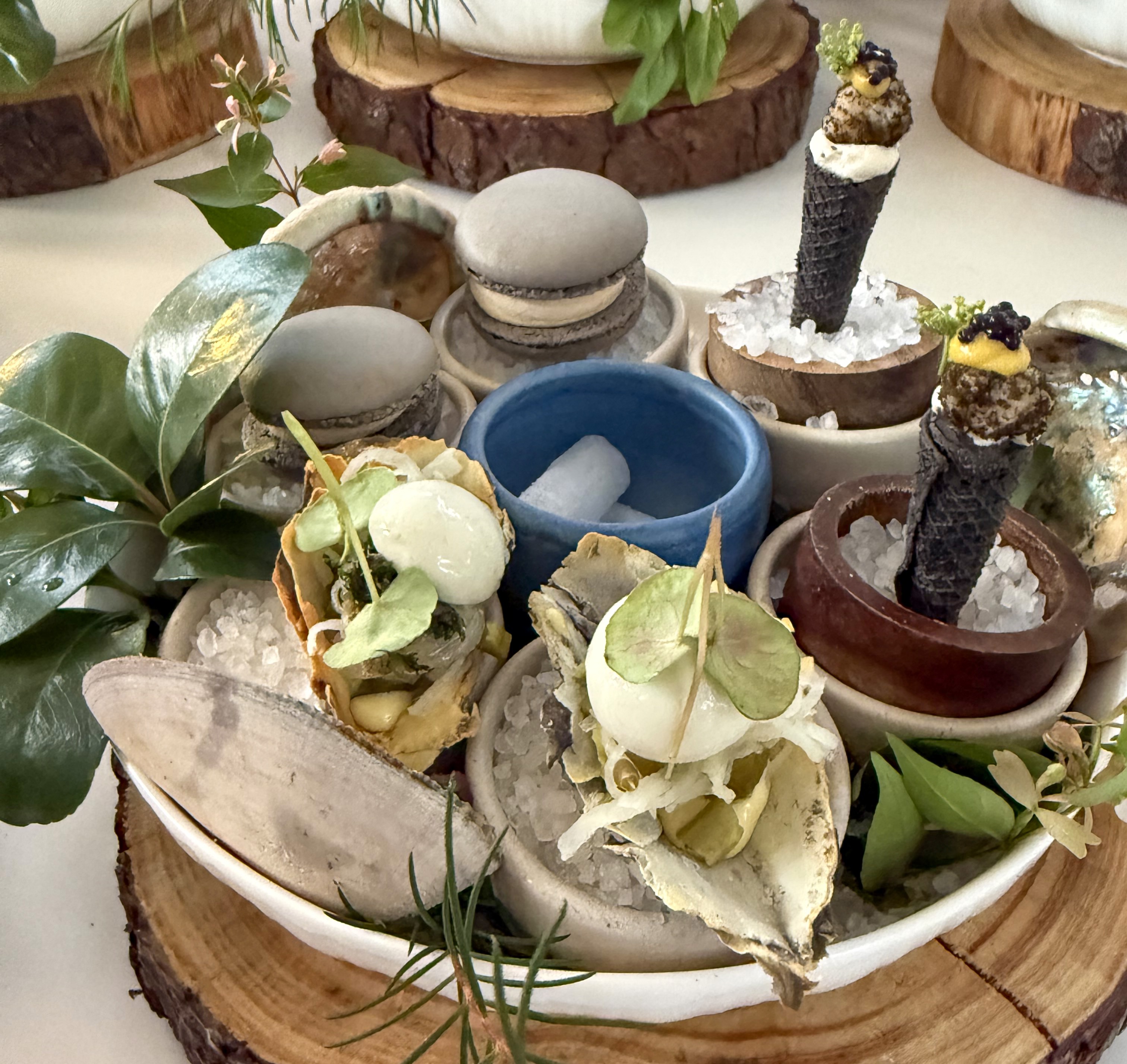
 The Confluence epicurean adventure began with three small bites: Knysna brown crab mousse with daikon radish and lemon-scented pelargonium sabayon; Cape rock oyster with honey buchu caviar, smoked wild garlic mayonnaise and coastal picklings; and a squid ink macaron filled with smoked snoek mousse and wild fennel. The trio was paired with Dalla Cia Bullicante NV, a pétillant Pinot Grigio. (Photo: Jan Ras)
The venue was the magnificent Palm House Boutique Hotel in Wynberg, Cape Town, where I’d been invited for an inaugural “epicurean extravaganza” that celebrated the confluence of land, sea, ingredients and palate.
There was some elegantly restrained plate envy going on at their De Tafel restaurant on Tuesday night. It wasn’t that there weren’t glorious morsels of all sorts of wondrous things on the menu I’d chosen – it had lobster in it, for one. It was just that having chosen all this… meant you had forsaken all that. And “all that” was going past your eyes and nose and on to other people’s tables.
But no matter. It isn’t every day that you get to taste the food of a chef of the calibre of Gregory Henderson, and I had never tasted his food before. Strangely, and with some odd coincidence, Henderson’s food reminded me in a way of the nuanced food of Durban’s Johannes Richter, who has also been on my radar this week (see my separate piece about his new venture at the Cape here.)
“Which menu would you like?” my colleague Nicole Williamson, Daily Maverick’s Webinars and Events Manager, had asked in a WhatsApp earlier:
Confluence: snoek, white mussels and rock lobster with waterblommetjie curry, or
Refugia: Karoo Lamb, West Coast springbok and buchu ice cream?
(There is a third menu at De Tafel, Botanica, but two were on offer.)
Oh come on. How is a Karoo boy now living within three sniffs of the sea supposed to choose between Karoo lamb and rock lobster? This was a new level of cruelty. But it was those two little words, “rock lobster”, that did it for me. And I do live at the coast now, and I have missed my seafood.
So Confluence it would be, “the meeting of waters, reimagined on your plate”. More fully, the Confluence menu is “shaped by confluence, where ocean, tide and freshwater meet and give life. Along the Cape coast, these shifting waters create ecosystems rich in movement, salinity and exchange.
“We work with traceable seafood and ocean-foraged ingredients, guided by the rhythms of current, season and shore.”
Those who know me will guess (correctly) there was a degree of eye-rolling going on at these descriptions (it was a good thing The Foodie’s Wife wasn’t there, she would have fled screaming into the night even before we’d tasted anything), but that does not mean I did not respect where chef Gregory, who is famed as “the Forage Chef”, is coming from. Just as I have enormous respect for Johannes Richter, I have very quickly, suddenly and unexpectedly come to respect the food of chef Gregory to pretty much the same degree. And Chef Johannes is South African Chef of the Year.
I’ll get back to the Confluence menu, but first let’s take a little skippety-hop onto that table over there, where some very posh people are being served Refugia, the name of the other menu. Okay, I did look it up: a refugia is “a geographical area, habitat, or microclimate that remains relatively unaltered by major environmental shifts – such as ice ages, droughts or global warming – allowing isolated or relict populations of plants and animals to survive.”
Or, as described on chef Gregory’s menu, it is “inspired by refugia, the places where life endures across South Africa’s nine biomes. From fynbos to savannah, each landscape shapes what grows, moves, and survives.
“We cook from these living systems, where game, fire and indigenous botanicals carry the memory of land and time. This is the taste of resilience, place and belonging. Enjoy your journey.”
What did I miss? An “Ancestral” starter, served in the garden, of denningvlies, venison dombolo, and a pressed quail terrine. I saw them and wanted them, but I also saw and wanted what I had from the Confluence menu in the garden – especially the exquisite squid ink and snoek macaron, strangely sweet, which seemed right (it’s a macaron), yet oddly savoury, inevitably. While eating this I caught the eye of winemaker supremo George Dalla Cia, who had brought his wines along to pair (yes, divinely) with the food, and our mutual eye-rolling (in a good way) made it obvious that our palates were enthralled with what had just gone down.
I think it was George (or maybe chef Gregory) who said: “South Africans love sweet and sour, don’t we?” Sure do. It was, to be more detailed, “Wild Settlers Fennel Macaron with Gerookte Snoek Mousse”. And suddenly there was a tongue in a cheek, and a little self-aware playfulness to offset all of the, you know, other words.
The other two garden morsels were a Cape rock oyster ingeniously served in a faux edible “oyster shell” which looked so much like the real thing you were sure it would crack your teeth, but instead provided a softly delicious crunch; and a Knysna brown crab mousse “lollipop” in a crunchy dark cone that made a decadent mouthful.
Sommelier Richard Gosa said of the Dalla Cia Bullicante sparkling Pinot Grigio that was paired with the trio of starters that it “draws them together but allows palate cleansing between bites”. I clinked glasses with George, whose Pane e Vino restaurant in an oddly industrial part of Stellenbosch serves some of the best Italian food at the Cape.
I cannot describe every last morsel, or you and I will still be sitting here this time next week, but let’s give it a go. I didn’t need to taste another morsel to know that Gregro Henderson was a chef to contend with, seriously. But I went inside anyway.
So follow me into the De Tafel dining room in this gorgeous Sir Herbert Baker homestead, and let’s sit at that table at the back there, with Dr Anna Trapido, colleague, friend and the current Galliova SA Food Writer of the Year, for company, along with an intensely charming man called Martin Pike, who headhunts for a living.
Anna played a role in this event, with RJ van Spaandonk, a very clever man who is the co-founder of Imagineers.ai and was our host along with Anna in what was the inaugural African Foodways epicurean extravaganza with Daily Maverick, Dalla Cia Wines (hence the suave George’s presence) and de Tafel restaurant at Palm House Boutique Hotel and Spa.
So, this is in part a Daily Maverick venture, and there will be more such events in future, which I will be sure to tell you about when they occur in the coming new year.
Anna, who is a chef and food anthropologist as well as a top-notch food author, had begun the evening out in the garden by explaining that African Foodways exists “to celebrate the ways in which South Africa’s deliciously abundant indigenous ingredients can make magic with our nation’s wonderful wines”.
Let’s skip straight past all the beautiful things going to other tables – and resist the urge to leap up and grab a taste of the kapokbos lamb fillet with ouma onder die kombers, burnt leek and Strandveld potato – to make our way through Anna’s very helpful and detailed descriptions of the fourth, fifth, sixth and seventh courses, bearing in mind that the first three had been served in the garden twilight.
All fish on the menu was sourced through ABALOBI, which is not a species of fish, as someone had suggested to Anna but a social enterprise that uses digital technology to connect small-scale fishers with restaurants and consumers. But we knew that.
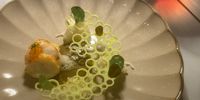
The East Coast rock lobster that had enticed me to the Confluence menu appeared on the next plate, alongside a pool of pond-green sauce and a pale green wafer resembling bubbling surf. The delicately spiced yet earthy sauce was made of pondweed and described as a waterblommetjie kerrie (curry), balanced by a lobster crème and with overconfident acidity provided by fermented Cape pondweed blossoms. The untamed acidity caught my throat three times, spoiling an otherwise delicious course. A sip or three more of Dalla Cia Pinot Noir 2019 was all the soothing I needed.
All along, we had been guided and entertained by a young restaurant manager with a knowledge of what went into every part of every dish so detailed that he is virtually a sommelier of food. His name is Nathan Meyer and we would all do well to remember it. Actual wine sommelier Richard Gosa is among the best I’ve encountered – and the standard of this profession in South Africa is high.
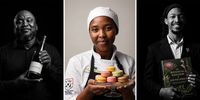
Of the pairing, Gosa said: “The Dalla Cia Pinot Noir brings cherry notes that are a great contrast to the curry spices but at the same time echo the lobster’s delicate sweetness. I am enjoying the way that the wine’s velvet texture complements the lobster crème while its acidity refreshes the palate. The gentle tannins allow the shellfish’s flavour to remain distinct, and the wine’s lightness suits the waterblommetjies’ subtle vegetal character.”
Next up was a white mussel pavé with strandspinasie (beach spinach), sugarbush nectar, Cape nori and wild fennel blossoms (wild fennel in its second appearance of the evening), paired with Dalla Cia Sauvignon Blanc 2025, and this was my favourite Dalla Cia wine of the night. I’ve paid scant attention to sauvignon blanc lately, having become very much a chenin sort of guy, but this one certainly got my palate’s attention. Luckily the sommelier (unasked) topped us up twice. Maybe he has “the sight”.
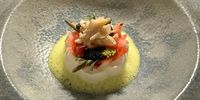
I loved this dish, perhaps skewed towards it by the overacidity of the previous one, but I noticed that Anna left half of hers untouched. I didn’t ask.
In her notes, which she kindly sent to participating diners the next day, Anna writes: “White mussel (Donax serra) is a Cape coastline surf clam rather than a true mussel. It is prized for its delicate, slightly sweet flesh. Strandspinasie (Tetragonia decumbens), an indigenous coastal plant with fleshy, salt-kissed leaves, contributes a mild spinach flavour, Cape nori seaweed adds sea salinity and fennel blossoms bring a delicate aniseed fragrance. Sugarbush (Protea repens), also called suikerbos, provides the floral sweetness of nectar and traditional bossiestroop. Here, that sweetness offsets the salt of the seaweed and shellfish, drawing the coastal and floral elements together.”
Sommelier Gosa described the Dalla Cia Sauvignon Blanc as having “great Cape gooseberry and ripe fig notes, mineral character, a crisp palate and a lovely long finish, without the aggressively grassy character of some Sauvignon Blancs. The mussel’s delicate sweetness finds an answering fruit flavour in this wine, while its acidity refreshes the palate after the pavé. Subtle herbal notes connect with the strandspinasie and fennel, completing the conversation between shore, fynbos and vineyard.”
All too true. I should have finished Anna’s for her.
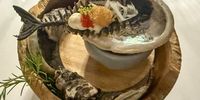
The sea bream that followed was embraced in a skeletal black fish spine described as an edible fishbone tuile, though we were warned not to bite into the abalone shell — which was an abalone shell. Sensible advice, after that oyster shell from the first course. The Cape bream was served with amasi dashi, potato layered with Ecklonia maxima and a bokkom crumble.
Yes, this is posh note of note, but with every bite of any part of any course, there was something real and simple, like these dried salted fish from the West Coast. And this is the point: I’ve been saying for years that our leading and most imaginative chefs should be working with the possibilities right under their noses – on the mountains, on the beaches, where sea meets land and where sky pours rain and sun down on a world of possibilities to help them grow. And here we have this chef that I have been looking for, to stand shoulder to shoulder with Kobus van der Merwe, Johannes Richter and a few others whose food I will find soon.
I did think, however, despite understanding that a multicourse menu requires small portions, that at least that bream fish course could have been a tiny bit more substantial.
Anna’s notes on the bream: “Delicate slightly sweet bream is energised by the acidity of amasi, southern Africa’s traditional cultured milk. Infused with a Japanese-inspired seaweed and seafood stock, the ferment brings beautiful savoury depth. Indigenous kelp (Ecklonia maxima) and bokkom (salted, dried mullet traditionally associated with the West Coast) add an intense umami buzz.”
It was paired with Dalla Cia Chardonnay 2022, of which Richard Gosa said, “For me, the pairing’s masterstroke is the amasi dashi: its cultured richness meets the wine’s lees-derived texture, while its acidity provides a refreshing contrast. Really exciting.”
He added: “Bokkom can be hard to pair because it is so powerful but here the crumble is sensibly small so there is a burst of concentrated salt and savoury depth to provide a counterpoint to the Chardonnay’s floral and honey notes, adding interest without overwhelming either the fish or the wine.”
And with that, he had undone my argument about size mattering in that fish course, and I’m happy to throw in the towel.
Just before grabbing an Uber home, with the clock ticking towards 11pm after a 6.30pm start, the dessert arrived in two parts: honeybush panna cotta with fynbos sponge, wildflower caviar and honeycomb; and honey-buchu crème glacée with bee pollen. Both were paired with H&G Fine & Rare Potstill Brandy, a heady hit of pleasure to think about during the Uber ride.
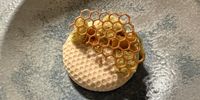
The modestly gorgeous dessert tasted as good as it looked. Like a pretty honey-hued brooch you’d want to pin to a fine blouse, but I ate it anyway. Softly creamy and airy, it dissolved in the mouth rather than needing to be bitten into, and not for the first time that evening, there was buchu, which had appeared in intriguing ways in several courses.
I liked the point that was made, if there’d been that intention on chef Gregory’s part: that this indigenous leaf, often thought too strong for delicate dishes, can be tamed to the point of obedience.
That is the mark of a great chef, right there. DM
Tony Jackman was the guest of Daily Maverick at this event.
Comments
Scroll down to load comments...