



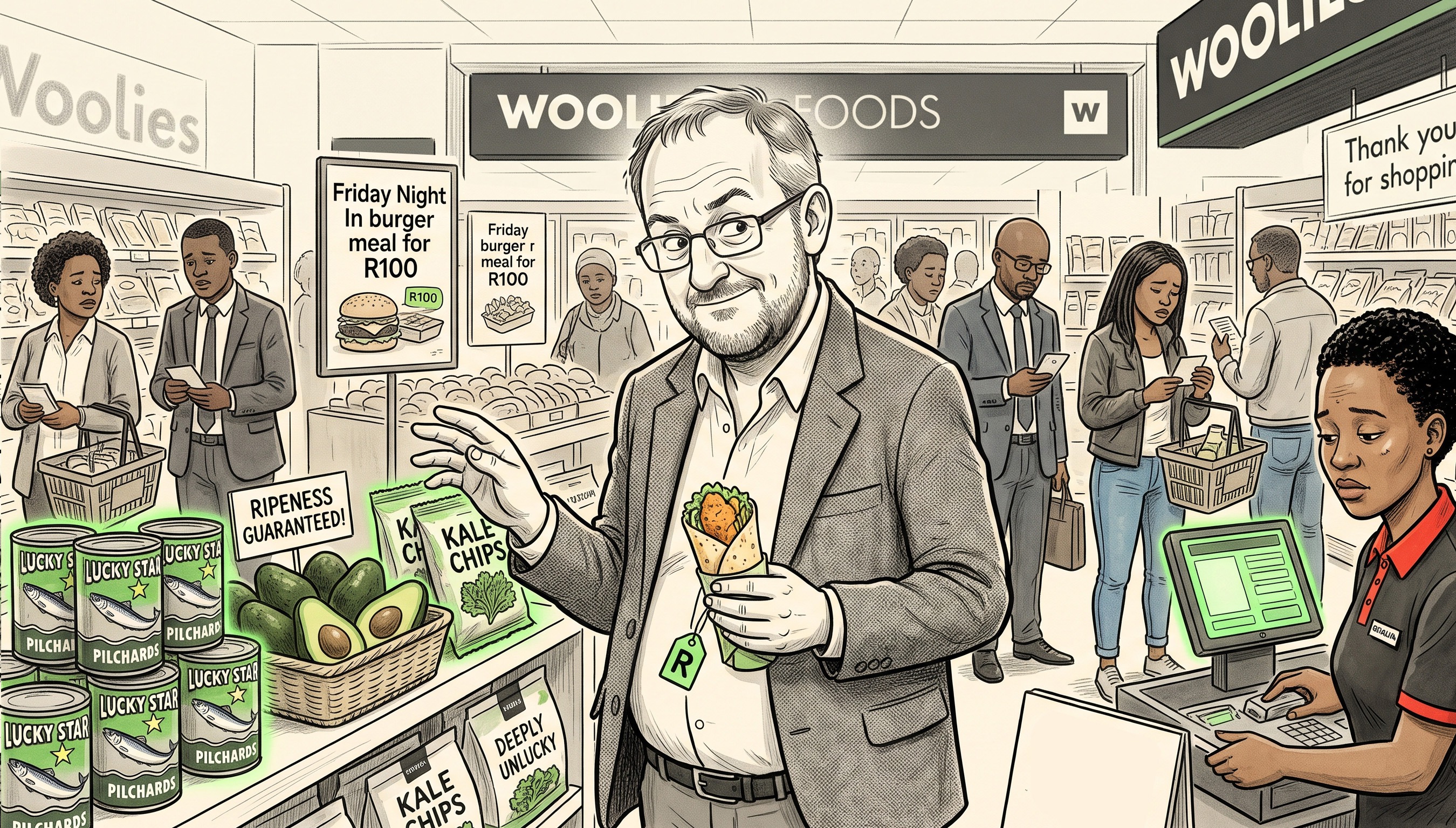
 Woolworths’ near-stagnant sales triggered a broad selloff in JSE consumer shares – an unusually direct market response to real economic data. | Illustrative image: (Generated with Google Gemini Flash Image 2.5)
It is not often in these turbulent times that a real life market update, actual data, affects markets to the extent that one did yesterday.
We have become accustomed to more mundane things moving markets, like a global AI CEO having an affair with an (alleged!) Chinese spy.
So, what happened yesterday was pretty incredible.
The JSE took a hit, while consumer shares across the board, whether they be in clothing or retail, were largely down, all because of one release.

Reliable barometer
It came from Woolies, that reliable barometer of the middle class.
It said its “group turnover and concession sales for the period grew marginally by 0.2% and 0.1%”.
I think for many people reading the release the real siren was the numbers from the food business.
It’s turnover and concession sales were up by just 1.9% and 0.1%
And thus was shaken one of the central tenets of many an investment thesis: that our middle class will continue to find the money to buy a lunchtime crispy chicken wrap at Woolies (with a side order, if you’re feeling rich, of kale chips).
Considering the decoupled era in which we live, where markets hardly ever really seem to bear any reflection on the economies which underlie them (look at how just a few companies are boosting the Nasdaq while beneath them many are struggling), it was a welcome reminder that economic gravity is actually a thing.
For a very long time, people like me, in columns like this [Business Maverick Editor’s comment: Not you, Stephen... the editor wouldn’t allow it] have been prattling on about high fuel prices and the impact they are having.
Now, in real life the facts and figures can be seen.
And what is happening to the numbers at Woolies is really just a dipstick reading from the luckiest group among us (although, if you are buying kale chips I think that must count as deeply unlucky…).
As the market commentator at Rand Swiss, Viv Govender, reminded me on The Money Show last night, people who are no longer shopping at Woolies are changing the food they buy for their children.
And when you do that, you really are feeling the financial pinch.
I have to say though, that while we consider Woolies a sort of vaguely upper-crust clientele, they have been competing very strongly in many sectors of the market.
Like Shoprite and Spar and the others, they’ve used everyday goods as loss leaders, trying to entice you back into their shop.
‘Friday Night In’
My favourite campaign was their “Friday Night In” option a couple of years ago.
It was a simple combination of burger patties, rolls and some garnish that promised to feed a family of four for about R100.
It would allow you to recreate the family burger experience without going out and spending a fortune.
I suspect that it was quite successful because I have a memory of the Spur CEO once telling me that they saw Woolies as one of their competitors. And that in fact all of the retailers with convenience offerings posed a threat to a diversified restaurant group.
They also moved in quite aggressively in what are generally considered “low-cost items”.
There was a lively social media discussion when they started stocking Lucky Star pilchards, generally considered one of the cheapest forms of protein.
All in all, I’m sure you will find that in some moments, they put up a very good fight on price compared with companies like Shoprite.
The problem is, that is not really their core business.
The core business of Woolworths Foods is to make more money from people who can afford it by competing with higher quality and better products [read: premiumisation].
There is virtually nothing you can buy at Woolies that you cannot buy somewhere else. You might have to work a lot harder to make the final crispy chicken wrap, but you can do it if you buy the ingredients somewhere else.
Where they do compete on value is when you buy something that you know will last for a specific period of time. If you’re buying one avo at Woolies you know that it will be ripe.
If you buy two somewhere else you may only be able to eat half of one of them for breakfast tomorrow.
In-store inflation
This is why their in-store inflation has been so much higher than the other chains for so long.
But it also reveals the vulnerability. When times are tough you can keep your children fed and healthy by going somewhere else.
This is the signal the market saw, and why clothing groups in particular were down so strongly yesterday.
For once, it seems to me, the market is fulfilling its function. It is telling us something that is important to know.
Just as those invested heavily in AI stocks find themselves in a position in which they absolutely need to know the innermost details of the private life of an unfaithful CEO, so we need to know the real impact of higher fuel prices.
None of it is pretty. But all of it is important. DM
Comments
Scroll down to load comments...