



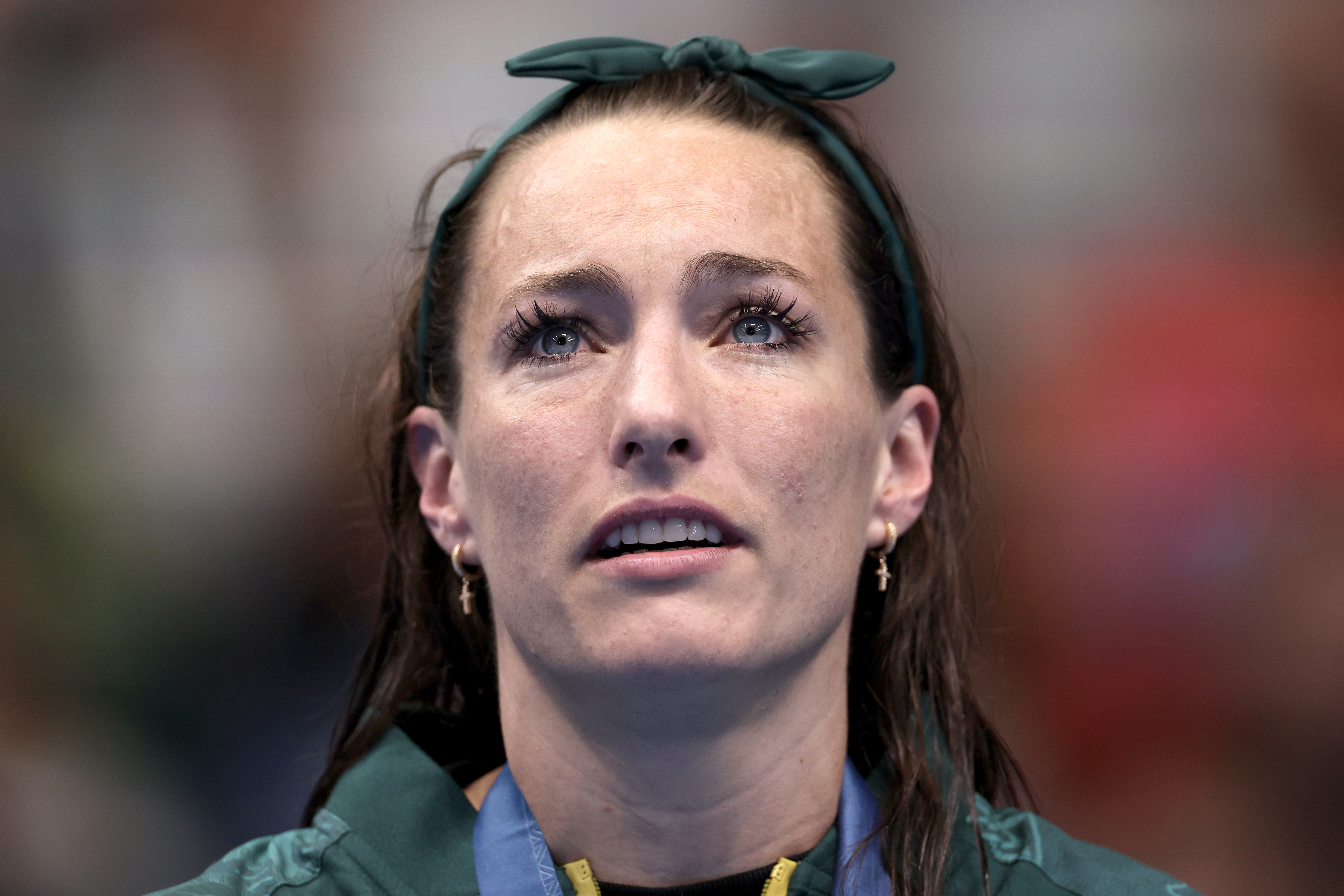
 Olympic champion Tatjana Smith tears up after claiming gold in the 100m breaststroke final at the 2024 Paris Olympic Games. Smith is now switching allegiances to represent the Netherlands. (Photo: Sarah Stier / Getty Images)
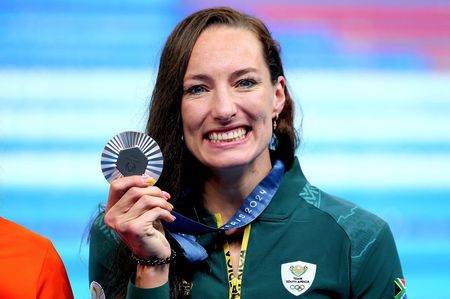
Swimming icon Tatjana Smith spent years in the pool making South Africans proud, standing on Olympic podiums and bringing home medals in the green and gold. Now, South Africa’s most decorated Olympian is switching allegiances and will represent the Netherlands.
The announcement, made on 10 November, is a big step towards breaking a culture of silence imposed on athletes. It comes at an important time for South African sport, with ongoing conversations around support and the financial demands placed on athletes.
Too often, athletes are expected to pay their way to international competition, while hearing about officials dipping their fingers into a federation’s coffers.
Athletes are expected to perform in spite of this and are chastised when they cannot.
Smith has recently been vocal about athlete welfare, challenging Swimming South Africa (SSA), the body governing aquatics in the country, over withheld prize money and limited commercial opportunities when competing.
Not safe
For Smith, representing the Netherlands was shaped by wanting to explore her Dutch heritage, she said, but more importantly, it would offer greater support and the opportunity to build a more sustainable swimming career.
“I chose South Africa at the beginning of my career because I wanted to prove what was possible, even when the system didn’t make it easy. And I did,” said Smith.
“But I also believe our athletes deserve a system that gives them an opportunity to thrive, not just survive.”

Daily Maverick first reported in August that Smith had issued SSA a letter of demand, seeking payment of interest allegedly retained after $35,000 in competition prize money was held for more than a year. SSA told her it was because she had competed in the wrong kit.
The money was paid more than a year later, around the time of the 2024 Paris Olympics. The interest it earned in the meantime was paid only after her lawyers demanded it and Daily Maverick reported on it.
Smith has said she still does not feel safe in her own federation.
And for every Tatjana Smith who has the clout, the legal resources and the means to choose a sporting nationality, dozens of South African athletes cannot afford to do the same.
Federations are there to do everything in their power to support athletes in fulfilling their potential, and athletes should have the power to stand up if that is not happening.
At the same time, a developing athlete does not want to risk losing funding or the support of their federation. They may know something is wrong, but speaking out could jeopardise the career they have spent years building.
That is precisely why a culture of silence is so damaging and why Smith’s decision is so significant in breaking the pattern.
The rules dictating the silence
This becomes particularly pertinent as South Africa’s swimmers prepare for the World Aquatics Swimming Championships (short-course, 25m) in Beijing from 1 to 6 December.
The 21 selected swimmers are expected to pay roughly R55,000 towards the cost of competing.
It is no secret that athletes must pay their way to international events. The national men’s and women’s hockey teams were expected to pay more than R65,000 to compete at the World Cup – that is before Sport, Arts and Culture minister Gayton McKenzie stepped in – and artistic swimmers selected to compete at the Junior Artistic Swimming Championships, facing a bill of R120,000 each, are just some other examples.
What raised concerns for the upcoming Beijing competition was the 10-page ‘Athlete and Team Official Agreement’, seen by Daily Maverick, which places restrictions on what athletes can say publicly and must be signed as a condition of selection.
The terms set out in the code of conduct bar swimmers from making public criticism or statements “designed to have a prejudicial effect on the interests of SSA”, the organisers, the competition, the team or any of its members.
A separate clause allows swimmers to speak to the media about their own prospects and performance, but clearly states that athletes “shall not pass any comments whatsoever” about SSA or the performance of any teammate or competitor.
Every provision of the agreement is “deemed to be material”, meaning SSA treats any breach as serious, states the document.
Expulsion threat
Consequently, should an athlete breach the terms, SSA may expel a swimmer from the team, send them home, bar them from competing, or demand the return of benefits, which include team kit, massage and physiotherapy treatment and PR advice, to name a few.
The agreement should not be treated in isolation. SSA’s constitution also contains provisions that appear designed to discourage athletes and members from speaking out.
Sections 14.2 and 14.3 state that taking internal disputes outside SSA’s jurisdiction by resorting to the media constitutes misconduct. It allows SSA to suspend members who take the legal route, without first following its internal dispute-resolution process.
Brett Redelinghuys, a former member of an SSA technical committee for water polo, was banned by SSA in 2022 for attempting to undermine SSA and bring the organisation into disrepute following his efforts to set up an independent body (WaterPolo4Change) to run water polo separately from SSA.
This is not to say that federations can’t expect athletes to behave professionally and respect team rules and be held to account if they don’t. That is not the issue. The issue is when those expectations are used to prevent legitimate scrutiny and accountability.
Other athletes who paid the price
The agreement does contain safeguards, stating that should athletes be found in breach of the contract, they must be informed within a “reasonable” time frame of the date and time of a hearing so as to give the athlete a chance to make their case. However, no detail is given as to what a reasonable notice may be.
However, following the very public dispute between SSA and artistic swimming pair Jessica Hayes-Hill and Laura Strugnell, one may be inclined to proceed with caution.
In 2024, they appealed against a decision after they were sanctioned, withdrawn and sent home from the World Championships in Doha, which they argue cost them a place at the 2024 Paris Olympics and subsequent financial losses.
A day before they were set to participate, they were called to a disciplinary hearing and charged with “deceitful actioning of training protocol without management approval”. However, both said they had been unaware of why they were called into the disciplinary hearing, meaning that they could not prepare a defence.
They subsequently won the appeal, with the finding that the process was not procedurally and substantively fair.

The experience of Olympic javelin silver medallist Sunette Viljoen shows that the culture of silence permeates not only the SSA.
In 2015, Viljoen publicly criticised Sascoc’s treatment of athletes in its Operation Excellence programme. She was subsequently labelled ungrateful and faced threats that her funding contract could be terminated.
In soccer, there are several instances of Bafana Bafana and Banyana Banyana not being paid. Players will often voice their concerns to Daily Maverick, but on condition of anonymity for fear of repercussions.
The result is a culture in which athletes may feel they have more to lose by speaking out than by remaining silent.
The minister responds
Smith’s announcement is her taking a stand; she has rocked the boat.
It invited public discourse, with many taking to social media to express feelings of sadness but also anger, calling out the ineptitude of the government and SSA.
In response, McKenzie issued his own statement in which he argued that national federations were independent of government, governed by their own boards and accountable to their international bodies. He argued the department could not take responsibility for all the costs of international competition.
“It is regrettable that some people have used a deeply personal decision by one of South Africa’s most loved athletes to attack the Minister. Tatjana’s choice belongs to her, and it should not be turned into a political weapon,” he said.
“The public needs to understand how sport is run in South Africa. National federations are deliberately independent of government. They are governed by their own boards and answer to their international bodies. Where the Department funds a federation, the federation must account for that money.”
McKenzie acknowledged the problems at SSA, including concerns raised by athletes, and said these were being addressed through a reform process with World Aquatics oversight.

There is a distinction, however, between government not running federations and government having a responsibility to ensure that public funding is accompanied by appropriate governance and accountability.
The department may not run SSA, but it does help fund it, and should bear some responsibility to ensure public money is spent appropriately.
Lest we remind the minister of his comments when the hockey teams had to fund their way to the World Cup:
“It cannot be right that athletes who have earned that place on the world stage through years of sacrifice are then asked to fund their own participation. Representing your country is a national honour and a national responsibility. It should never be a personal financial burden,” said McKenzie.
Whether it is ensuring athletes have sufficient financial support or a platform to voice their concerns without fear of repercussions, if South Africa wants to retain its best sporting talent, it must give those athletes reason to believe they can build successful careers here, sans fear. DM
Comments
Scroll down to load comments...