



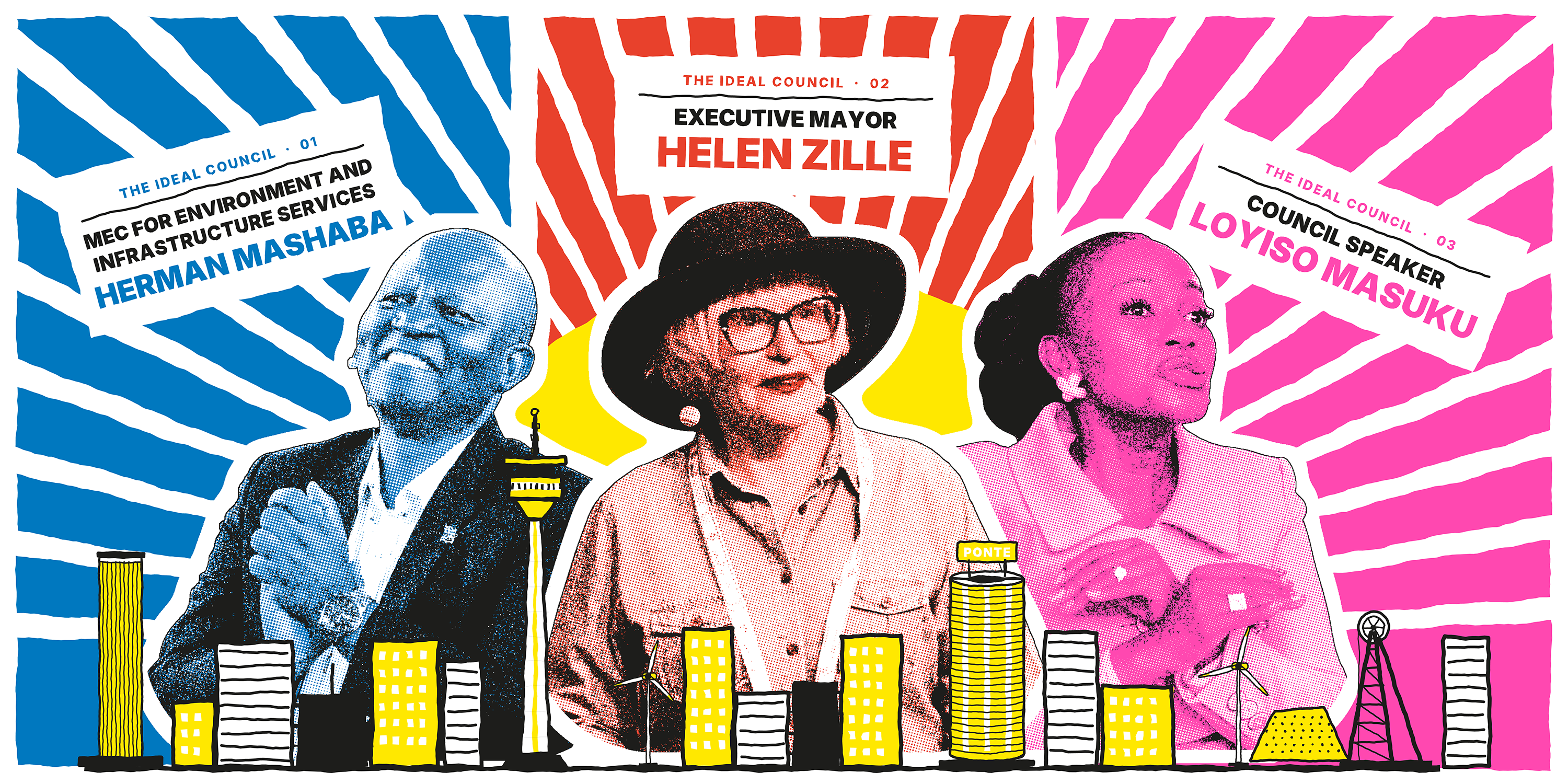
 Herman Mashaba. (Photo: Fani Mahuntsi/Gallo Images) | Helen Zille. (Photo: Felix Dlangamandla) | Loyiso Masuku. (Photo: Felix Dlangamandla) (Illustration: Kevin Momberg)
As political leaders bicker and early signs point to a largely stay-the-same coalition government for Johannesburg, the city grid is exploding. Both the Garden City Clinic and the SABC, along with more than 20,000 residents, have been affected by serial fires at the Mayfair/Brixton substation, while Alexandra was also without power. The facilities have alternative electricity systems to keep essential services running, but are still hobbled.
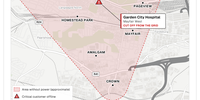
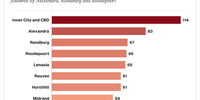
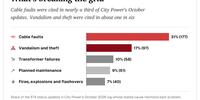
This is the backdrop to City coalition negotiations characterised by heat not light, by ego not service, if initial social media posts are anything to go by. The charts show 574 incidents of outages across the city in October, and the substation fire affecting the expanded Ward 58 and environs could see a prolonged outage. A major blaze early on Sunday morning (8 November) heavily damaged seven cables, a transformer and vital electrical panels.
Alexandra has the highest total number of blackouts, followed by Randburg. The sprawling Alex, with an estimated 179,000 residents, has seven wards, with one controlled by the DA and one by the IFP. The ANC kept control in the other five wards, but with, on average, declines of 20 percentage points from the 2021 election.
The reason for the high number of outages is that Joburg’s electricity grid is in a death spiral and has been for years. This must be Item 1 of any incoming administration, which has two weeks to complete coalition talks.
The Joburg Crisis Alliance (JCA), an umbrella alliance of 57 residents and peoples’ associations, warned political parties negotiating Johannesburg’s next coalition government to respect voters’ choices rather than trade positions for political power.
“The people of Johannesburg have spoken,” the alliance said on Wednesday, 11 November. The JCA says support for the largest parties “cannot be disregarded”. Smaller parties also have legitimate representation, but coalition arrangements must reflect proportional voter support rather than give minor parties disproportionate influence, it said.
A people’s choice-led coalition
We’ve designed what a people’s choice-led coalition might look like if political leaders paid obeisance to pure democratic principles.
In such a case, the DA’s Helen Zille would become mayor – she received the highest number of votes and proved her mettle as mayor in Cape Town.
ActionSA leader Herman Mashaba, an excellent business leader and now one of South Africa’s popular politicians, could stamp his authority on the City by choosing to become the member of the mayoral council for environment and infrastructure services. If he fixes City Power, Johannesburg Water and Pikitup in South Africa’s largest city, that would set Mashaba on a path to compete to be president in 2029 when the next national election will be held.
Johannesburg still accounts for 18% of South Africa’s GDP, six million people call the city home, and it remains a leading African metropolis. Mashaba would have to add Transport to the portfolio, as this is also a troubled directorate that has failed to manage public or commuter transport in the city.
At the ANC’s current trajectory and with its internal reform strategy (called the renewal plan) withering, it is unlikely that the next national leader will come from that party.
If Mashaba can quickly make a difference in the City and leaves the hard coalition negotiation to Zille (for whom a single term is likely – she would not want to leave her family for longer than that), it could work.
A confidence-and-supply coalition hasn’t been tried, but could work for the ANC. This is an arrangement in which one party takes the legislative arm of council as Speaker while the other takes the chains – the mayoralty. It’s a balance-of-power coalition.
The ANC’s Johannesburg regional secretary, Loyiso Masuku, could become Speaker of the Johannesburg Council, a position of some influence and power and which has been wasted on Margaret Arnolds’ tiny African Independent Congress (AIC). This kind of arrangement would be a meaningful reflection of how Johannesburg’s voters chose.

“The election results belong to the people of Johannesburg, not to political parties or individual leaders,” said the JCA. The alliance wants coalition negotiations to prioritise ethical leadership, financial accountability and reliable basic services. Its pre-election Residents’ Call should inform the incoming administration’s programme.
It also demands that the final coalition agreement be made public, including governance arrangements, policy commitments and accountability mechanisms. The JCA welcomed increased voter participation, with turnout rising from 42.1% in 2021 to 52.8% in 2026, as evidence of renewed democratic engagement. It pledged to monitor the new council and activate its “Follow The Money” campaign from day one. (To join the JCA or read the Residents’ Call, see here.)
‘Things have gone backward’
To understand local democracy, I spend time going back to where I grew up in Newclare and its environs of Bosmont, Westbury and Coronationville. Ahead of the elections, we traced the same path Daily Maverick reported on in 2021 ahead of the local government elections. Five years later, the people said it best when they repeatedly said: “Things have gone backward.” Johannesburg needs a reformist government, not more of the same.
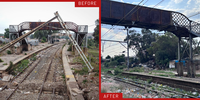
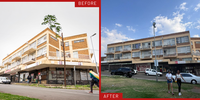
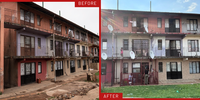
The before and after images we’ve chosen below tell a story.
Off the rails
The Newclare station was part of a working-class line that commuters used to get from the group areas to the CBD. Always segregated, always a little rough, but it worked as a cheap means of transport. Come State Capture and the trains stopped running. Now the trains run again, but the station is an absolute pit. The day we visited in October was before the Pikitup strike, so this is how it usually looks.
An unchanged urban context
The La Fiesta flats in Newclare are where I grew up. The surrounds have not changed since we moved out decades ago, and the photographs are from 2021 and 2025. The butcher Rashid Asvat showed us where two bullets had recently ricocheted in through a window and fanlight. Gangs control the nights, and drugs are the biggest economy. Asvat said that when he cuts bones to give to people, the queue is long. But generally, business is quiet as most people can’t afford meat.
Resident Shahid Mohamed showed us a nearby water leak that hadn’t been fixed for months despite repeated calls to the Patriotic Alliance councillor and Joburg Water. A sewage leak had been repaired the day before, but the street hadn’t been cleaned and was stinking.
A Wendy house and a toilet as a home
When a block of flats burnt down years ago, the council provided these Wendy houses as temporary accommodation. Temporary became permanent. The woman who spoke to us did not give us her name but said they collect water from the council flats, with electricity supplied by a temporary mini-substation. Children played too near to it for safety. Promised social housing in Fleurhof, a respectable community near Florida, had not materialised. Five years ago, the temporary accommodation had just been put up. We spoke to homeless men living in these temporary toilets, their clothes serving as bedding.

This is the council flat where my gran lived
The municipal flats in many areas are often the only form of social housing. Like this one, many haven’t been maintained. Successive council administrations have not regularly painted, repaired or in any way enhanced the flats or improved the urban context to avoid the everyday violence about which most people have a story. We met Keisha Abraham, who has been living here for 24 years. Asked what had changed, she said: “Absolutely nothing. Everything’s the same. There [are] no parks for our kids. You can’t be outside after eight [at night].” She said the council had painted some blocks of flats but not all. She said they wanted to speak to the councillor about public works (local public employment).
A cemetery called home
Since 1998, I’ve been reporting how homeless people live in cemeteries in Joburg. In 2021, we reported about a family living in the Brixton cemetery. They had left this time around, but we still found evidence of people coming in off the streets to find a grave to bed down on. Brixton is much improved thanks to the work of the Friends of Johannesburg Cemeteries, an affiliate of the Johannesburg Crisis Alliance.
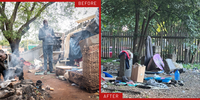
I went back on this long-term reporting route on election day, 4 November, and what struck me at all the voting stations we visited is how invested people still are in the processes of democracy. In our reporting ahead of the election, everyone we spoke to still intended to vote – except the guy who lives in the toilet, who was out of it and couldn’t really answer. Turnout in Johannesburg was higher than in previous years.
In an exit poll on voting day, the Human Sciences Research Council (HSRC) found that 59% of those surveyed believed their vote would make a difference (down from 61% in 2024), while 38% said it was their responsibility to vote (down from 40% in 2024).
An HSRC survey from earlier in 2026 found that trust in democracy was down among the general population (not only those who went out and voted), while there was growing support for “non-democratic” alternatives, such as strongman political leaders. DM
Comments
Scroll down to load comments...