


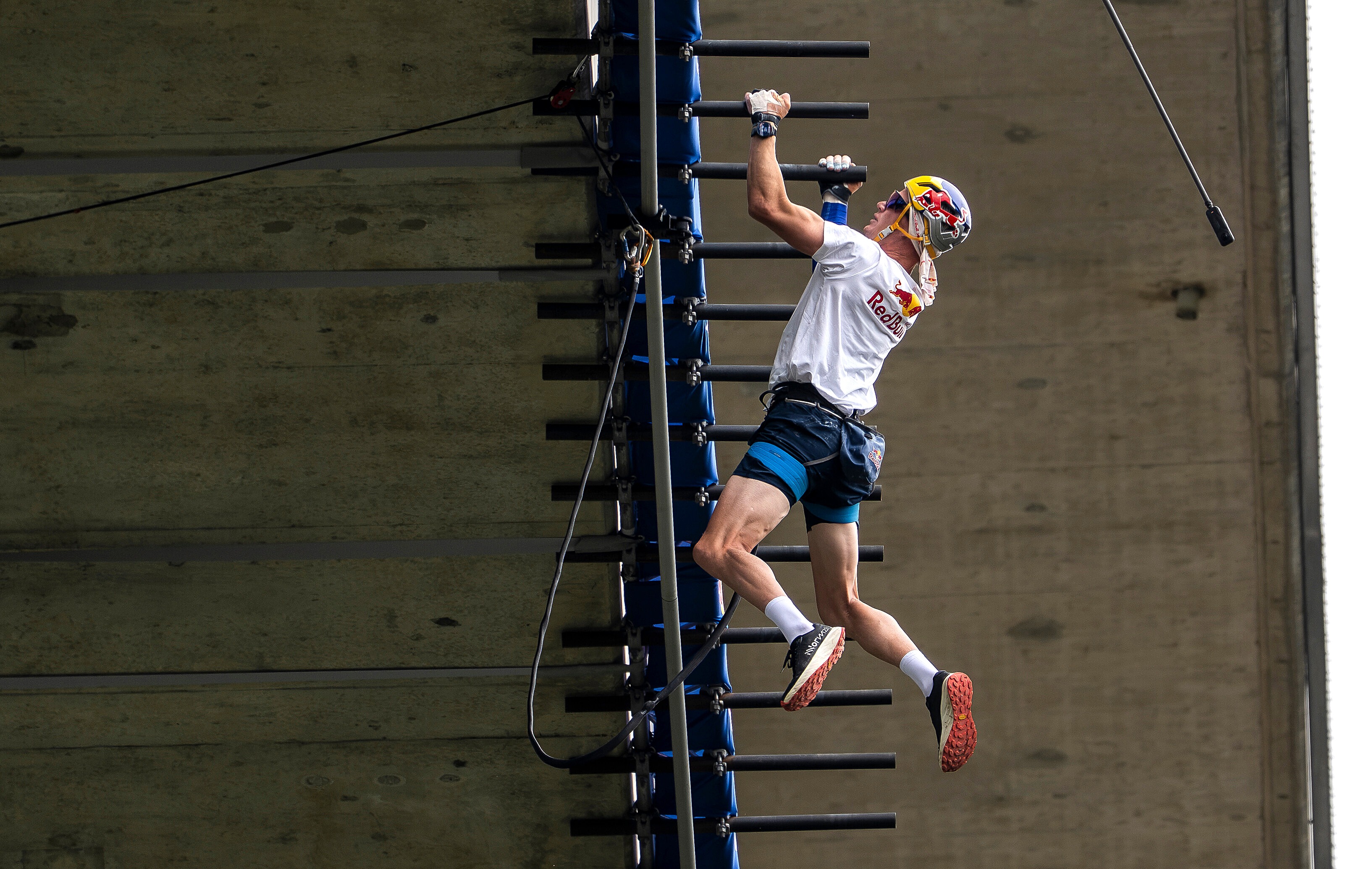
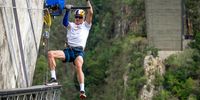
 Thomas van Tonder takes on the Bloukrans Bridge in the Western Cape via monkey bars on 26 October 2026. (Photo: Joerg Mitter / Red Bull Content Pool)
South Africa’s Thomas van Tonder has always been a sporty and active human being, participating in different activities. But by his own words, he was never particularly good at any individual sport, even though he has a black belt in kickboxing and was an avid cyclist before switching his focus to the obstacle course racing (OCR) discipline.
“Why OCR? The biggest reason is that I’m really, really good at it. I wasn’t really good at anything else. I was relatively good at a bunch of things. But I have this natural ability to be really good at taking on obstacles,” Van Tonder told Daily Maverick.
“If we are just running, people will beat me. If we just do power things, people will beat me. But if you combine these into one single discipline, I’m really good at it,” he said.
OCR combines a number of disciplines, similar to the decathlon. However, unlike its Olympic Games counterpart, it is mostly done on rugged terrain and not the structured infrastructure that hosts the decathlon.
Bloukrans Bridge monkey challenge
For example, Van Tonder recently completed a mind-boggling individual challenge. The 34-year-old daredevil crossed more than 600 monkey bars suspended beneath the arch of the Bloukrans Bridge in the Western Cape. It is Africa’s highest bridge, at 216m above the Bloukrans River gorge.
Rather than crossing a straight run of horizontal bars, the Hartbeespoort-raised OCR star followed the natural arch of the bridge. This meant he had to take on the bridge’s uphill arch, cross its flat crown and then descend the far side.
A straight line across the top of the bridge was a possibility and would have led to a much easier crossing. But Van Tonder chose the more difficult option to challenge his mental and physical capabilities. When he succeeded in his mission on 26 October, he became the first human to achieve the feat.
“The whole experience was very intense and very rewarding. The whole project was more than a year of planning to just figure out how to do it. But that in itself was a major challenge; getting the right people involved, solving problems that no one has ever had to solve before,” he said.
“And then physically and sportingly, this feat is a result of the last 10 to 12 years of my dedicated focus in the obstacle racing world. It’s really a combination of a decade of work and dreams that’s come together to make this a reality. So it’s been quite an emotional journey,” the father of three added.
“Every time I would get nervous about all of this, the way that I would ease my mind is by thinking about all the preparation that we’ve done and the immense detail at which we have planned the whole attempt, down to the sizes of the bars and the spacing and the safety systems. So I found a bit of mental composure through that.”
OCR experience was key
Van Tonder is a veteran of six OCR World Championships, finishing inside the top 10 in five of them. In 2019, he won the 100m world title and finished second in the 3km, before returning to the podium with bronze in the 3km in 2024.
In South Africa, he has claimed more than 20 Warrior Race Black Ops Elite victories and the national titles in 2016 and 2018. He also won the Red Bull Rancher Strong race in both 2025 and 2026.
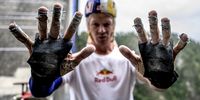
In November 2020 he set a Guinness World Record for the fastest 50m rope climb, reaching the 50m mark between Johannesburg’s Soweto Towers in 3 minutes and 19.68 seconds. That achievement combined the grip strength and endurance developed through years of OCR competition with the kind of standalone challenges that have become part of his career.
Bridge to success
Nevertheless, when battling the Bloukrans Bridge, Van Tonder found himself suffering mentally after coming in extremely confident due to his past achievements.
“The bridge looked like an infinite railroad of monkey bars. It’s really hard to describe how big that bridge is,” he explained.
“So, the mental approach there was focusing on the possible positives, not thinking about everything that can go wrong, but rather trying to focus on everything that can go right. If you start thinking about negativity then it’s more bound to happen because you’re spending time thinking about it the whole time.
“About a quarter of the way in there was a realisation that this is going to be significantly harder than I imagined it would be. So, there was definitely a moment of, ‘I knew this was going to be hard, and I prepared for it to be hard’. But it ended up being way harder than I ever prepared for.”
On why he puts himself through such gruelling physical challenges to begin with, Van Tonder told this publication that it is to inspire the next person to believe in themselves. More importantly though, it is to inspire his children to never stop chasing their dreams.
“It’s really nice to be able to do something that in the future my kids can look back on and hopefully pull some inspiration from. I reckon that’s probably a huge part of my motivation for doing these kinds of things,” he said.
“I like to say that ‘kids don’t do what you say, they do what you do’. If they can watch me do things that are really hard, hopefully in the future it will give them encouragement to do something that’s hard and not feel too intimidated by it,” Van Tonder added.
“We were literally swinging on monkey bars underneath a bridge. That’s as weird as it gets. So, whatever a person’s dream might be out there, they must feel confident enough to chase it. Even if it doesn’t make sense to other people.” DM
Comments
Scroll down to load comments...