



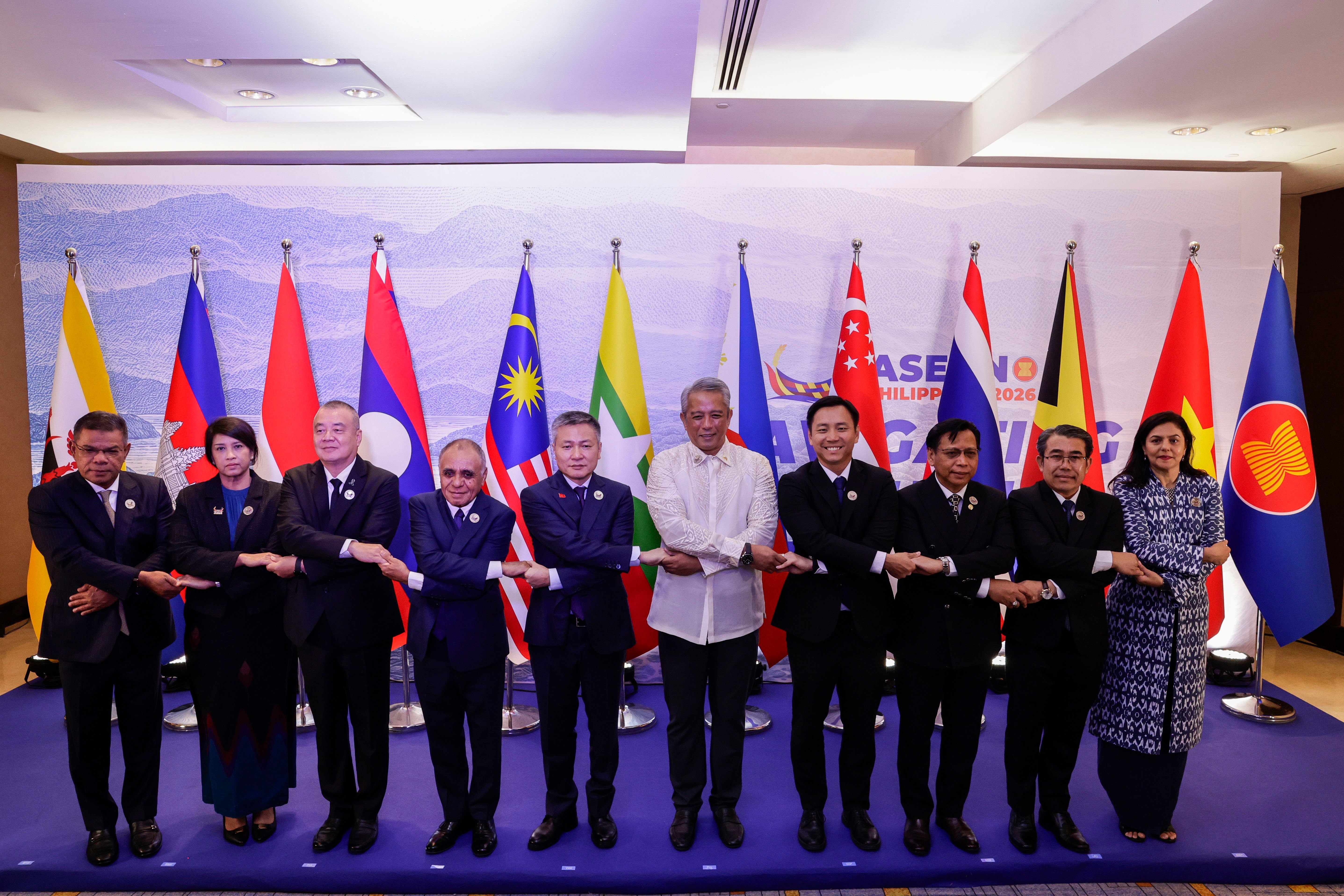
 (L-R) Malaysia Home Minister Saifuddin Saifuddin Nasution bin Ismail, Myanmar Ambassador to the Philippines Ei Ei Tin, Royal Thailand Police Assistant Commissioner-General Ittipol Ittisarnronnachai, Timor Leste Interior Minister Francisco da Costa Guterres, Vietnam's Deputy Minister of Public Security Senior Lieutenant General Nguyen Ngoc Lam, Philippines Department of Interior and Local Government (DILG) Secretary Juanito Remulla, Singapore Home Affairs Senior Minister Goh Pei Ming, Brunei Security and Law Minister Dato Seri Setia Awang Haji Sufian bin Haji Sabtu, Lao Vice Minister of Public Security Major General Kongsavat Bounlieng, and ASEAN Deputy Secretary General Dato Astanah Abdul Aziz pose for pictures during the 20th Association of Southeast Asian Nations (ASEAN) Ministerial Meeting on Transnational Crime (AMMTC) and Related Meetings at the Fairmont Hotel in Makati City, Metro Manila, Philippines, 20 October 2026. EPA/ROLEX DELA PENA
The US State Department outlined a plan to expand influence and potentially gain access to Myanmar's rare-earth deposits in a strategy document released last week, after months of secretive talks with Myanmar officials.
"Ultimately, the United States should treat Myanmar as a critical minerals priority, not simply a diplomatic challenge," Washington lobbying firm DCI Group said in a newsletter on Monday published on behalf of Myanmar's information ministry.
"Minerals are the natural place for this deepening relationship to grow, since they connect Myanmar's economic potential to U.S. national security and supply-chain priorities."
The US State Department did not immediately respond to a Reuters request for comment.
ONE OF THE MAIN SOURCES OF HEAVY RARE EARTHS
Myanmar, engulfed in civil war triggered by a military coup in 2021, is one of the world's main sources of heavy rare earths, most exported to China to be turned into magnets used in electric vehicles, wind turbines and other high-tech items.
China, which turns out about 90% of the world's rare earth magnets, partly relying on raw material shipped in from Myanmar, has recently tightened state control of the sector.
But Myanmar's main rare earths production sites in the northern region of Kachin are controlled by the Kachin Independence Army, a long-standing rebel group fighting the Myanmar military that has the backing of Beijing.
Since the 2021 coup, Washington froze Myanmar's assets at the Federal Reserve Bank of New York and imposed sanctions in a bid to isolate its generals, until it reversed course by holding direct talks in September.
WASHINGTON'S NEW STRATEGY
Washington's new strategy aims to secure "at least three major commercial or investment deals valued above $5 million each" for US companies. But Myanmar's government is asking for more.
"That is modest, given Myanmar's mineral resources and America's stated ambition to compete with China," DCI Group said in its newsletter, after Myanmar roped in the lobbying firm last year to help rebuild US ties.
"China has already spent years building its position in Myanmar's resource sector, and its companies and intermediaries hold advantages that will not be easily displaced."
China's foreign ministry and the Myanmar military-led government did not immediately respond to Reuters requests for comment.
President Donald Trump has made rare earths a national security priority since returning to office, pouring billions of dollars into a clutch of companies in a bid to loosen China's grip.
(Reporting by Panu Wongcha-um and Devjyot Ghoshal in BANGKOK; Additional reporting by Simon Lewis in WASHINGTON; Editing by Clarence Fernandez)
Comments
Scroll down to load comments...