


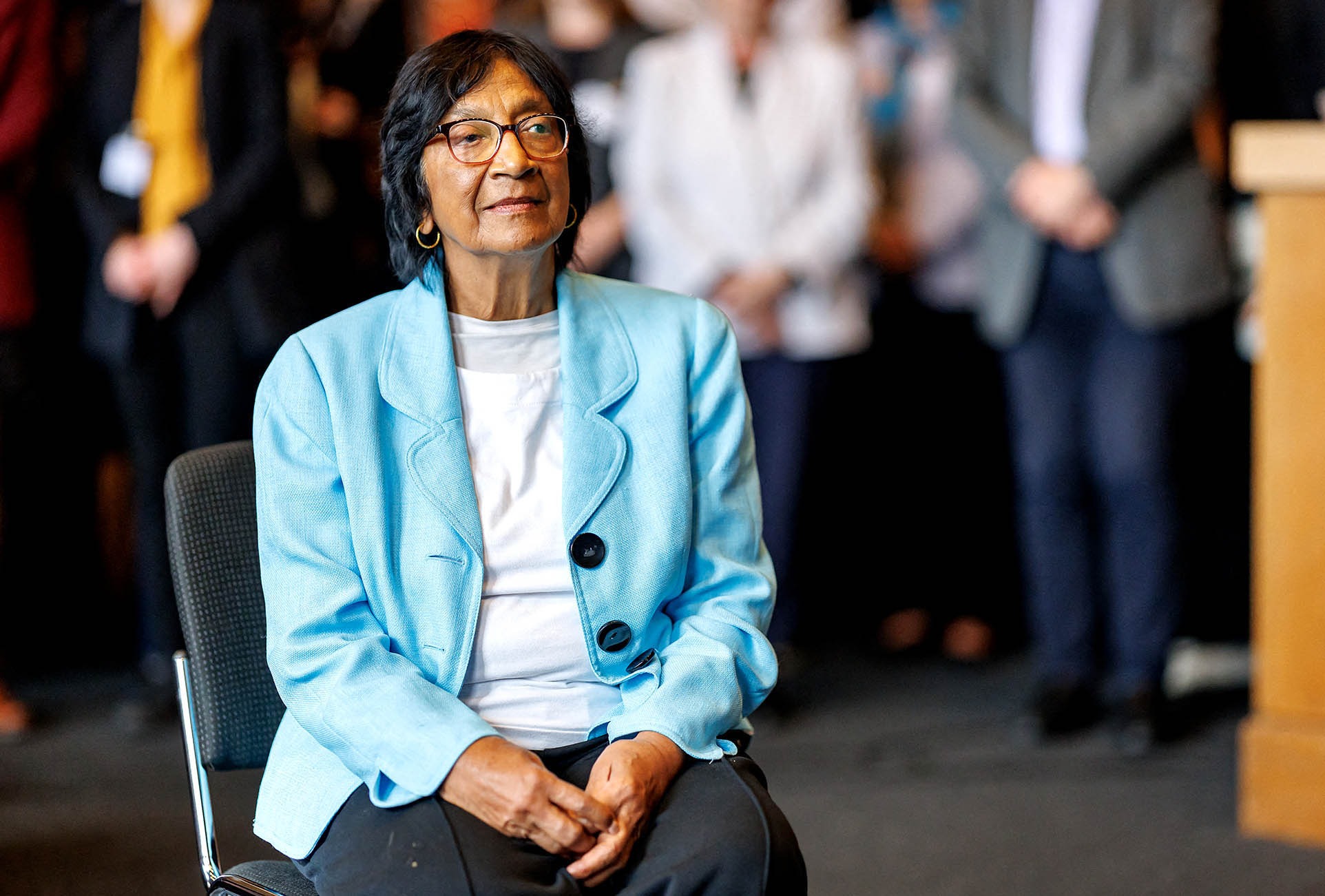
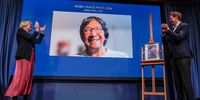
 South African jurist Navanethem ‘Navi’ Pillay attends the Nuremberg Forum in Germany after being named the recipient of the 2026 Nobel peace prize. (Photo: Daniel Karmann / dpa Picture-Alliance via AFP)
Around the world, people are celebrating the return of the Nobel peace prize to its rightful home — the halls of justice.
That’s the gist of the message from South Africa’s distinguished judge of international criminal law, Judge Navi Pillay, who in October was announced as the winner of the 2026 Nobel peace prize.
She is South Africa’s fifth Nobel peace laureate, following ANC leader Albert Luthuli in 1960, Anglican Archbishop Desmond Tutu in 1984 and South Africa’s incoming President Nelson Mandela and outgoing President FW de Klerk, who jointly won the 1993 prize.
Pillay told Daily Maverick the Norwegian Nobel Committee had noted that her award generated more media attention than any other recipient’s in history.
“So I find it gratifying that the world’s public were waiting to return this Nobel Prize to what it was meant to be, to individuals who have followed the law,” she said. Pillay was the first person in the 126-year history of the prize to win it for her achievements as a judge.
She has sat on the benches of South Africa’s high court; the International Criminal Tribunal for Rwanda (ICTR), a temporary court created by the United Nations in 1994 to try the main perpetrators of the 1994 Rwanda genocide; the International Criminal Court (ICC); and the International Court of Justice (ICJ), where she is still on the panel trying Myanmar for alleged genocide against the minority Rohingya community.
A landmark judgment
Speaking to us from her hometown of Durban, she reflected on which of her many judgments she considered the most important.
“Obviously one’s first major decision is always important,” she said, explaining how the Rwanda tribunal had been overshadowed by the International Criminal Tribunal for the former Yugoslavia – until the Rwanda tribunal delivered its first judgment. “And the report of that judgment hit the headlines in almost every newspaper around the world.”
It was the first-ever judgment of genocide by an international court, which Pillay and her fellow judges handed down on 2 September 1998 against the former mayor of Rwanda’s Taba commune, Jean-Paul Akayesu.
The judgment recognised for the first time that rape and sexual violence could constitute crimes against humanity and genocide, which the Norwegian Nobel Committee highlighted in its citation.
‘Why am I here?’
Pillay agreed that her greatest achievement to date had been to ensure greater rights and justice for women and girls.
“I think I’m justified in claiming that. People say, and they’re right, that it takes a lot of courage when you do something for the first time.
“So we’re talking about 1997, 1998 and as late as that, the rape and sexual violence of women and girls during conflicts was considered rewards for the soldiers for fighting very well. Or they were simply regarded as collateral damage: ‘These kinds of things happen in wartime.’
“But once we looked at the indictment [in the Akayesu case], there was no count of rape and sexual violence. Yet the witnesses were giving the evidence before us. There was a mother who hid in a tree, and she said her six-year-old daughter was pulled down and raped by three men in front of her. Then they pulled her down, and she endured multiple rapes. There was no such charge in the indictment.
“So, normally, judges may say we’re not dealing with any matter that is not charged in the indictment. You can take that technical positive attitude, or you can ask yourself: ‘Why am I here? Aren’t we here to render justice?’
“We listened to the witnesses who said: ‘We waited for this day to see justice being done’, and therefore we felt it’s only fair for us to hear the total experiences of these witnesses.”
In its citation, the Norwegian Nobel Committee also said that an international legal system in which war criminals are held to account, and the victims of abuse see justice served, is a condition for a peaceful world.
But have the judgments of the Rwanda and former Yugoslav tribunals and the ICC in fact made the world more peaceful?
“Yes, I do believe it,” said Pillay.
“It’s because of my experience serving as the United Nations high commissioner for human rights for six years, in which I went formally on mission to 79 countries. And in every country I went to, we would see the head of government, parliament, rulers, the military, but also the NGOs, civil society. And all of them wanted not just peace – they wanted justice and accountability, exactly as South Africans demanded and are still demanding ... after the TRC [Truth and Reconciliation Commission] deliberations.”
Pillay said that in all her work she asked for nothing more “than the aspirations of people themselves.”
Sanctions and threats of arrest
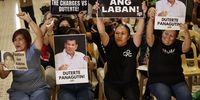
International criminal justice is now under considerable threat, as the US and Russia, which are not members of the International Criminal Court, “seem to be engaging in many activities to undermine this court because suddenly the spotlight is on them”, said Pillay.
“The United States objects to the judges authorising the prosecutor to investigate not only the acts of the Taliban in Afghanistan, but the US soldiers who were based there.”
She noted that Russia had also tried – in absentia – the ICC judges who had issued an indictment against President Vladimir Putin, for his forces abducting Ukrainian children.
“They have warrants of arrest against them, and they’re threatening to arrest the judges.”
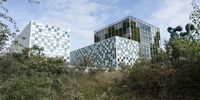
Recently, the US had gone further by sanctioning the whole of the ICC and its staff at The Hague.
Pillay went to see them, “and I was really moved by how fragile they felt. What’s going to happen to them, their jobs? Can they bank? Can they receive their salaries? How can they even work when they don’t have proper internet digital access and so on, because that’s been cut off too.”
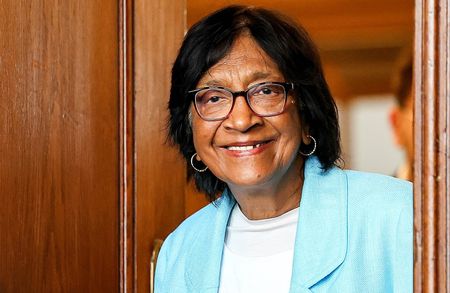
She added that she and her two fellow commissioners on the independent international commission on Israel, Palestine and East Jerusalem, set up by the United Nations Human Rights Council, had also come close to being sanctioned by the US.
The commission concluded last year that Israel had committed genocide in Gaza, infuriating not only Israel but also the Trump administration.
“We were briefed authoritatively by UN security that we were being targeted as well, I as the chair and my other two commissioners.”
This would include denying them visas to travel to the US – which they needed to do to present their report to the UN – and to impose financial sanctions on them.
“And then I received information reliably that the White House staff had received instructions to prepare the papers to sanction me and the other two commissioners. It’s very serious. You can’t use your credit card because the domain servers are in the US.
“I had to take steps to safeguard my savings and so did the other two. So we came close, but apparently there was a health scare and staff [in the US administration] were asked not to come in to work for about two weeks.”
By the time they returned, the three commissioners had retired anyway, “because I felt that I’d been serving too long”.
‘I stand by the report’
Daily Maverick asked her to respond to the criticism, mainly from Israel and the US, that her commission’s conclusion that Israel was committing genocide in Gaza was premature since the ICJ was still considering that question.
“We produced a report strictly under the mandate we were being given by all the [UN] member states,” she replied.
The commission was the most authoritative body “when the genocide was occurring in real time in full view of the world’s population. They were seeing, and we were investigating things happening by the second in Gaza. And so we felt a special need to do a thorough investigation. It took us two years to prepare that report.
“So we did the best we could under the circumstances, where Israel declined to allow us into the country to investigate. Even refused [to allow] us to go into Palestine, which is regarded as a state by the UN.
“So, of course I am not claiming that this is a perfect report. I am inviting anyone to read the report and see what you think. Do you think the evidence fits what we are saying is the interpretation of the law?”
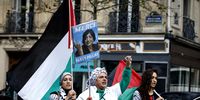
Pillay said that as a judge who had delivered the first-ever genocide judgment and participated in five genocide judgments, she and her team “knew what we should be looking for to make it court-like.
“But there is a lower standard of proof that we followed,” she said, which was that the conclusions they drew were “the only reasonable inference” that could be made from the evidence before them. This followed the standard of the ICJ. The ICC observed a higher standard.
“The ICC, being a criminal court like our criminal courts here in South Africa, will want proof beyond a reasonable doubt, because you’re punishing an individual there.”
She added that her commission’s findings remain authoritative until the ICJ or ICC pronounces on the matter.
“So I stand by the report, the United Nations stands by the report because we are accountable to the secretary-general.”
An ‘unbelievable’ journey
We asked Pillay if she ever marvelled at how far she had come. She started practising law during apartheid in 1967, the first black woman in Natal to do so.
“I do find it unbelievable when I look back on my own life. I think that even though we were poor, we were brought up with values. And I grew up in Clairwood [in Durban], which is a poor community.
“So it was a very unequal educational system where teachers were too afraid to talk about anything topical that might be interpreted as political. The courtrooms were the biggest challenge, because it was so humiliating. When I walked in, as a lawyer, into the magistrate’s office in Durban, for instance, what you saw were the soles of his shoes because he would have both feet on the desk. He wouldn’t take them off.
“He wouldn’t greet me. Wouldn’t offer me a chair. That’s what we went through. We didn’t talk back or argue back. We didn’t want to prejudice the chances of defence for our clients. Many of us kept quiet.”
But each day, she learnt to stand up to it more.
Pillay has, since 2019, been an ad hoc judge on the ICJ, hearing the charges of genocide brought by Gambia against the military government of Myanmar for alleged genocide against the Muslim minority Rohingya community.
Will this be her last appointment as a judge? She seemed ambivalent. She said she had planned to retire at 60. She had not applied for any of the positions she had held since then but had been asked to serve.
“And most of them are not paid positions; they’re pro bono, and I’m not exceptional here.”
Most people agree readily to act free of charge when the UN asks them.
“Of course, I never planned that I’ll go on and on at this age.”
She said when she stepped down from the commission on Palestine and Israel in 2025 she gave age as her reason. She’s now 85.
“But now I’m totally overtaken by events, and I am very, very aware that any person receiving such an award is expected to continue to contribute. I will do that. I see new responsibilities. I will continue to do what I can. Yes. As long as I can.” DM
Comments
Scroll down to load comments...