



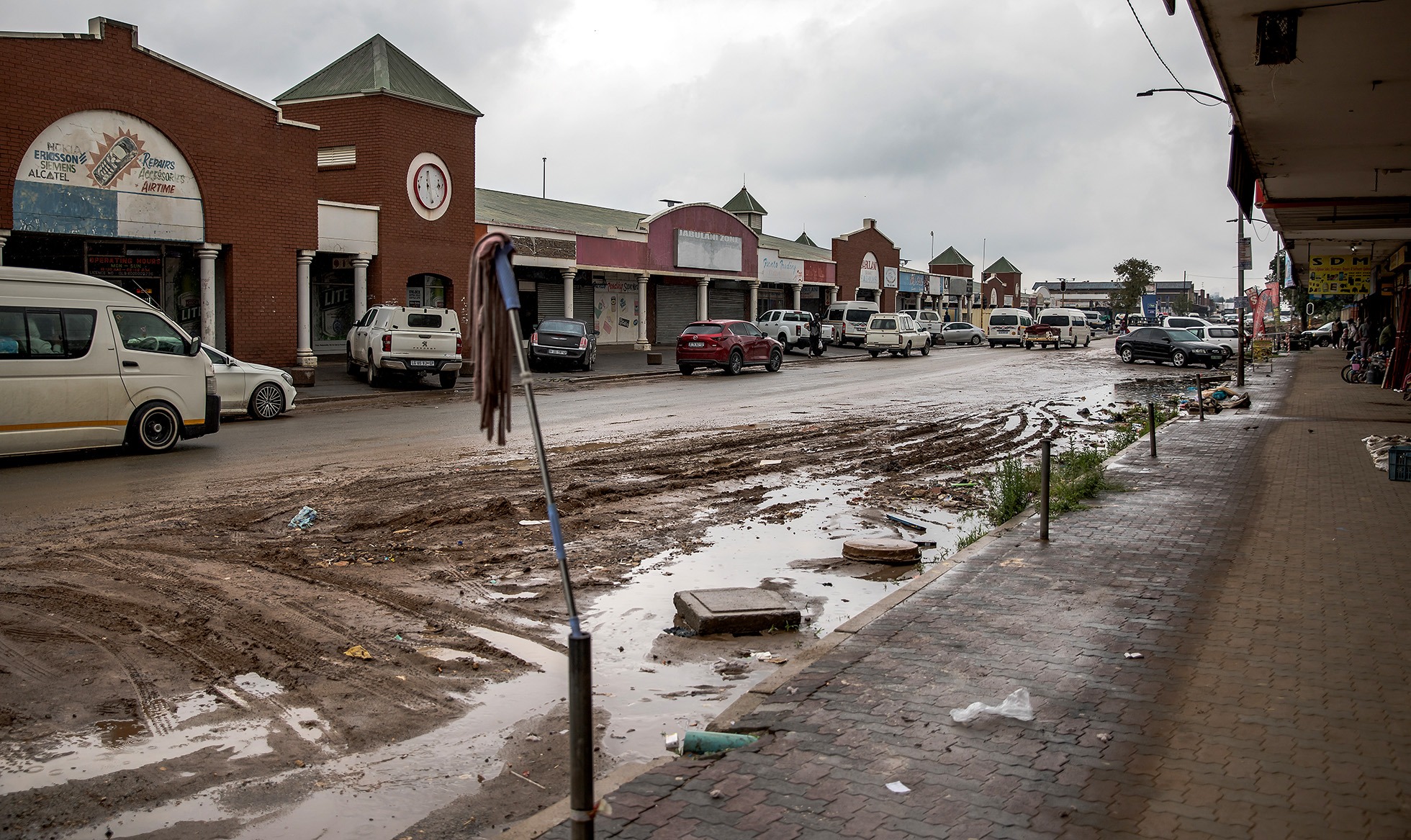
 Crumbling tarmac and struggling storefronts on Vereeniging’s Union Street, capturing the severe economic malaise that fuelled Emfuleni’s historic political shift. (Photo: Nathalie Bertrams)
The DA stormed through Emfuleni’s townships, capturing ward after ward in Sebokeng and Evaton. The DA won key voting districts in Boipatong and Tshepiso. And the DA won Ward 013 in Sharpeville with 2,719 votes to the ANC’s 2,507. When the ANC can’t hold Sharpeville, it’s in serious trouble.
In terms of the overall vote in Emfuleni, the DA did better than in any other Gauteng municipality or metro except for Midvaal. The DA garnered 41.04% of the vote in Emfuleni. The ANC got 23.96%. Voters largely rejected the EFF: its overall share of the vote dropped to 6.04%. The FF+ hardly rocked the boat at 5.63%, while ActionSA garnered just 5.71%.
As in so many other municipalities across South Africa, the DA will have to build a coalition in Emfuleni: it has 37 seats (ward and PR) in the municipal council and the ANC has 22. Since 46 seats are required to take control, the DA is in a strong position. Odds-on favourites, you might say.
Emfuleni electoral maps from 2000 to 2016 are a sea of ANC green; it was a one-party municipality. While the ANC’s overall vote in the municipality dropped to 39.71% in 2021, the townships remained loyal to the party. The DA received 26.91% of the vote in 2021, the EFF 15.59% and the ANC controlled the ensuing coalition government.
In the 2026 election, the DA gleefully watched in Johannesburg, Tshwane and Ekurhuleni as ActionSA wrenched township votes and wards from the ANC. Along the way, the DA picked up proportional representation votes in places like Protea North and Dobsonville in Soweto. Thirteen percent here, 15% there, it adds up after a while and represents a victory in the wider struggle for power in the metros.
The emergence of a party with a strong black base and one that is amenable to a working coalition, a party that can split the Gauteng township vote, has probably been a long-standing goal for Helen Zille.
But in Emfuleni, the DA did something far grander. The DA went toe-to-toe with the ANC. The DA won township wards and voting districts in its own right, rather than being an indirect beneficiary of the implosion of the ANC’s electoral base. Only two parties won wards in Emfuleni: the DA (34) and the ANC (11). Just 8 out of 168 voting districts were won by parties other than the DA or the ANC.
For the first time in its history, the DA can lay claim to genuine township support.
The DA’s success in Emfuleni is unprecedented, but it is not surprising. Not in the least. A year ago and on assignment for Daily Maverick, photographer Nathalie Bertrams and I spent a month in Emfuleni and surrounds. We interviewed people across races and economic classes. Daily Maverick published our long read in March 2026.

Emfuleni is deeply broken. When we returned to Johannesburg after a long day of taking photos and interviewing, there was always a feeling of relief. In comparison to Emfuleni, things work in Jozi. The roads are in decent condition, there isn’t sewage flowing all over the place, the air is breathable, and jobs are on offer.
In Sebokeng, we interviewed a former ANC activist, a man who was there in the 1970s and 1980s, and he admitted with much sadness that he was voting DA. I had a feeling that the game was up. If the ANC was losing old people’s votes, its core demographic, the end was nigh.

In her small house, mired in poverty, a former EFF activist said that she had left the party because nothing was changing. Young people were skipping the polls, she added, because they realised political parties were simply playing games with them. Nearby, another interviewee – a Struggle icon and former ANC mayor of Emfuleni’s administrative predecessor – admitted he hadn’t even bothered to renew his party membership.
Service delivery
Across the various sectors of society, people had similar views. Drugs were killing communities, service delivery was a joke, all the ANC did was loot resources, and things were better in the past. Xenophobia was rife. People looked next door at Midvaal and said, sometimes grudgingly, sometimes longingly, that the place functioned.
The Emfuleni municipality building in Vanderbijlpark looks the same, if you blank out the rubbish on the lawn and the decayed interior, as it did in the 1970s. The ANC couldn’t even get it together to change the name of the street the building is on: Klasie Havenga was the man instrumental in getting the National Party into power in 1948.
When we interviewed DA politicians – two black guys and an older white lady – inside the building, what they said wasn’t as important as their sense of blood in the water. They could see, unlike Johannesburg’s chattering political class, that the DA had an actual chance in these elections. I got the idea that, in this horror show of a municipality, there was a real future for the DA. That it could go beyond its minority cul-de-sac. And so it came to pass.
The DA in Emfuleni feels different. Like its African edge came from below, unlike the DA’s failed top-down approaches. Eighty-five percent of Emfuleni is black.
As one former metalworker put it, the Vaal is a historical place. The peace treaty between the Boer Republics and the British was signed in Vereeniging in 1902. The Vaal’s factories, smelters and steelworks built South Africa. Its people were at the forefront of the Struggle. The Vaal gave everything to this country and all that it has received in return since 2006, when it produced nearly half of South Africa’s steel, is government neglect. Industry in the Vaal is gone. The job losses have been enormous. The economic devastation total.

Hardly a platform for the ANC to campaign on.
But herein lies a trap for the DA. Even if it improves service delivery – something that will almost naturally happen provided the DA and its coalition partners are not as corrupt as the ANC and are moderately competent – the DA won’t be able to rebuild Emfuleni’s ruined economy. That will require national-level intervention.
Perhaps a real change in national politics is possible. Emfuleni shows that it could happen, more so than Johannesburg, Tshwane or Ekurhuleni. If the DA wants to play a truly meaningful role in national change, the party will have to be more like Emfuleni than Sandton.
Emfuleni was South Africa’s past; it is the country’s present-day economic malaise, and it could be its future. That doesn’t mean a DA-led government – having a DA president on any foreseeable timeline is highly unlikely – but a different kind of politics. A different order where South Africans abandon voting on a racial or ethnic basis and the country becomes the type of democracy that so many hoped for.
The tragedy is that Emfuleni had to suffer so much to show the way. DM
Comments
Scroll down to load comments...