


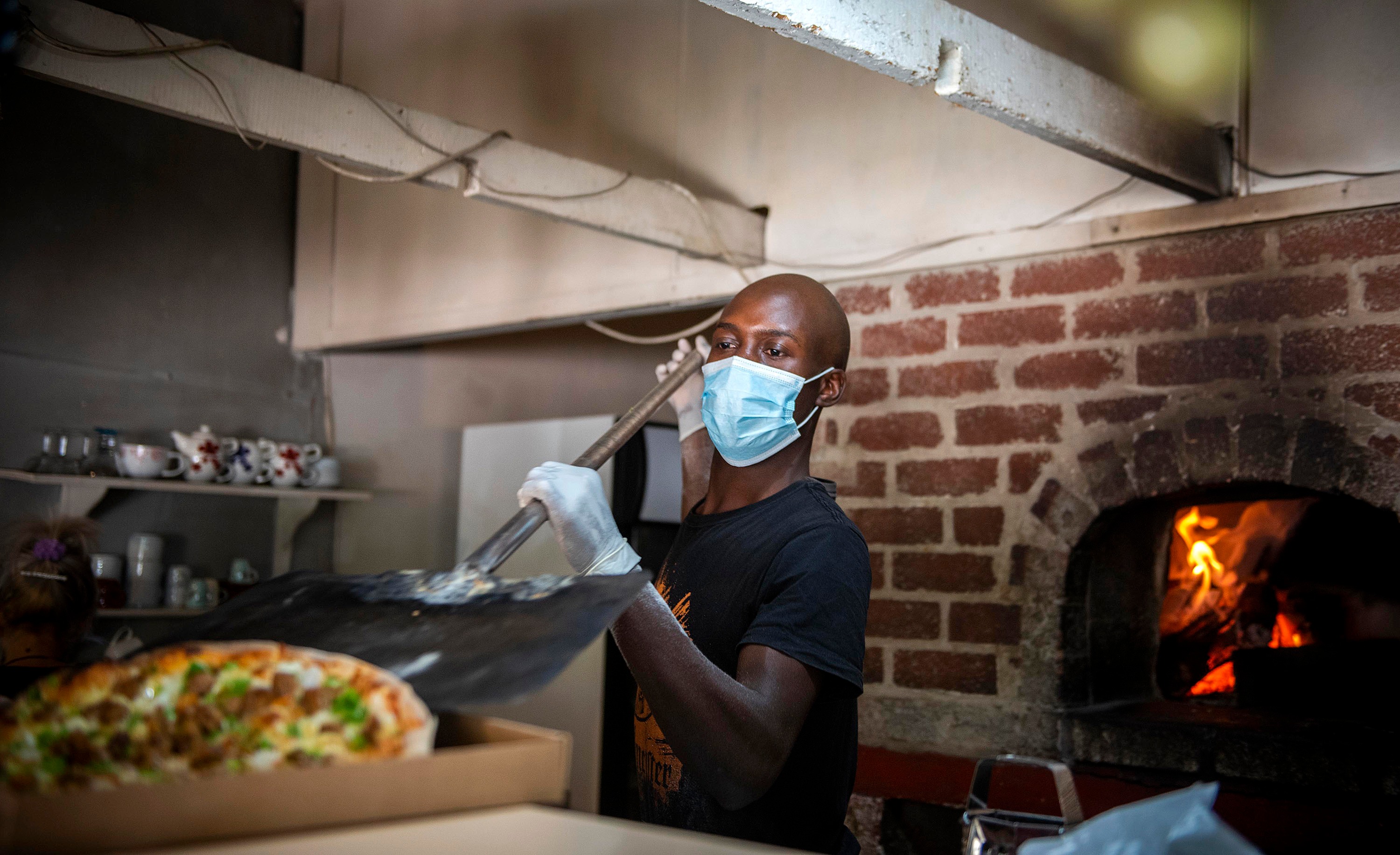
 Chef Kenny Ramokone makes pizza for delivery at Luini’s Pizza on the first day of national lockdown level four on 1 May 2020 in Pretoria. (Photo: Alet Pretorius/Gallo Images)
About one out of every five randelas earned in the franchising sector – which does an estimated R1-trillion in turnover annually – is from serving people food. That works out to roughly 3% of South Africa’s GDP (if you stick to the Competition Commission’s estimation of the sector being 15%), and many of those are pizza places.

If you have a taste for the fancier, wood-fired flavour of pizza dining, you are probably familiar with Col’Cacchio, which has been serving handmade discs of deliciousness for more than 32 years.
Now they’re changing the way they do business by introducing the Col’Cacchio Go model of small-format, click-to-collect and delivery-centric stores.
Retaining traditional back-of-house, hand-crafted food preparation and converting front-of-house operations to digital counter service has helped to reduce capital expenditure requirements from about R6-million to R8-million down to R2-million to R2.5-million per outlet.
This adaptation addresses severe overhead pressures, makes for easier expansion into smaller regional markets and establishes a sustainable unit economic framework optimised for third-party delivery ecosystems, digital click-to-collect ordering and multichannel retail integration.
In normal-person speak, it means it’s cheaper and easier to buy into as a franchise owner.
“I got rid of the word franchisee,” Col’Cacchio group CEO Etienne Pieterse tells Daily Maverick. “I hate that word because franchisee means parent/child and that’s not what our business is.”
In Pieterse’s view, they’re in the partnerships business. “So all our franchises are called partners... think about it, yes it’s one thing to have standards but if there can never be a relaxation of that standard – or an openness to explore something new – that’s where you lose innovation.”
Meeting customers where they want to be
Operationally, Col’Cacchio combines strict national quality standards for core commodities (read: pizza and pasta ingredients) with localised autonomy for regional produce and wood sourcing.
For instance, store owners in Kimberley are allowed to source fresh produce and wood locally (selecting between wattle and blue gum, because there are standards) rather than forcing central logistics from Cape Town, provided quality benchmarks are met.
Store owners can also maintain signature menu pages unique to their specific location to preserve an authentic, community-focused dining experience.
“If you strip back, each of our stores is a mom-and-pop store. And the reason why I say that is because we franchised out. So, every restaurant has got its own owner in its own area... What I’m trying to get to is something you might think of as a chain... it’s not. It’s local people, local owners putting [in] hard sweat.”
Vladislav Priadko, founder of Coffee Bike World, approached Daily Maverick in response to previous reporting on the franchising sector to advocate for a business model centred on independent equipment ownership rather than traditional franchising.
“My preference for independent ownership comes from being an operator myself,” he says. “We built our first Coffee Bike in Vancouver in 2017 and spent more than eight years operating our own bikes, serving over a million cups, before offering the concept to other entrepreneurs.”
“Running the business taught me how much every expense matters. Owners are already paying for ingredients, staff, maintenance and everything else required to make the business work. I wanted to give people the equipment and knowledge to get started without adding franchise fees, ongoing royalties or mandatory purchasing obligations.”
Priadko structured his expansion strategy around eliminating recurring franchisor fees and mandatory supply constraints. To date, Coffee Bike World has distributed 36 mobile units across 31 independent owners in Canada, the US and Peru, operating primarily in mobile coffee and chai catering markets.
Under this model, the initial capital purchase includes the specialised mobile equipment, operational training and supply chain access.
“Franchising certainly has its place, especially when the brand brings customers through the door,” Priadko says.
“With our model, I believe the owner should be able to build their own brand and benefit from the relationships and reputation they develop locally. We provide the Coffee Bike, training and support, while they retain control over their business.”
Flexible franchising
This operational flexibility becomes particularly important in international expansion, where rigid corporate standardisation often collides with local consumer preferences and economic realities. Using the operational autonomy of an independent licensee in Peru as an example, Priadko has learnt that operational knowledge can travel internationally without requiring uniform store execution.
“The lesson for me is that expanding internationally does not have to mean making every location identical,” he says. “The equipment and practical knowledge can travel across borders, while each owner builds a business that reflects their local market.”
In contrast to non-franchise licensing, WAXIT, a local wax-only specialist brand founded in 2015 by Michelle Royston, operates 49 branches in Gauteng, KwaZulu-Natal and the Western Cape under a traditional franchise model, with standard store setup costs positioned at approximately R1.7-million (excluding VAT and working capital).

Because steep upfront capital requirements can exclude talented operational staff from equity ownership, Royston established an internal micro-franchise incubation pathway.
The framework spans a structured five-year period during which long-serving team members who have demonstrated operational excellence within the company’s internal recognition structure (the “Smooth League”) receive mentorship in financial discipline, operational governance and secured funding support.
“This has been on my goal list since the start. I want to build a legacy, not an empire,” Royston says. “WAXIT was never built to sell services; it was built to empower people.”
“The process is designed to produce true operators. We are proving this model works before we seek external support, demonstrating that with the right structure, accountability and brand standards, we can create sustainable ownership pathways from within.”
In the pilot implementation of the micro-franchise model, two long-standing internal leaders, Thuli Ngwenya and Precious Matabane, moved into joint franchise store co-ownership.
Ngwenya, who spent 11 years with the business and went from a being waxologist to the head of WAXIT’s seta-accredited training centre, is a great example of how internal career progression translates into franchisee capability.
It’s all about staying healthy
Larry Hodes, the CEO of Grow Franchising, a Franchise Association of South Africa (Fasa) board member and the founder of Arbour Café and Courtyard restaurant in Johannesburg, has a more analytical perspective on the structural vulnerabilities that threaten franchise networks.
Drawing on findings from Fasa’s 2023 industry survey, Hodes points out that 60% of franchisors identify escalating operating costs as a critical challenge, while 45% flag franchisee-related operational issues, and 42% cite staff recruitment, training and retention difficulties.
“Capital matters, of course, but having the money to buy a franchise and having the ability to run one successfully are two completely different things,” he explains.
“You are looking for someone who can manage people, read the numbers, follow a proven system, make sound decisions under pressure and accept accountability when things go wrong... Franchisors need to become comfortable with saying no to prospective franchisees who are wrong for the network, even when the cheque is ready.”
There are more than 800 franchisor brands in the South African market, more than 3,500 individual franchisees and upwards of 30,000 franchised outlets nationwide, according to Fasa data cited in the Competition Commission of South Africa’s Draft Terms of Reference (ToR) for the Franchise Market Inquiry.
Although franchising serves as an established entry point into the formal economy because of lower failure rates and brand recognition, ownership patterns remain severely skewed. Fasa’s survey shows that ownership of franchised outlets is dominated by white business owners at 57%, followed by black owners at 18%, Indian owners at 17%, and coloured owners at 8%.

(Photo: iStock)
Given that black citizens make up more than 80% of the national population, participation in franchise ownership remains significantly disproportionate.
Changing the idea of what a franchise is and how those businesses can work could help to bridge the identified ownership gap. We don’t always have to play by the established rules. DM
Comments
Scroll down to load comments...