



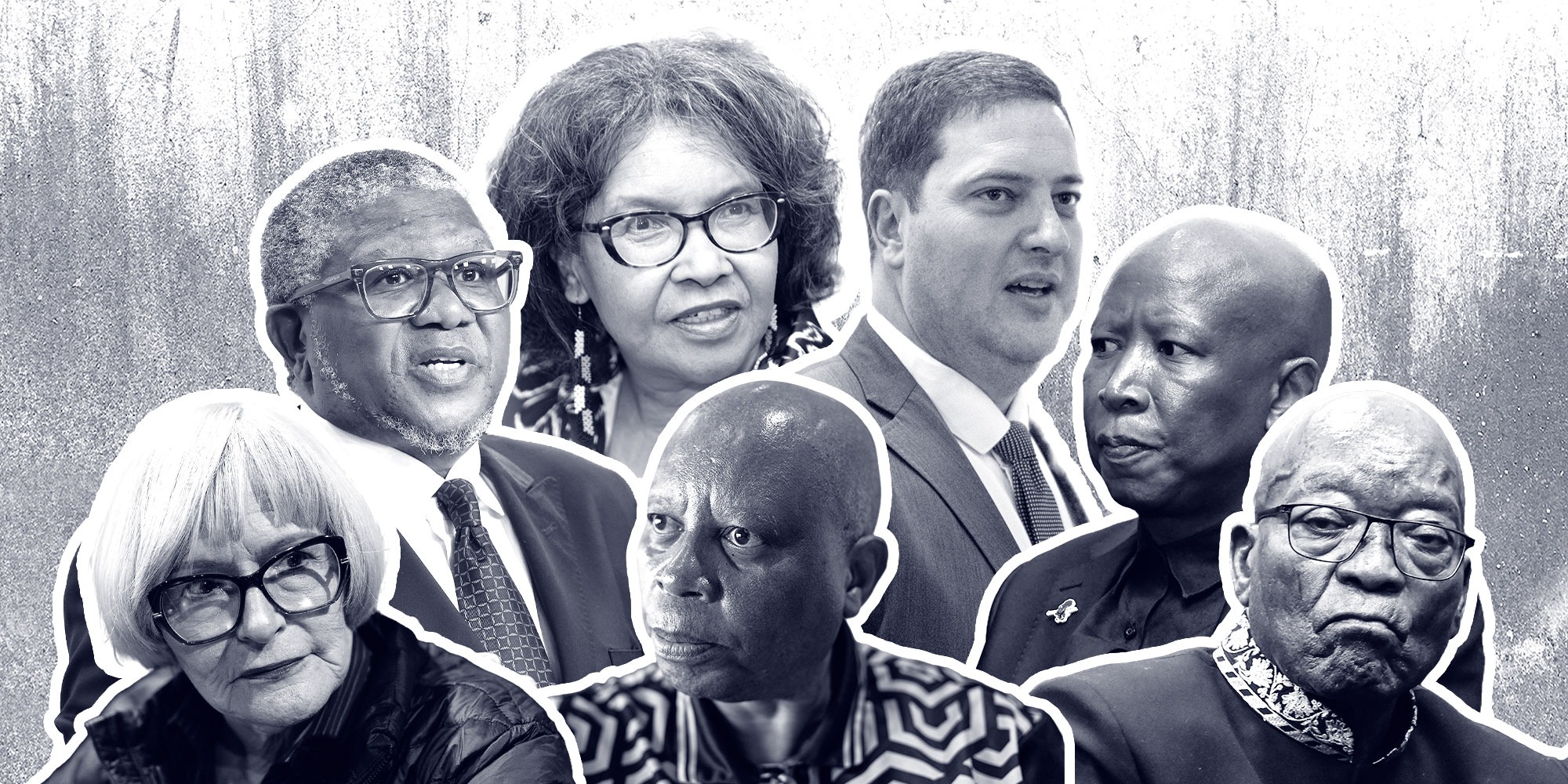
 Illustrative Image: ANC Secretary General Fikile Mbalula. (Photo: Sharon Seretlo / Gallo Images) | DA leader, Geordin Hill-Lewis. (Photo: Brenton Geach / Gallo Images) | MK leader Jacob Zuma. (Photo: Darren Stewart / Gallo Images) | EFF leader Julius Malema. (Photo: Frennie Shivambu / Gallo Images) | Herman Mashaba, the ActionSA mayoral candidate for Johannesburg. (Photo: Our City News/ James Oatway) | Fébé Potgieter-Gqubule of the African National Congress. (Photo: Papi Morake / Gallo Images) | Helen Zille, the Democratic Alliance’s mayoral candidate for Johannesburg. (Photo: Our City News / James Oatway) | (By Daniella Lee Ming Yesca)
The African National Congress (ANC) faces a difficult balancing act after suffering major losses in the 2026 local government elections: regrouping quickly to negotiate from a position of strength, while determining which parties to partner with to retain municipal influence.
The party has been pushed out of the leading position in several key metropolitan councils, including Johannesburg, Tshwane and Ekurhuleni, where the Democratic Alliance (DA) has emerged as the leading party.
In eThekwini, the uMkhonto Wesizwe (MK) party leads, while the ANC remains the top party in Buffalo City. Mangaung also faces tight contention, making securing a governing majority a tough task for the party.
The results emphasise the scale of the ANC’s electoral setback and the challenge confronting its leadership as it prepares to enter coalition negotiations across the country.
With 99% of the national votes counted by Saturday evening, Independent Electoral Commission data showed the ANC secured 30.88% of valid votes (9,101,793 votes and 3,194 seats), leading in 125 of 213 municipalities.
Across eight metros, ANC support ranged from 13.95% in Cape Town to 41.93% in Buffalo City. It took 20.25% in Johannesburg, 20.29% in Tshwane, 21.9% in Ekurhuleni, 25.48% in Nelson Mandela Bay, 33.91% in Mangaung, and 16.61% in eThekwini.
Compared with 2021, the ANC’s provincial support dropped sharply. In KwaZulu-Natal, its share fell 20.7 percentage points (41.5% to 20.8%), as the MK party secured 34.2%. In the Free State, it dropped 13.4 points (51% to 37.6%), and in the Western Cape, six points (20.9% to 15%).
In Gauteng, where the ANC led Johannesburg, Tshwane and Ekurhuleni in 2021, the DA has now emerged as the leading party in all three. In Johannesburg, the ANC secured 20.25% (59 seats); in Ekurhuleni, 21.9% (55 seats); and in Tshwane, 20.29% (44 seats).
The party’s losses are not confined to Gauteng. Elsewhere, the DA retained its lead in Nelson Mandela Bay, Cape Town, Johannesburg, Tshwane and Ekurhuleni. These results reflect reduced ANC reach across major urban centers, forcing the party to choose between coalition negotiations, going into opposition, or constructing alternative pacts with smaller parties.
A week of meetings, but no coalition blueprint yet
The immediate question is whether the ANC can get its leadership aligned on a coalition strategy before the new councils begin their work, in 14 days.
The ANC’s Top Seven officials are expected to meet Monday to assess the outcome, National Working Committee (NWC) followed by a National Executive Committee (NEC) meeting on Thursday, 12 November, to determine the strategic direction forward.
Secretary-general Fikile Mbalula noted officials would analyse results ahead of the NEC, while continuing talks with parties. However, the ANC has yet to publish a formal local coalition strategy. Recalling the 2024 national election when loss of a majority led to the Government of National Unity (GNU) with the DA, the upcoming NEC discussions are expected to be tense.
However, the ANC has yet to publicly set out a detailed coalition strategy for the local government negotiations.
Mbalula stressed the ANC will not rush into coalitions or compromise service delivery continuity, adding the party is willing to enter opposition rather than sign unfavourable deals.
Legal timelines add urgency. Under the Municipal Structures Act, first council meetings must take place within 14 days of declaration to elect Speakers, mayors, and office bearers, driving intense two-week bargaining sessions.
This means parties will be under pressure to negotiate ahead of the first council meetings, with the possibility of two weeks of intense political bargaining as they attempt to secure the numbers needed to govern.
Mbalula termed the ANC's performance "catastrophic," attributing losses to cost-of-living pressures, particularly among middle-class voters in Gauteng and campaign shortcomings by senior leaders. He also noted strong DA turnout and gains among black middle-class voters.
“Where we govern a council, we will govern well,” Mbalula said.
The DA question and the possibility of an ActionSA deal
One of the most politically significant questions facing the ANC is whether it will consider working with the DA at local government level, despite the tensions that have emerged between the parties in the GNU.
The ANC’s national coalition with the DA has been a source of discontent among some of its members, who have questioned the party’s decision to govern alongside a political opponent with whom it has fundamental policy differences.
Those tensions were also brought into sharp focus last month after the Constitutional Court ruled in favour of the ANC in its dispute with the IEC over 181 candidates who had been left off the ballot in six municipalities.
The DA had opposed the ANC’s legal challenge, arguing that the party should be held to the IEC’s candidate nomination deadlines. After the court ruled in the ANC’s favour, Mbalula questioned whether the DA remained aligned with the principles underpinning the GNU.
He said the ANC would have to discuss the DA’s continued participation in the national coalition, arguing that the party’s opposition to the ANC’s case raised questions about its commitment to the GNU’s founding statement of intent.
The dispute could complicate any attempt to extend the ANC-DA relationship into local government, particularly in municipalities where the parties are competing for control.
But the ANC also has another potential route to influence: ActionSA.
Alternatively, ActionSA presents an avenue for influence. Strong Gauteng performances — including leading 26 wards in Tshwane — position ActionSA to key roles in Johannesburg, Tshwane and Ekurhuleni. An agreement between the ANC, ActionSA and smaller parties could challenge DA-led metros.
Mashaba has said ActionSA is prepared to negotiate with any party, including the MK party, although he has expressed reservations about working with Jacob Zuma’s party.
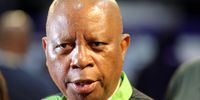
ActionSA leader Herman Mashaba and national chairperson Michael Beaumont indicated openness to cross-spectrum negotiations, subject to commitments on service delivery, anti-corruption, stability, and illegal immigration.
The conditions could prove a test for the ANC, particularly given ActionSA’s criticism of the party’s record in government.
DA prepares its own coalition offer
The ANC will not be the only party entering the negotiations with a plan.
DA leader Geordin Hill-Lewis confirmed the party has drafted transparent coalition frameworks and is considering a “government of local unity” (GLU) model for hung councils.

This approach brings multiple parties together to secure well over 50% council support, offering broader stability in metros where the DA leads without an outright majority.
It also presents a challenge to the ANC: the DA is preparing to negotiate from its own position of strength, with the possibility of bringing several smaller parties into its administrations.
Smaller parties set out their conditions
On the other hand, the ANC’s potential coalition partners are also making clear that they will not necessarily enter government on the party’s terms.
EFF
EFF leader Julius Malema has called for the ANC, MK party, EFF and South African Communist Party (SACP) to come together, arguing that the parties should unite against what he described as “enemy forces”.
He also said President Cyril Ramaphosa should step aside if his continued leadership stood in the way of such an arrangement.
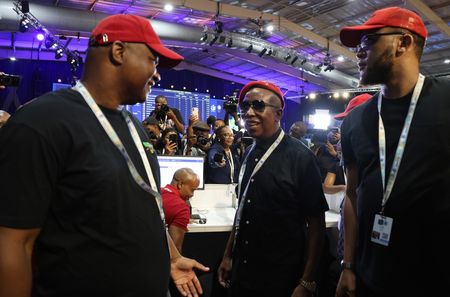
“The ANC must agree that Ramaphosa must go because we are in this mess because of him. You are losing your organisation because you are protecting an individual,” Malema said.
Despite EFF support dropping from 10.31% (2.4m votes) in 2021 to 6.26% (1.8m votes), Malema also signaled readiness to collaborate with ActionSA on local service issues like housing and infrastructure.
“We may not see eye to eye, but I am prepared to hear other parties out and work together on municipal issues. For now, the priority should be getting the municipality working and not letting ideological differences get in the way,” he said.
Rise Mzansi
Rise Mzansi leader Songezo Zibi noted openness to discussions based on public service priorities, though the party secured 0.24% nationally (70,856 votes) with no seats.

He told Daily Maverick that coalition arrangements should not be reduced to the question of who becomes mayor, pointing to the importance of positions such as Speaker and chairperson of a municipal public accounts committee.
Zibi added that agreements should be made public so that voters could understand what parties had negotiated and hold them accountable.
SA Communist Party
The SACP, contesting independently, secured 164 seats (2.39% / 705,982 votes), primarily in the Eastern Cape (97) and Limpopo (53).
General Secretary Solly Mapaila stated willingness to partner with the ANC if it reevaluates neoliberal economic policies, while ruling out deals with the DA or FF Plus.

“If they [ANC] are able to listen to us and humble themselves on the basis of this vote and reposition their own value system, we will work together with them on a comradeship basis,” he said.
MKP
The MK party will be key in KZN negotiations. Acting deputy secretary-general Sifiso Mahlangu highlighted alignment with the EFF and ATM.

KZN leader Willies Mchunu emphasised determination to enter government and avoid repeating the 2024 outcome, where an IFP-ANC-DA-NFP coalition excluded MK despite its leading vote share.
For the ANC, negotiations require navigating rivalries, GNU friction, and potential deals with ActionSA, EFF, SACP, or MK. Though electoral losses weaken its bargaining position in key urban centers, fragmented results leave open opportunities to shape municipal administrations. DM
Comments
Scroll down to load comments...