


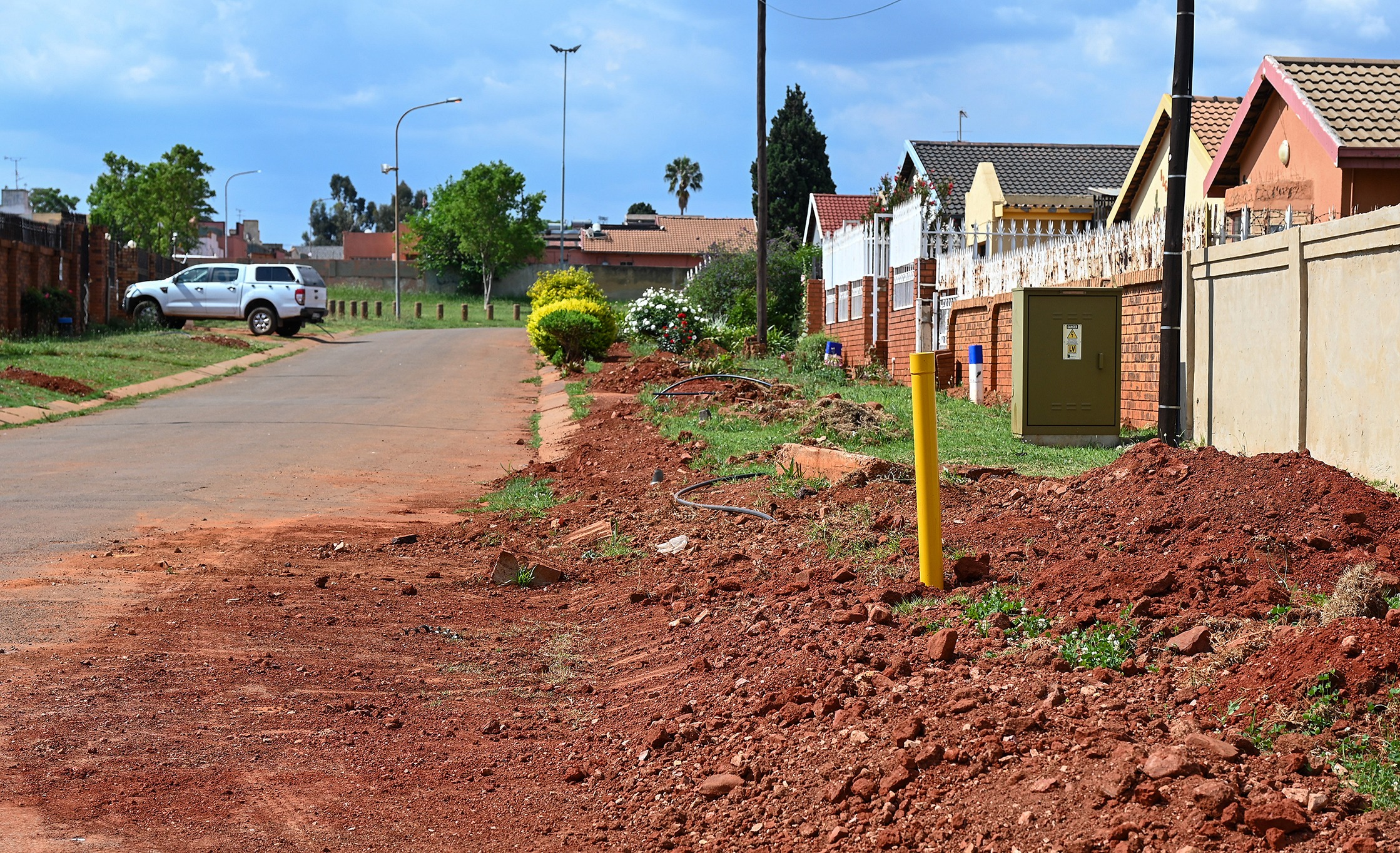
 Excavated pavements and disturbed road verges along Liverpool Street in Lenasia South Extension 1 on 15 October 2026 reveal the extent of construction work associated with Johannesburg Water’s R24-million pipeline upgrade. While the project is intended to improve ageing water infrastructure and reduce frequent pipe bursts, the ongoing excavations have disrupted access and raised concerns about the restoration of affected roads and pavements. (Photo: Globepost)
A reference number is not a repair
For 72-year-old Anastasia Barlow, accountability is the difference between boiling a kettle and organising life around failing services in the Ennerdale, Extension 5 home she shares with her 87-year-old aunt. Electricity disappears without warning and water is unreliable. The household reports problems and receives reference numbers, but those numbers do not show whether a technician arrived, what fault was found or whether anyone checked before a case was closed. “We can’t even make coffee or tea,” Barlow said.
Her experience echoes across Johannesburg’s Region G. In Lenasia South, blocked drains have flooded homes and threatened electrical infrastructure on Balkan and Abibas streets, Extension 4. Residents Shakila Hassim and Michael Mhlanga patched potholes on Balkan Street after months of waiting for the Johannesburg Roads Agency to act. Hassim said she was tired of complaining: “We just want better living conditions, so I decided to take it upon myself to do it for the community.”
This same sentiment echoed across Orange Farm and Drieziek. Community groups clean neglected spaces and streams with inadequate equipment. “Most Orange residents do not log calls. We may raise it with the local ward councillor but we can’t keep waiting,’’ one community volunteer said. The question is not whether residents complain or officials meet. It is who has the authority, budget and leverage to make the responsible institution act – and who faces consequences when it does not.
A reform benchmark, and a fragmented city
The Public Service Amendment Act 9 of 2025 was assented to on 26 March 2026 and published on 1 April. It transfers significant administrative powers from ministers and members of executive councils to heads of national and provincial departments. Those administrative heads must create appropriate management structures, assign clear responsibilities, manage employees and discipline, and implement departmental strategy. The Act also prevents heads of department and their direct reports from holding senior political-party office, reinforcing the distinction between elected political leadership and professional administration.
There are two decisive limits. Section 20 says the Act begins on a date set by presidential proclamation; no commencement proclamation was identified in the material reviewed. The Act also does not directly govern Johannesburg, Region G or municipal entities, which operate under the Constitution and local government legislation. Its relevance here is therefore diagnostic: politicians should set policy and oversee, professional administrators should manage operations, and an official held responsible for an outcome should possess the staff, budget and authority needed to deliver it.
Region G at a glance
Location: Key Johannesburg region in the metro’s southern/southeastern corridor;
Population: ~709,000; about 13% of the city;
Business: Dense, mixed-use area with strong transport links and active township economies;
Investment: Tied to Gauteng’s reindustrialisation, SEZs and improved transport/digital infrastructure;
Age: Likely median age in the early thirties.
Region G director Mickey Padiachee described a system of 17 urban inspectors linked to 17 wards, monthly integrated service delivery meetings and escalation through reports and councillor forums. “However, my office does not control the budgets, technical staff or performance agreements of Johannesburg Water, City Power, Pikitup or JRA.” Their managers answered through separate entity chains. “I can bark but I can’t bite,” he said.
Who must answer, and for what
Accountability should attach to functions, not dissolve into a general accusation against the City. Padiachee and the Region G office must answer for whether complaints were logged, monitored and escalated, and whether repeat failures appeared in regional reports. The city manager’s office must answer for whether delegations and performance systems connect regional outcomes to entity managers. Johannesburg Water must answer for water and sanitation failures; City Power for electricity; JRA for roads; and Pikitup for refuse. The mayor and mayoral committee must answer for political oversight, budgets and reform of the entity model.
That map does not prove corruption or misconduct by any named official. It identifies where documentary answers should exist: complaint histories, work orders, budgets, contractor records, project sign-offs, performance scorecards and corrective or disciplinary action where failure was within an official’s control. The records reviewed show city-wide irregular expenditure and investigations, but do not connect a named Region G official to corruption in the cases examined here.
The public sees one City; internally, a flooded street may be divided among drains, waste, roads, electricity and enforcement. Mayor Dada Morero acknowledged this weakness in a June 2026 submission to Parliament, describing semi-autonomous entities, split accountability and management failures.

He reported 1,168 Region G cases, an 85% resolution rate and 174 unresolved cases. But, closure needs testing: who verifies a repair, how many faults recur, and does a closed job card mean the physical problem is fixed? I directed this question to Candice Molefe, acting group communication manager for the City of Johannesburg, for feedback. By the time of publication no response had been received. Pressure on the system is real. Padiachee said Region G contains 54 informal settlements, while ageing infrastructure, theft, vandalism and limited revenue constrain delivery. Yet “demand exceeds supply” is not a complete explanation.
Speaking during a joint parliamentary hearing before the Standing Committee on Public Accounts and the Portfolio Committee on Cooperative Governance and Traditional Affairs on 9 June 2026, Morero said Johannesburg Water’s non-revenue water losses stood at about 44.7%, amounting to about R3.8-billion, while the City’s total electricity losses were about 30%. These figures suggest that scarcity is also driven by leakage, theft, infrastructure deterioration, weak revenue collection and management failures.
Asked whether losses on this scale point to a system resistant to reform, Professor Joseph Sekhampu, chief director of the NWU Business School, cautioned that they do not, on their own, prove that vested interests are responsible. “They do show serious infrastructure and institutional stress: water and electricity that cannot be billed weaken revenue, reduce the money available for maintenance and deepen deterioration. A power failure affecting pumping infrastructure can quickly become a water interruption as reservoir levels fall, illustrating how failures compound across entity boundaries,’’ he says.
Sekhampu’s warning becomes sharper once a municipality has lost internal engineering, maintenance and project-management capability. It then relies more heavily on consultants, contractors, emergency procurement and outsourced services. He adds: “Much of that work may be legitimate and necessary, he said, but prolonged weakness can create an economy around that weakness – including water tanker and repair contracts – in which some businesses or individuals benefit from continued municipal dependence.’’ This is not evidence of wrongdoing in the Region G cases examined here. It identifies a reform risk: rebuilding internal capacity can affect contracts, procurement opportunities and influence over municipal spending, creating resistance as well as winners and losers.

Failure survives political change
Sekhampu says there is no single ratio that marks the point at which a municipality becomes “too failed to fail”. The warning lies in a combination of persistent negative cash balances, unfunded budgets, weak revenue collection, large and ageing debtor books, creditors unpaid for more than 90 days, growing obligations to Eskom and water boards, and infrastructure losses that further erode municipal revenue.
National Treasury figures cited by Sekhampu show the national scale. As of December 2025, consumers owed municipalities R467.2-billion, with R406-billion already more than 90 days old. Municipalities, in turn, owed creditors about R160-billion, of which R135-billion had been outstanding for more than 90 days. The decisive warning, he said, is when those problems begin feeding one another. Poor collection creates cash shortages; cash shortages delay maintenance and creditor payments; deteriorating infrastructure increases water and electricity losses; and those losses remove still more revenue.
A financial problem becomes a cycle that is increasingly difficult to break. At that point, changing leaders or cutting discretionary expenditure may no longer restore the institution. The national government cannot simply allow it to collapse because residents still need water, electricity and sanitation. Yet, repeated intervention can keep a municipality functioning without making it viable.

The Auditor-General’s 2024/25 findings cited by Sekhampu show how deep that institutional inheritance has become. Only 39 of South Africa’s 257 municipalities achieved clean audits. None of the metros achieved one; five received qualified opinions and all had material compliance findings. Metros operate some of the country’s largest and most complex service delivery systems, so incoming political leaders inherit substantial financial, administrative and infrastructure problems.
That does not make elections meaningless. Voters cannot vote away a damaged pipe, municipal debt or a weak billing system, but they can change the people who control budgets, appointments and priorities. Political change can alter the direction of travel – whether deterioration continues or recovery begins – even though rebuilding technical capacity, infrastructure and financial health may take years.
Sekhampu’s analysis also exposes the limits of blunt financial punishment: withholding funds or enforcing debt can harm residents, particularly indigent households, before it reaches those responsible for avoidable failure. The challenge is to protect essential services without shielding responsible officials, contractors or political leaders.

The Public Service Amendment Act’s professionalisation principles can improve who holds operational power and how they are held accountable, but they cannot erase inherited debt or infrastructure failure. If Johannesburg’s leadership changes after the local elections, what will stop Region G’s unresolved cases and infrastructure commitments passing unchanged into the next term?
Liverpool Bloc: A promised solution stalls
The Liverpool Bloc’s once-pristine streets in Lenasia South Extension 1 are now dusty roads littered with evidence of repeat pipe break repairs. After years of bursts and resident pressure, Johannesburg Water announced a three-phase pipeline upgrade estimated at R24-million in December 2025. The plan promised trenchless installation of modern high-density polyethylene pipes, replacement of ageing valves and fire hydrants, local jobs and completion in four months.
One resident experienced 14 major pipe breaks on and outside her property. “This project promised relief to our neighbours but now there is much uncertainty. Replacement of ageing asbestos piping with newer PVC joins since 2021 has caused repeat breaks on recent breaks on my corner of Richmond Street.’’
Preetham Mangar, a resident on the corners of Liverpool and Parliament roads, has been one of the most outspoken on the Bloc and also a repeat victim of major pipe breaks, said he has had enough. “Residents are being taken for a ride. We urgently require a meeting with Johannesburg Water and the mayor. We are living off five-litre water bottles. This is ridiculous.”
Residents promised relief was short-lived. On 11 June, workers employed by contractor TILBIT Construction protested on site over unpaid wages reportedly exceeding R11,000 for some employees. A partial payment followed. “We have been working without pay for over a month now. We get no updates from the CLO, supervisors or management. All I want is my money, they owe us over R11,000 each worker. When we ask them, they dismiss us. My kids are not going to the crèche because I owe school fees,” one worker explained.

The dispute did not prove that the engineering had failed but exposed an accountability chain involving Johannesburg Water as client, TILBIT as employer and implementer and the community liaison and councillor structures responsible for communication. Calls and messages to the TILBIT liaison person went unanswered.
On 27 August, Ward 120’s councillor Puseletso Nzimande told the Globe Post that the contractor had been expected back on site by 24 August. At the time of writing, work had not resumed, and the reason for the further delay had not been confirmed.
During a 10 August site visit, Deputy Minister of Water and Sanitation Jack Bloom reported routine cuts, three nearby leaks and Richmond Street suffered 18 pipe breaks. Residents described unstable pressure, plumbing damage and unusually high bills, questioning why the repiping and a reservoir launched in 2022 had not delivered reliable supply.
Liverpool is neither a clean success nor proof that R24-million was wasted. Its engineering response had a plausible mechanism, but supplier-payment delays, labour complaints, continuing interruptions, an unconfirmed restart date and unanswered hydrant questions reveal implementation and accountability failures. Success is not kilometres of pipe laid. It is fewer bursts, stable pressure, shorter outages, accurate bills, working emergency infrastructure and residents able to verify improvement.

Orange Farm: Community action cannot replace the City
In Orange Farm, Ibandla Green Roots responds to food insecurity, unemployment and environmental decline through seedling and nursery projects, tree planting, clean-ups and outdoor rehabilitation. Director Phuphuma Lesego Eugene told Orange Farm News: “The cooperative creates opportunities while giving residents practical agricultural and environmental skills.” It is a credible community response, but it should complement rather than quietly inherit municipal responsibility for maintaining public land and supporting safe, lasting work.
In Drieziek, Sibusiso Dhlamini founded the Msesha Phantsi Cleaning Services Group in March 2026 to clean public spaces and unblock streams and drainage systems. “We are committed to serving our community, but we do not have enough tools to carry out our work effectively,” he explained.
The initiative reduces immediate sanitation and flooding risks, yet the municipal system remains responsible for drainage, waste removal, safe equipment and enforcement against conditions that recreate the problem. Community action can buy time; it cannot substitute for a funded maintenance system with a named owner.
Concerns over illegal dumping and unsafe surroundings pushed residents of Orange Farm Ext 2 to launch a community clean-up campaign around Vulanindlela Secondary School on 15 May. Armed with refuse bags, rakes and cleaning tools, residents cleared litter, cut overgrown grass and removed waste from areas surrounding the school in an effort to create a cleaner and safer environment for pupils.

Residents said neglected spaces and growing levels of dirt near the school had become a concern, especially for the safety and wellbeing of pupils. “This is about protecting our children and showing them that their environment matters,” resident Khonzaphi Mbele told Orange Farm News.
Residents as the missing auditors
Residents document what dashboards often miss: recurrence, false closure and the cost of delay. Pastor Sam Chauke and neighbours on Mount Cook and Mount Fuji streets saw a cleared drain block again; Hoosein used bricks to stop foul water entering a doorway; Mambhele feared water and sand near an electrical box would trigger another outage.
During an August Pikitup backlog, residents tracked collection trucks street by street on WhatsApp and challenged claims that areas had been serviced. Community action supplies valuable evidence, but it must not become an excuse for municipal withdrawal. Residents who patch roads, clear streams or protect property may reduce immediate harm while inheriting risks without tools, insurance or support. Their most powerful role is to document failure, force escalation and verify completion.

Professor David Everatt of the Wits School of Governance at the University of the Witwatersrand, cautioned that strong legislation can fail without political will and public pressure. “That distinction matters at service delivery level. “When a road collapses, a sewer block or a street remains dark, residents need to know which unit is responsible, who controls the budget and staff, what turnaround time applies and who must explain a failure. Accountability becomes credible only when the official assessed for an outcome also has the authority and resources to achieve it,” Everatt explained.
The 2026 draft White Paper on Local Government similarly warns that accountability has tilted upward towards parties, departments and compliance reporting while weakening downward accountability to communities. Region G can begin reversing that imbalance without waiting for another law: standardise resident evidence, link it to case histories and use it to test official closure claims.
What Midvaal does differently
Across the municipal boundary, Midvaal is smaller and less fragmented than Johannesburg, so the comparison has limits. Yet, it remains a useful positive deviant because its governance principles are visible in how the administration operates, measures performance and responds when services fail.
“Good governance is not accidental; it is the result of consistent leadership, sound financial management and a commitment to putting residents first,” mayor Peter Teixeira said.
Teixeira attributes Midvaal’s performance to a firm separation between political leadership and professional administration. Politicians set policy, determine strategic priorities and exercise oversight, while the municipal manager and officials implement council decisions and manage daily operations. “In Midvaal, there is a political will to serve, we understand we are public representatives elected by the people.” Councillors, he said, provide oversight without interfering in administrative functions.
“This separation creates accountability, protects professional decision-making and prevents political interference in day-to-day operations,” Teixeira said. “When everyone understands their role, service delivery becomes more efficient, and residents benefit.”
Midvaal at a glance
Location: Southern Gauteng, between Johannesburg and the Free State;
Population: ~112,000;
Business: Home to Heineken, Ferrero Rocher, Paramount Trailers, Soufflet Malt;
Investment: Part of the planned Vaal SEZ; focus on agro-processing, green industry, logistics and Vaal River tourism;
Age: Likely median age around late twenties to early thirties.
According to the mayor, recruitment is competitive and based on qualifications, experience and competency assessments rather than political affiliation. “Appointments are never about political affiliation; they are about qualifications and capability. Professionalisation allows municipalities to continue performing regardless of changes in political leadership.”

Every member of the mayoral committee and head of department signs a performance agreement containing measurable targets aligned with the municipality’s strategic objectives. Performance incentives are not automatic but depend on whether agreed targets have been achieved. Where officials underperform, corrective support is provided before disciplinary action is considered. Alleged misconduct, negligence or financial wrongdoing is investigated through the applicable labour and municipal processes.
This accountability is carried into service delivery through a municipal Service Charter that sets expected response times for water leaks, potholes, electricity faults and other common problems. Teixeira said water leaks may be targeted for attention within 24 hours, depending on their severity. That is a service standard rather than proof that every complaint is resolved within that period, but it gives residents a benchmark against which performance can be tested. “This gives residents certainty about the level of service they can expect and allows us to measure our own performance,” he said.
The municipality has invested in systems intended to make complaints traceable. Reports submitted through the MyMidvaal App, WhatsApp virtual assistant, call centre and customer care offices feed into a central service management system. Each complaint is logged, allocated to the responsible department and tracked until closure. Outstanding cases are escalated, while the mayoral committee and departmental heads receive regular reports.
“We also analyse complaint trends to identify recurring issues and implement long-term solutions rather than repeatedly treating symptoms,” Teixeira said.
The results show why that system matters. Midvaal’s April-to-June 2026 customer care report recorded 10,765 complaints, of which 8,709 were closed – an overall resolution rate of 81%. Engineering Services, which handled about 80% of all complaints, resolved 92%, with an average resolution time of five days. Electricity achieved a 96% resolution rate, sanitation 97% and water 85%.
The report does not present performance as a single favourable municipal average. It breaks complaints down by department, service category, ward, status and turnaround time. Supervisors update cases electronically, while monthly performance meetings are used to verify data and monitor outstanding incidents. This makes it easier to identify which department owns a problem, where delays are occurring and whether corrective action follows.
The same system exposes Midvaal’s imperfections. A total of 1,952 complaints were carried into the next reporting period – 255% more than in the comparable quarter a year earlier. Of 530 residents surveyed, 33% rated their experience negatively. Water performed below electricity and sanitation, while some community service functions recorded substantially slower turnaround times. Midvaal’s strength is therefore not the absence of failure, but that failure is counted, assigned and reported alongside success.
Teixeira said the municipality’s approach also rests on long-term planning, disciplined finances and preventative maintenance instead of dependence on emergency repairs. According to the mayor, Midvaal has achieved 12 consecutive clean audits. The Auditor-General confirmed a clean audit for 2024/25. “Municipalities must focus on getting the basics right before pursuing grand projects,” he said. “Good governance is not about having the biggest budget – it is about making the best use of the resources available to improve people’s quality of life.”
Midvaal also links reliable administration to economic development. Its economic presentation identifies digital land use and building plan systems, trackable applications and faster approvals as measures intended to reduce delays and improve investor confidence. It reports that more than 9,600 jobs were created through local economic development programmes and capital projects between 2020 and 2024. These figures do not prove that governance systems alone produced economic growth, but they illustrate how stable administration, infrastructure investment and predictable approvals can support it.
For Teixeira, public trust is part of the operating model. “When residents trust their municipality, they are more willing to pay for services, participate in public processes and work in partnership with local government,” he said. “That trust creates a positive cycle of better governance, improved service delivery and stronger communities.”
Midvaal therefore stands out not simply because it is governed by a different political party or holds clean-audit certificates.
Its practical distinction lies in clearer lines of authority, competency-based recruitment, measurable performance agreements, defined service standards, preventative maintenance and a complaint system that makes both success and failure visible. The model is not perfect or directly transferable to a large metropolitan municipality. But it shows what professional administration can look like when responsibility is linked to evidence, timelines and consequences.
Why Midvaal matters to the reform debate
The Public Service Amendment Act is directed primarily at the national and provincial public service. It does not directly govern Midvaal or rewrite the legal powers of a municipal council, executive mayor or municipal manager. Municipalities operate under the Constitution, local government legislation, their own delegations and municipal policies.
The Act is nevertheless relevant as a reform benchmark. Its central logic is to draw a clearer line between elected political leadership and professional administration, place operational authority with administrative heads, support merit-based appointments and make responsibility for performance easier to identify.
Midvaal can therefore be examined as a local-government comparison: not to claim that the municipality is implementing the Act, but to ask whether similar principles are already visible in its systems and whether those systems produce measurable public value. Clear authority is meant to make responsibility visible. The administration is headed by the municipal manager, who is also the accounting officer. Powers are delegated to different functions so that decision-making authority and responsibility are intended to be clear.
Political leaders are responsible for direction, oversight and council decisions, while the municipal manager and administration are responsible for implementation within the legal and financial framework. This resembles the reform logic behind the Public Service Amendment Act: politicians set policy and exercise oversight, while professional administrators manage operations.
According to Everatt, of the Wits School of Governance, that distinction matters at service delivery level. “When a road collapses, a sewer block or a street remains dark, residents need to know which unit is responsible, who controls the budget and staff, what turnaround time applies and who must explain a failure. Accountability becomes credible only when the official assessed for an outcome also has the authority and resources to achieve it.”
What the Act can – and cannot – change
Midvaal achieved its governance record without relying on this national Act. That does not make the Act irrelevant; it narrows the claim that can honestly be made for it. The law can strengthen the national and provincial legal basis for professional administration, clearer operational authority and political neutrality. It can make it harder to defend a system in which administrators are blamed for results while political executives retain day-to-day control. But, legislation does not enforce itself: appointments can still be manipulated, performance data can be garnered and institutions can comply on paper while old practices continue.
For Region G, the limit is sharper. The Act cannot restructure Johannesburg’s municipal entities, give the regional director control over their budgets or managers, or guarantee that a closed job card represents a repair. Those changes require Johannesburg’s own delegations, budgets, performance agreements, procurement controls and consequence systems. The Act’s practical contribution is to expose the standard the City is not yet meeting: responsibility matched with real power, measurable delivery and evidence of consequences.
Five reforms Johannesburg can test
The comparison points to five practical reforms: place Region G outcomes on entity managers’ signed scorecards; automatically escalate overdue cases to named managers; require technical proof and, where possible, resident confirmation before closure; publish logged, overdue and recurring cases by entity and ward; and make councillor meetings, attendance, escalations and feedback visible. A limited regional intervention budget for urgent cross-entity risks could also be piloted, but only with strict caps, independent audit and public transactions.
Safeguards matter. More administrative power without transparent procurement can relocate corruption. Dashboards can be gamed through premature closure, while targets can reward easy jobs and leave complex failures ageing. Open data, resident verification, independent audit and consequences for false closure are therefore part of the solution.
The measure that matters
The Public Service Amendment Act cannot repair a burst pipe, reconnect a fire hydrant or restore a stolen cable. But it forces Johannesburg to confront a question it can no longer avoid: who has the authority to act, and who is held responsible when nothing happens?
In Region G, accountability is divided until it almost disappears. One office receives the complaint, another controls the staff, another holds the budget, and a municipal entity closes the job card. Yet the resident may still be sitting in the dark or waiting for water. Midvaal shows that this cycle is not inevitable. When professional appointments, operational authority, financial discipline and measurable performance reinforce one another, the government becomes easier to hold accountable.
The Act is therefore not a cure for Johannesburg’s failures, but it offers a standard against which the City can be judged. Responsibility must be matched with real authority. Service delivery commitments must be assigned to named officials. A closed case must be supported by evidence that the work was completed, and repeated failure must carry consequences.
Elections can replace councillors, mayors and governing parties, but broken systems do not disappear at the ballot box. Municipal debt, ageing pipes, stolen cables, weak revenue collection and unresolved job cards pass quietly from one administration to the next. Reform will mean little if only the names of the leaders change while the machinery of failure remains untouched.
For Anastasia Barlow and her 87-year-old aunt, governance is not measured in legislation, meetings, dashboards or reference numbers. It is measured by whether the light stays on, whether water comes from the tap and whether they can make a simple cup of tea without reorganising their lives around municipal failure.
That is the final test: not whether a complaint was logged, a meeting was held or a case was marked closed, but whether the service was restored – and whether someone with the power to act is answerable when it is not. DM
This story is produced with the support of the Henry Nxumalo Foundation, which supports quality journalism, and the New South Institute. Anton Harber is the executive director of the foundation.
Comments
Scroll down to load comments...