



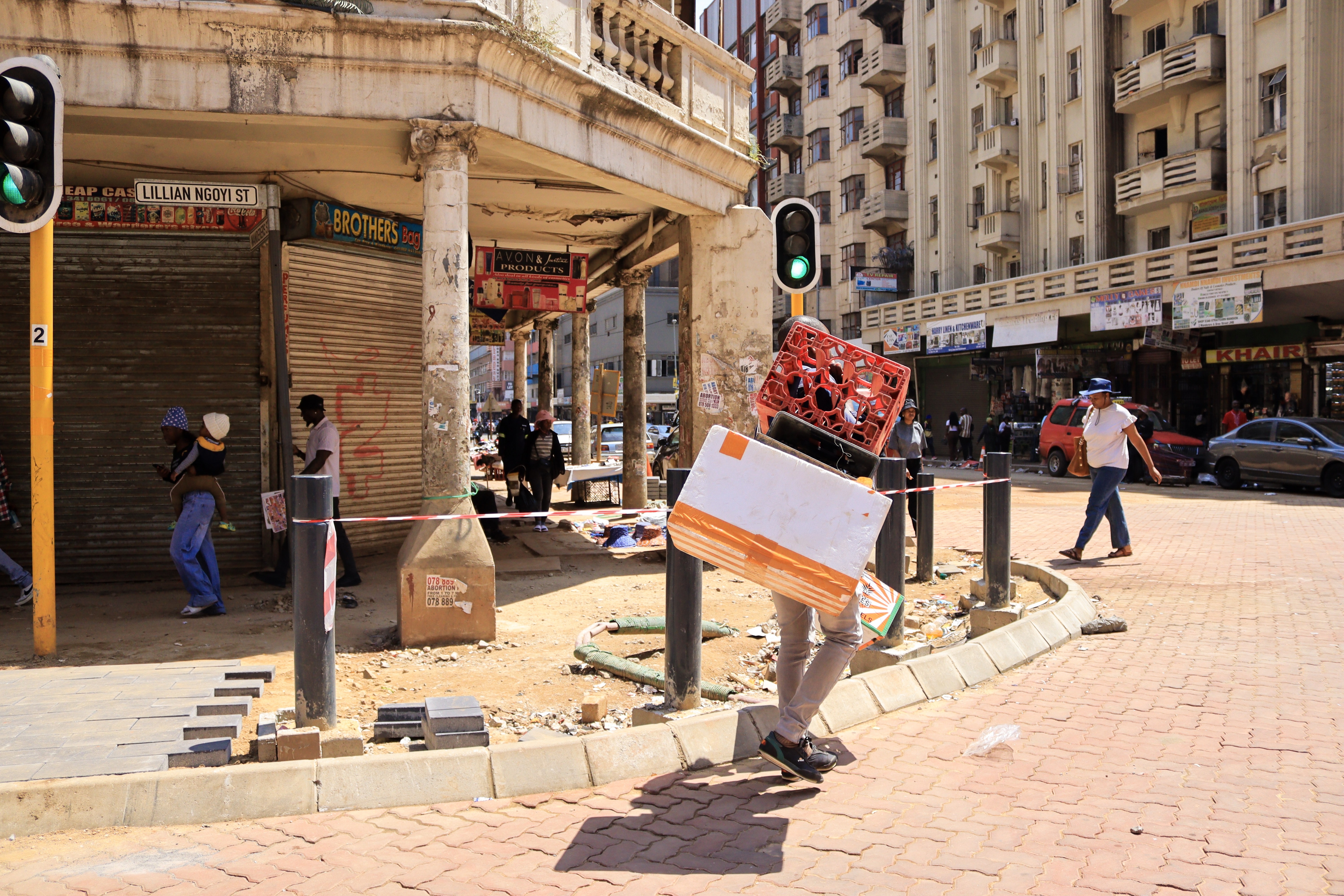
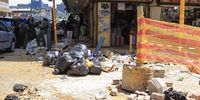
 A commuter carries goods past stacks of unlaid paving bricks and hazard tape cordoning off the pavement on Lilian Ngoyi Street shortly after the road was officially reopened on 2 November. (Photo: Jamie Ho)
Lilian Ngoyi Street in the Johannesburg CBD was officially reopened to traffic on Monday, but Joburg’s mayor admitted the work was unfinished and it will be another two weeks before the pavements are completed and street furniture installed.
“I have ended my term, and I have delivered,” declared Morero.

The Johannesburg Roads Agency (JRA) describes Phase 2 as having reached “practical completion”, with street furniture installation still outstanding.
More than three years after an underground explosion ripped through the street on 19 July 2023, the reopening brings the major construction phase of a project plagued by contractor problems, shifting deadlines and cash-flow constraints to a close.

What began with the reconstruction of the approximately 450m section devastated by the explosion ultimately became a much broader rehabilitation and redesign of the Lilian Ngoyi Street corridor.
The project included installing new road surfaces and wider pavements, reconstructing the underground service tunnel, and replacing electrical, sewer, water and stormwater infrastructure.
The tunnel has been fitted with gas, heat and smoke detection and ventilation systems intended to monitor gas build-up and prevent a repeat of the 2023 disaster.

A trail of changing deadlines
The project has been marked by contractor problems and shifting deadlines.
The original contract with Step Up Engineering was terminated in August 2024 following performance issues after the firm had been paid R19-million. Korone Engineering was appointed as the replacement contractor, and by September JRA said the construction expenditure had reached R185-million.
The total allocated project budget was about R230-million.
Completion dates shifted repeatedly. After Step Up’s termination, JRA initially targeted June 2025 for Phase 1 and June 2026 for Phase 2. Those deadlines later moved to August 2025 and August 2026.
Phase 1 reopened in September 2025, but the August 2026 deadline for Phase 2 was also missed.
Shortly before that deadline, JRA infrastructure development head Khayalethu Gqibitole told Daily Maverick it was “incorrect to suggest that there are delays”. Days later, JRA acknowledged “operational cash flow constraints” and moved completion to 31 October.
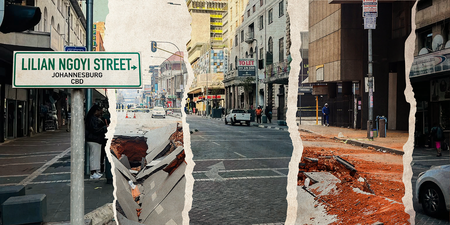
Morero subsequently acknowledged that City cash flow problems in June and July had delayed the project by two months.
During a September site visit, City Manager Floyd Brink defended the project’s cost and complexity, telling Daily Maverick: “There is a whole life underneath this street with water and power and cable connections.”
He said engineers had excavated as deep as 5m to reconstruct the underground infrastructure.
From five lanes to three
The finished road is substantially different from the one that existed before the explosion.
Phase 2 extends between Ntemi Piliso and End streets, and has reduced the road from five lanes to three.
The redesign includes wider pavements, spaces for informal traders, bus stops, ablution facilities and street furniture.
Morero said no parking would be allowed along the redesigned street, which was intended to give greater priority to pedestrians and public transport.
He called on the Johannesburg Metropolitan Police Department to enforce the City's bylaws.

Lilian Ngoyi Street was one of the inner city’s major transport corridors, carrying an average of between 1,800 and 2,000 vehicles during peak hours, many of them minibus taxis.
Morero said the project had created 210 work opportunities and involved 27 SMMEs, including businesses involved in paving and painting.
JRA CEO Zweli Nyathi said construction had been complicated by adverse weather, ageing underground services, the relocation and replacement of water and sewer infrastructure and sinkholes caused by underground erosion and leaking services.
He said recovery plans had been implemented to bring the project to completion.
‘Bring back beauty’
Morero placed the reconstruction within a much broader plan to rejuvenate Johannesburg's deteriorating inner city.
He said the City planned to spend between R800-million and R900-million on the MTN taxi rank and R500-million on the Johannesburg Art Gallery precinct, creating a link between Joubert Park and the taxi rank.
“We want to bring back beauty to the inner city,” he said.
The timing of Monday’s reopening comes just two days before Johannesburg residents vote in the local government elections, with Morero using the occasion to reflect on his record as mayor. DM
Comments
Scroll down to load comments...