


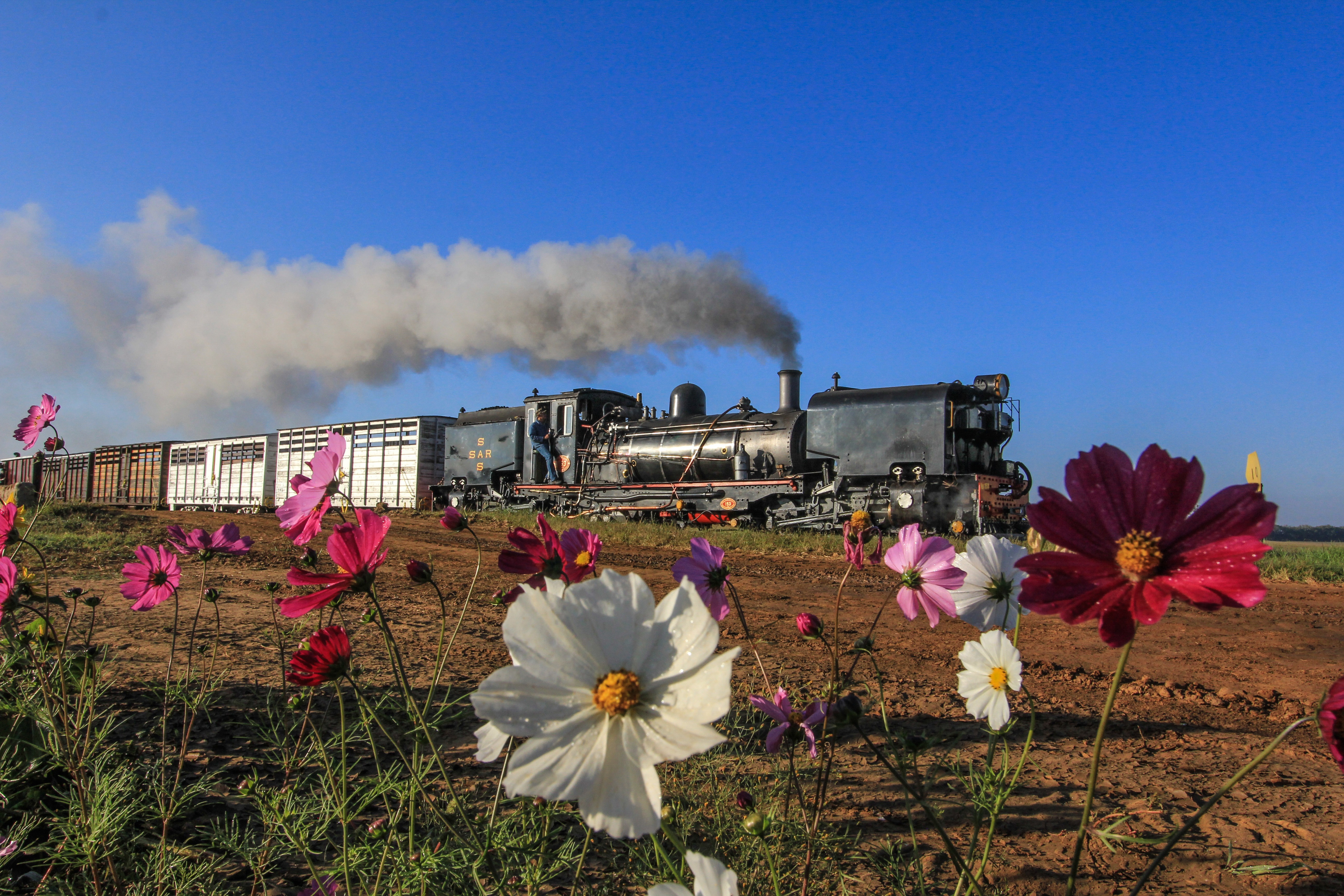
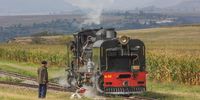
 The Old 153 lets off a head of steam as she moves on, framed by cosmos. (Photo: Chris Marais)
5.30am – It has been many years since I’ve awoken to the long, mournful toot of a steam locomotive engine.
If I weren’t lodged here in the staff house just across the tracks from Hoekfontein Station on Sandstone Farm in the Eastern Free State, I’d say it was all a dream.
But it’s not. It’s a call to action, so I grab a camera and stumble out, still in my jammies – straight into a scene from a Harry Potter movie.
Here it is: Platform 9.75 in the dawning of a new day, with the Hogwarts Express breathing glistening white steam and waiting to take me on an adventure. I am, right now, a little boy once more.
And, of course, it isn’t really the Hogwarts loco. It’s actually a narrow-gauge No. 153, built in 1968 by a Germiston-based firm called Hunslet-Taylor. It was part of the last batch of steam locomotives ordered up by the old South African Railways and now lives here in gracious dotage.
That’s the last bit of steam tech you’re ever going to hear from me. I wouldn’t really know a footplate from a footman, to be brutally honest.

Globetrotting steam nuts
But I do know there is deep and profound magic in steam. That’s why I’m here at Sandstone Estates outside Ficksburg, festooned with every camera in the Marais household.
It’s a few years ago, and we are covering a remarkable event called the Stars of Sandstone, during which steam lovers from all over the globe get their Thomas (the Tank Engine) on and play like kids again.
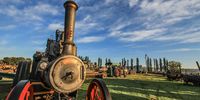
They pay good money to breathe in the soot, dig at the coal, work the levers and make these gleaming Colossi roll over more than 26km of narrow-gauge tracks in the shadow of the sandstone cathedrals called the Malutis.
A world-travelling steam nut is called a “foamer”, for obvious reasons. The ultimate all-time champion foamer was King Boris of Bulgaria, who had a thing for the classic Orient Express.
King Boris had his own set of custom-designed canvas overalls and would insist on pestering the driver and firemen in the cab.
If they refused, he would wait until the train crossed into Bulgaria and have it stopped by his soldiers. Then he would take charge of the footplate and steer the Orient Express from one end of Bulgaria to the other. Boris – the foamer of note.
We chat to James Egan, from Sydney. He says there are seven Aussies here. Back home he is an electrician. He is also a trainee locomotive driver.
“These steam trains need constant checking. Each one is different, so they’re like people. In fact, they’re like babies. They take two hours to get ready, and by then they’ve made a complete mess of themselves.”
The visiting drivers and firemen are the rock stars of the week. Recording their every move is the pack of international steam photographers. I only ride in the Photo Bus once and then decide to chuff around the farm with my wife Julienne du Toit in the Karoo Space bakkie. There’s only so much Lens Envy a man can stand.
Pennies in the river
Over the years, I’ve come to pick up bits and pieces of South African steam lore, mostly from the Karoo.
When migrant mineworkers used to ride by steam train from their homes in the Transkei to the ever-deepening gold shafts of the Transvaal, they would toss money into the waters of the Orange River as they crossed it.
Legend has it that they were convinced there was some form of deity, a watersnake perhaps, in the Orange that needed to be appeased. And the children of nearby Bethulie village would stand under the railbridge, waiting to catch the glittering coins.
Poems have been penned about labourers on steam trains in South Africa, likening the locos to fire-breathing dragons. Rudyard Kipling wrote about British soldiers guarding the blockhouses that used to stand next to the lines.
A steam train driver approaching his home in the once-major rail centre of De Aar in the Northern Cape would blow a signature whistle – which his family knew well. Supper would soon follow the signal.
I heard the stories of many of the retired drivers, one of them being Piet Claassen. He described the different sounds made by the loco on a run:
“You’re going up a steep hill in 150 tonnes of steam locomotive. That old thing talks to you, you work on the sounds and the cadences. And then on a straight, with speed, there comes that smooth, rhythmic chug – and you’re at one with your train.
“The locomotive sounds are rooted in you. You learn to pick up the smallest abnormality. And the sounds come from everywhere: the stoking, the wheels, the regulator, the valves, the steam release.”

Preservation legend
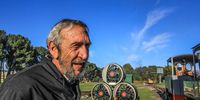
If Wilfred Mole heard you were hoarding the skeleton of an old steam loco in your backyard, he’d be on your case in a flash. He’d come for a peek and, if he fancied adding it to his ever-growing pack of steamers, he might make you an offer.
As the laird of Sandstone, Mole owns the largest private collection of narrow-gauge locos and rolling stock in the world. I can’t think of anybody else who has done more to keep an honourable segment of South Africa’s steam heritage intact than Mole.
He’s not the technical type who can expound on every nut and bolt of his locos, but he is the arch-preservationist who understands the timeless value of an old machine.
Lukas Nel, however, is the guy who can take a rusting hulk of a loco apart and, eventually, bring it back to gleaming, breathing life. He is the Master of Steam. As one of South Africa’s last working steam fitters, Nel keeps a stern eye on the Sandstone engines.
Wilfred finds the old trains just about everywhere in southern Africa, from cane fields in Angola to gold mines on the Reef. Nel sometimes gets scant warning about the arrival of a new loco.
“I’ll just hear from Wilf that something is on its way.”
So, we ask Nel why, in his eyes, people get so excited about steam.
“They can sit down and watch all the moving parts on a steam locomotive, but not on a modern train.”
We tell him about the various locomotives we have seen on plinths and rusting away in Karoo towns like Klipplaat, Graaff-Reinet, Calvinia and Fauresmith.
It is painful for Nel to see them so. His hands itch to fix them up and get them living again. He has brought engines with far less to them back to life.
He speaks of the Graaff-Reinet display locomotive with great wistfulness.
“That’s a special one, that,” he says gruffly.
Locomotive man
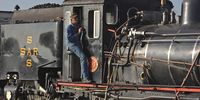
We proceed from the master preservationist to the master fitter to the master driver, a man called Les Labuschagne, who has the look of a long-distance train driver. Both his father and uncle worked on the railways.
“I used to ride in the caboose with my uncle. I met drivers who showed me how to jump off a moving train. From when I was a boy, I loved steam.”
After some years in the military, Labuschagne started his steam career as a trainee fireman – an exhausting and exacting skill.
“You have to learn where to place the coal – the beast has to be fed in a specific way. If you don’t it turns into a solid mass of clinker, you lose steam and the driver will be on your case.”
Les loves a narrow-gauge Garratt loco, which holds a special place in South Africa’s railway history.
“South Africa added some adaptations that made them strong and perfect for dragging freight up and down hills and around sharp curves.”
Other Sandstone offerings
These various Sandstone events are about mechanical shock and awe. To achieve this effect fully, Wilfred and his team often combine forces with the SA Armour Museum from Bloemfontein.
That’s why, at various times of the day, there are all manner of tanks churning through the dust, bearing civilian passengers young and old.
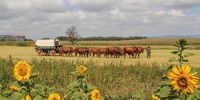
Look, there’s a Harvard passing overhead, coming in to land on a grass strip at Sandstone. And was that a full team of Afrikander oxen we just spotted in between the sunflowers?
Ask Ox Master Daniel Mofokeng what some of their names are and he will recite them for you: “Witpens and Selani. Shirty and Boesman. Phakiso and Star. Rooinek and Kroonstad. Machine and Free State.” And so on.
There is far more than loco business afoot here on Sandstone, when it comes to preservation matters.
Maluti Mountain ride
However, for us, the main event of each day has to be the evening ride on the Mountain Wanderer, a two-engine tag team of Garratts that leaves from Hoekfontein on a thrilling two-hour round trip.
On the train itself, we catch the excitement of the passengers. Off the train, setting up photographs, we jabber to each other like children. We wait for the Mountain Wanderer to make a specific curve, catching the evening light at a certain angle.
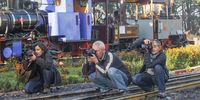
Of course, the fellows in the anoraks know exactly where to shoot from, and I often make them part of my images.
On one of these magical afternoons, I try to urge Wilfred to come down to the Karoo and establish a similar steam fantasy. But he won’t be budged from his familiar sandstone cathedrals.
“I’ve looked elsewhere before,” he confides. “But it was no good. Nothing can match Sandstone. Everyone who comes here talks about the light – and the mountains.”
And the shiny locomotives that drift backwards and forwards on the open plains in the distance, puffing their way into our collective imagination. DM
Find up-to-date details of events at the Sandstone Estates’ website.
Chris Marais and Julienne du Toit are the authors of the five-book Karoo Heritage Collection (R1 300, including courier in SA). For orders, contact julie@karoospace.co.za
Living overseas? The Karoo Heritage eBook Collection (R500) can be bought online: The Karoo Heritage Collection Ebook - Karoo Space

Comments
Scroll down to load comments...