




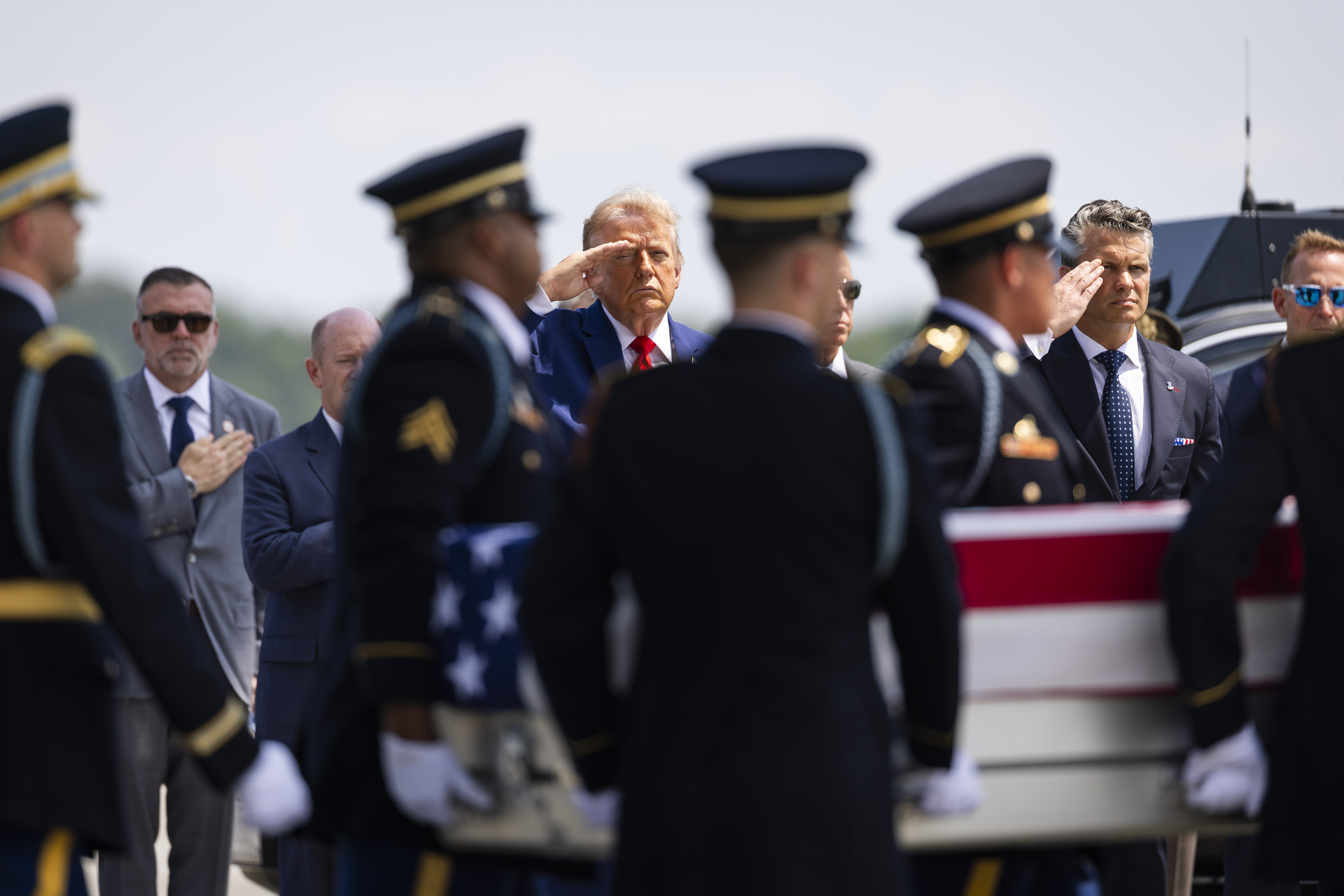
 US President Donald Trump (C) and US Secretary of Defense Pete Hegseth (R) salute as a carry team carries the remains of Sergeant Angel Rampersad, who was believed to be killed in an Iranian airstrike in Jordan, during a dignified transfer at Dover Air Force Base in Dover, Delaware, USA, 22 July 2026. Four US service members have been killed since the ceasefire between Iran and the US fell apart. EPA/JIM LO SCALZO
By Phil Stewart
The Pentagon did not immediately respond to a request for comment on its estimate, which has not been shared publicly.
The disclosure about the rising cost of the Iran war comes as Republicans wrestle with the political fallout of the unpopular conflict ahead of the November 3 election that will determine control of Congress for the next two years.
The war's impact on global energy costs has weighed on support for Republican candidates and hurt President Donald Trump's approval ratings. Trump's Republican Party holds a narrow majority in both chambers of Congress.
The Pentagon's latest estimate was tied to the operational costs of carrying out the war, with a projected cost of more than $29 billion to replace expended munitions used in the conflict.
More than $6 billion would be needed to replace military equipment and so-called "platform losses," which include the loss of aircraft including many drones lost during the war.
Trump launched the Iran war jointly with Israel in February, predicting that the conflict would last a short time.
Trump's initial strategy in the Iran war focused on first using expensive, high-end precision missiles to bomb Iran's defenses so it could later use less expensive munitions, including gravity bombs like the air-launched JDAMs, which are plentiful.
But an April ceasefire gave time for Iran to dig out underground storage facilities, bringing back online some Iranian defenses, as well as missiles and drones that had been inaccessible.
Trump has since imposed a naval blockade on Iran to starve it of oil export revenue and held out the possibility of restarting combat operations after the midterm elections. US officials, speaking on condition of anonymity, say the Pentagon has been planning to restart heavy fighting if ordered to do so.
The latest Pentagon estimate compares to Defense Secretary Pete Hegseth's July estimate of $37.5 billion for the cost of the war.
While the figures include a host of operational costs, from flight operations to cyber support, the US military's Iran war cost estimates did not clearly account for the massive expense expected to repair damage to US bases sustained by Iranian missile and drone attacks.
(Reporting by Phil Stewart; Editing by Tom Hogue and Stephen Coates)
Comments
Scroll down to load comments...