



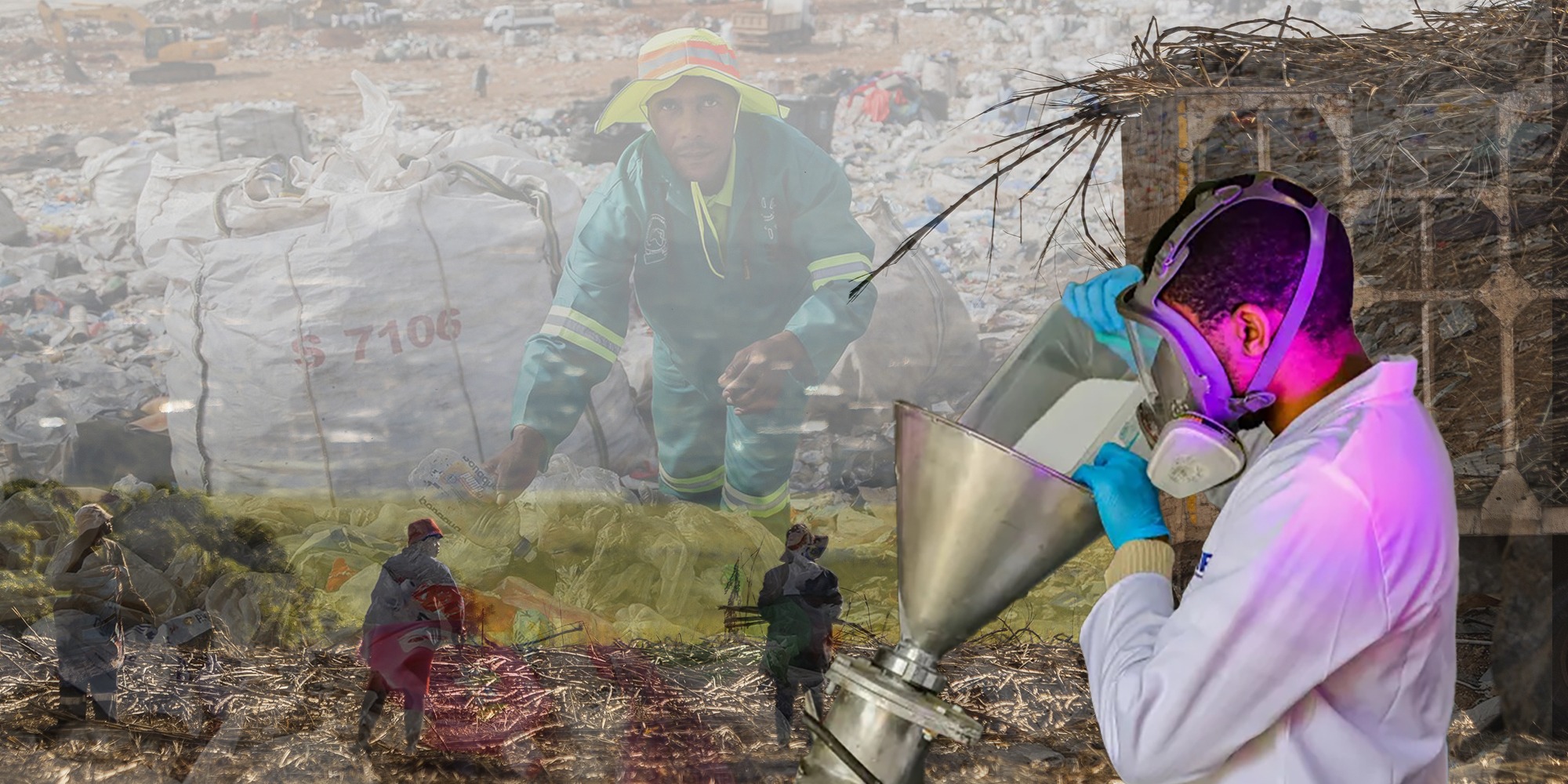
 Illustrative Image: An African Reclaimers Organisation employee at the Robinson Landfill. (Photo: Felix Dlangamandla) | Workers load sugar cane on to a truck in a field at a farm in Driekoppies, Mpumalanga. (Photo: Guillem Sartorio / Bloomberg via Getty Images) | A scientist in a lab. (Photo: CSIR website)
We live in a plastic world. It’s only natural: when it was first invented, virgin plastic (a synthetic polymer made from fossil fuels) transformed countless industries by creating an incredibly cheap, durable, lightweight, and versatile material that revolutionised manufacturing, packaging and consumer culture.
From medical devices to vehicle components and furniture. From food packaging to children’s toys and even skincare products, the list goes on and on. Plastic is virtually everywhere.
But that’s also the problem. Plastic is virtually everywhere: in our ecosystems, in wildlife, and even in the human body.
The United Nations Environment Programme (Unep) estimated that in 2025, more than 400 million tonnes of plastic were produced globally, 79% of which either ends up in landfills, is dumped, or is left as unmanaged litter in the environment.
South Africa is no different. An estimated 440,000 tonnes of plastic waste leak into the country’s rivers, coastlines and open landscapes every year.
The Centre for Scientific and Industrial Research (CSIR), through its advanced polymer research, is trying to address SA’s plastic pollution problem by developing biodegradable, compostable plastics made from plants.
Speaking to Daily Maverick in his lab in Pretoria, CSIR principal scientist Dr Sudhakar Muniyasamy explained that South Africa’s plant-based plastic industry was growing rapidly, and the CSIR was at the forefront of developing innovative bio-polymer solutions to the country’s plastic pollution problem.
“So we know that in South Africa, we produce a lot of plastic that is being sent to landfill. Normally, it’s mainly made from petroleum-based materials that can last 200 to 300 years. So we are trying to find out what the problematic plastics are in South Africa and replace them with structurally sound plastics made from plants,” Muniyasamy said.
This includes agricultural biomass that is openly available, like sugarcane by-products, forestry by-products, and other organic material that is underutilised in South Africa.
From the soil to the lab, through the hands that harvest it
The journey of alternative plastics begins long before plant-based materials reach the hands of Scientists like Dr Muniyasamy, or local manufacturers like Bonnie Bio and Fortis X, on the diverse farms scattered across South Africa.
From the sugar cane belts of KwaZulu-Natal and Mpumalanga, to the maize fields in the Free State and North West and even poultry farms in KZN and Gauteng. Farm workers collect the harvest, and processing the plants generates mountains of bagasse (a by-product of sugar cane), sawdust (a by-product of forestry), and even chicken feathers.
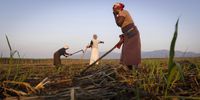
Instead of composting the crop residue, they send it to facilities like the CSIR, where it is turned into plant-based plastic products.
Leading Daily Maverick through the CSIR’s bioplastics and packaging production facility, Dr Muniyasamy said one of the organisation’s most significant achievements was developing biodegradable mulching film for the agricultural sector.
SA’s agricultural sector, while far from the leading driver for single-use plastic consumption, uses approximately 140,000 to 180,000 tons of plastic products per year.
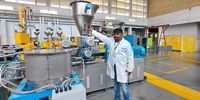
The CSIR’s plant-based mulching films are designed to cover crops like pineapples, strawberries and cucumbers, protecting them and promoting growth. What sets them apart is that they are tailored to biodegrade naturally in soil in one to three months for short-term crops, or up to 12 months in longer-term crops.
Beyond mulching films, CSIR is developing a range of biodegradable products, including cutlery, takeaway containers, medical test kits, straws and compostable bags, and is even exploring applications for fishing nets and hygiene products.

Although it is a relatively new field in the country, SA’s plant-based plastic industry is growing rapidly. However, so are consumer misconceptions about what is biodegradable and greenwashing from some manufacturers.
Clearing the molecular confusion
A persistent misconception undermines public understanding of green packaging: that plant-based inherently means biodegradable. In reality, these two terms are not synonymous.
Plant-based plastics fall into two distinct groups: bio-based “drop-in” plastics (Bio-PET) and compostable biopolymers (PLA and PHA).
Bio-PET is derived from sugarcane ethanol rather than crude oil, effectively replacing fossil feedstocks with renewable plant materials. But its final molecular structure is chemically identical to standard, traditional plastic (PET). It behaves like conventional plastic: recyclers can melt and reprocess it, but if it ends up on a roadside or buried in a landfill, it will exist there for centuries. It cuts fossil carbon at the source, but it does nothing to prevent plastic pollution.
On the other hand, PLA and PHA are made from fermented plant starches, like corn or cassava, and can naturally break down into water, biomass and carbon dioxide, but only under specific conditions.
In reality, most PLA and PHA only break down properly under industrial composting conditions. This means they need sustained temperatures of 58°C to 60°C, specific humidity levels, and regulated aerobic microbial activity to break down. Home composting cannot provide these conditions.

The infrastructure gap
South Africa faces a gap between the promise of bioplastics and the reality on the ground. Although compostable plastics such as PLA offer green alternatives, the country possesses virtually no municipal industrial composting facilities capable of handling post-consumer packaging at scale.
The government has acknowledged this infrastructure gap. Speaking to Daily Maverick, Sello Molekwa, Acting Chief Director at the Department of Forestry, Fisheries and the Environment, explained that modern bio-polymers require specialised waste facilities that local infrastructure simply cannot match: “The end-of-life treatment for most of the biodegradable alternative materials requires industrial-scale facilities with standard operations (i.e., temperature-controlled) which are currently in short supply in South Africa,” Molekwa said.
Without temperature-regulated processing, post-consumer alternative plastics can go straight into municipal landfills like Robinson Deep in Johannesburg or Mariannhill in Durban.
Buried beneath layers of mixed domestic waste, the environmental benefits vanish. Deprived of oxygen, heat, and microbial activity, PLA sits intact for decades, slowly decaying under anaerobic conditions that generate harmful methane.
Molekwa said that under SA’s circular economy vision, “landfilling is no longer a feasible option”.
To divert plant-based plastics from dumpsites, the Department of Forestry, Fisheries and the Environment relied on its 2018 Guidelines on Separation of Waste at Source, encouraging households to sort refuse before collection. To build needed capacity, Molekwa said the department was using the Waste Management Flagship Programme, supported by the International Finance Corporation and Development Bank of Southern Africa, to pilot organic recovery, alongside the Recycling Enterprise Support Programme (Resp), which offers up to R5-million in grants to emerging waste ventures.
Until those initiatives scale up, compostables threaten mechanical recycling. South Africa has a robust recycling network that processes tons of conventional PET and HDPE annually. But when well-meaning consumers throw PLA items into standard recycling bins, trouble begins. Because clear PLA looks identical to standard PET, it slips into recycling batches. Because PLA melts at a lower temperature, it chars during processing, degrading the recycled material’s structural integrity.
The department highlighted this contamination risk, noting that protecting clean streams demanded strict sorting at the source: “It is important to note that the correct blend of materials is required to ensure proper degradation without negatively impacting compost quality. Furthermore, there is a high risk of contamination with non-biodegradable plastics; therefore, separation at source and accurate sorting are required. If this is in place, conventional plastics can slot in with other mechanical recycling systems,” Molekwa said.
To assess the situation, producer responsibility organisation Petco is conducting a targeted study on market penetration of plant-based packaging to guide future policy interventions.
While the bio-plastic industry in South Africa is growing, it is still at an early stage compared to other countries. Munyisamy said that accelerated growth required a concerted effort from the government, industry, scientists and policymakers. The CSIR continued to advocate for scientifically backed, locally relevant solutions to ensure a truly sustainable and pollution-free future. DM


Comments
Scroll down to load comments...