



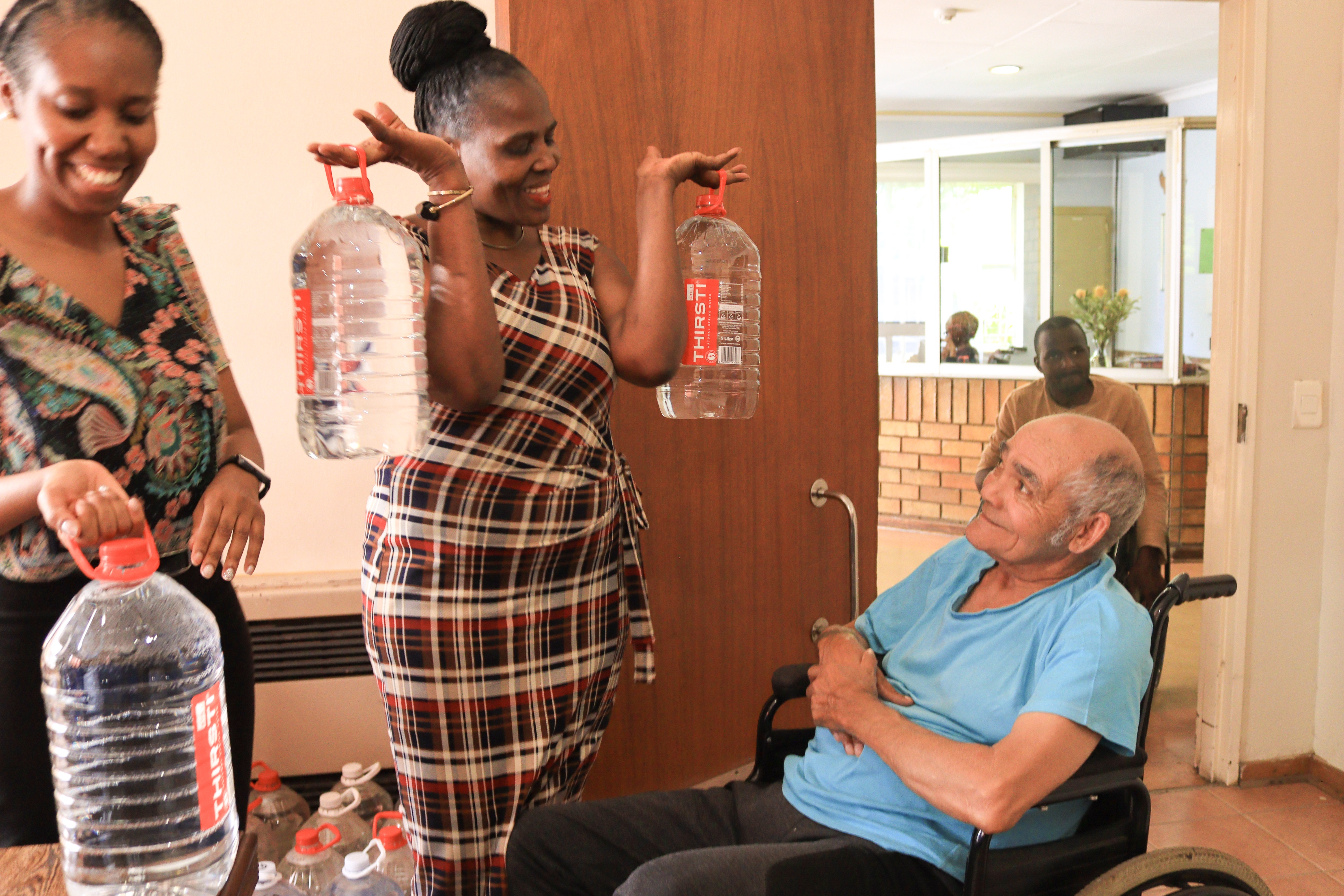
 Social worker Nobona Kala Maswanganyi (left) smiles with bottles of donated water alongside disabled resident William van Wyk. (Photo: Jamie Ho)
Soiled nappies piled up, toilets went unflushed and dirty bed linen could not be washed as a five-day water outage plunged a Johannesburg home for people with disabilities into a hygiene crisis.
At St Giles Association for the Physically Disabled in Dewetshof, near Kensington, many of the 29 residents are frail or physically disabled and rely on caregivers to get out of bed, dress, bathe and use the toilet. Some need to be bathed two or three times a day because of incontinence.
“The past few days have been hell. We have never had such a long outage, and for us it was a complete nightmare,” said manager Palesa Nhlapo.
Emergency reserves of 25 litres in each bathroom ran out within a morning. Dirty linen and clothing accumulated, floors could not be washed properly and staff struggled to keep toilets clean, raising fears about the spread of disease.
“We keep 25 litres of water in every bathroom for emergencies, but that was finished in one morning,” Nhlapo said.
Even preparing meals and providing drinking water, tea, coffee and juice became difficult in the heat.

Staff hired a bakkie to collect water from the Jeppe Fire Station – an extra expense for a struggling nonprofit whose residents contribute only about 40% of its running costs.
“It has been very distressing and caused a lot of anxiety as we watched the pile of soiled bedding and clothing and nappies grow, wondering about the spread of infection and germs. Not only were our 58 members of staff alarmed, but it deeply affected our most vulnerable residents who were not being given their regular care,” Nhlapo said.
But when the home’s plight was shared through the Water Crisis Committee network, neighbours arrived with bottled drinking water and filled 25-litre containers.
“The outpouring of love has overwhelmed us. People have been coming in for days now, just bringing whatever water they can. We are truly grateful. We now at least have containers, although we never know when there is going to be another outage,” Nhlapo said.
Residents take to the streets
The ordeal at St Giles comes as water shortages trigger protests across Johannesburg in the days before the 4 November municipal elections. Some households say they have gone more than a week without running water or an emergency tanker delivery.
On Saturday, 24 October, residents of Mayfair, Crosby and surrounding areas protested outside Brixton Police Station after days without running water. They depend on the troubled Commando supply system, which includes the Brixton, Crosby and Hursthill reservoirs.
Further water protests have been announced in the coming days.
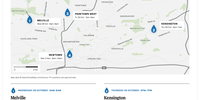
Melville residents plan to gather at Main Road and Fourth Avenue from 6am to 8am on Wednesday, 28 October, urging neighbours to bring bottles and “make some noise”.
On Thursday, 29 October, residents of Kensington, Observatory, Bezuidenhout Valley, Bertrams, Judith’s Paarl, Yeoville, Berea and surrounding areas plan to meet at Queen Street and Albertina Sisulu Road from 5pm to 7pm.
The Water Crisis Committee says many have been without reliable supply since 22 October. It is demanding emergency water deliveries, clear restoration timelines and repairs, and has barred political branding from the protest.
Parktown West residents plan to gather on Jan Smuts Avenue, between Loch Avenue and Seymour Road, from 7am to 9am on Friday, 30 October.
Their notice reads: “Weeks Dry. ZERO Answers.”
Residents also protested in February, when some reported weeks without dependable water.
In Lenasia, service-delivery protesters blocked the N12 near Nana’s Farm on 26 October, after another demonstration the previous week. Their grievances have included water and electricity shortages.
Join the protests
If you’ve been affected by the water cuts or want to protest in solidarity, you can make your voice heard at one of the above protests. The events are aimed at being peaceful and are not affiliated to political parties. Pitch up with or without a sign and feel free to bring something to make some noise.
Desperation in the suburbs
In Malvern, opposite Malvern West Primary School, a resident reported this week seeing people illegally opening a municipal fire hydrant and filling 20-litre containers, which were loaded on to a bakkie. It is not known who opened the hydrant, whether they were authorised or what the water was intended for.
In neighbouring Bezuidenhout Valley, Johannesburg Water issued a warning on 24 October after receiving reports of a private truck selling water on Ninth Avenue.
“The source and quality of the water being sold have not been verified,” the utility said, urging residents not to buy it because its safety could not be guaranteed. Water delivered by authorised Johannesburg Water tankers is free and must not be sold, it said.
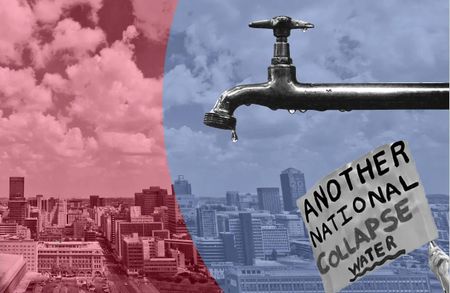
Yet residents complain that official tankers are not reaching them. One person living in flats opposite 226 Sixth Avenue in Bezuidenhout Valley wrote in a community WhatsApp group: “9 days without water and not even a water truck in 9 days.”
The resident questioned how many germs were accumulating in homes where people could no longer maintain basic hygiene in the heat.
A Kensington resident complained that emergency supplies appeared to be concentrated in Bezuidenhout Valley.
“It feels as though we in Kensington are being punished, despite also having had no water since Thursday last week,” the resident wrote.
“To make matters worse, water tankers are not reaching us, and when assistance does arrive, it appears to go only to Bez Valley.”
The complaints about unequal tanker distribution have not been independently verified.

Despite their growing desperation, residents have expressed appreciation for the community volunteers trying to help them.
“We appreciate you guys, heartily! You are doing a noble job,” one resident wrote in the Water Crisis Committee’s WhatsApp group.
“We just can’t help but cry out loud right here when the pain of being waterless cuts deep.”
At least 11 care, medical and educational facilities have been identified in or near the eastern suburbs, including homes for elderly people and people with disabilities that were left without water for days.
Water that may not be safe
Bezuidenhout Valley residents face a second difficulty: a precautionary water contamination warning after a drinking-water pipe was damaged during sewer-replacement work.
Initial tests showed no indication of contamination, but Johannesburg Water warned residents in a limited section of Eighth Avenue, near Fourth to Seventh streets, not to use tap water until further clearance.
On 26 October, the utility said a supply interruption had delayed further sampling. Councillor Neuren Pietersen said this was because there was no water to test as the pipes were empty.
Financial strain
The failures are unfolding as Johannesburg grapples with serious financial pressures.
In April, Finance Minister Enoch Godongwana warned Mayor Dada Morero about mounting debt, weak revenue collection and an unfunded budget.
The City has rejected suggestions that it is bankrupt and says it is working to restore services. Residents, however, are judging those plans by whether water flows, the lights stay on and rubbish is collected.
Pietersen said the shortages were part of a province-wide crisis, with Johannesburg losing an estimated 400 million litres of water daily and Ekurhuleni another 200 million litres, while Rand Water struggled to meet demand of about five billion litres a day.
On Friday, Rand Water said, “To protect the water supply system and ensure equitable distribution, Rand Water will begin restricting supply to municipalities that continue to exceed their allocated consumption volumes. These restrictions may result in low water pressure or intermittent water supply in affected municipalities.”
Following a public meeting with MP Stephen Moore, Pietersen said the national government was considering stronger measures to compel municipalities to reduce water losses and protect revenue for infrastructure maintenance.
An O6 pipeline (a high-capacity bulk water transmission main) and pump station project was already under way to improve supply to the Yeoville reservoir serving his ward. However, he warned that residents needed to conserve water to reduce pressure on the system and avoid further restrictions while infrastructure was repaired.
Power failures
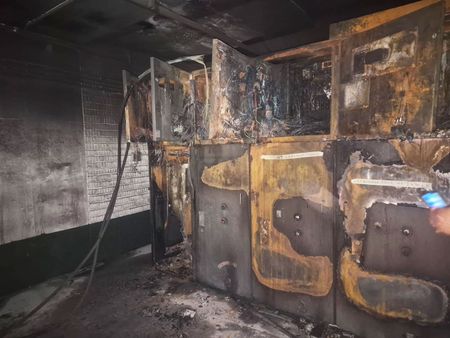
Electricity outages are adding to the pressure on households and businesses. Repeated fires and explosions at City Power’s Central Substation left sections of the CBD without power, forcing businesses to buy diesel for generators or interrupt trading. Another explosion on 14 October delayed repairs; by 23 October, City Power said it had restored supply to about 98% of affected customers.
Elsewhere, residents continue to report unplanned outages linked to ageing equipment, faults, theft and vandalism. City Power has also scheduled maintenance interruptions in several areas. Those planned shutdowns are distinct from breakdowns, but both leave households and businesses having to make alternative arrangements.
Refuse collection
Rubbish has also gone uncollected in parts of Johannesburg as Pikitup struggles with vehicle shortages and recurring collection backlogs. The entity acknowledged delays earlier this month and said teams were clearing missed rounds. Previous disruptions included protests affecting six depots in August, while its reliance on hired trucks has raised further questions about the sustainability of the services. DM
Comments
Scroll down to load comments...