



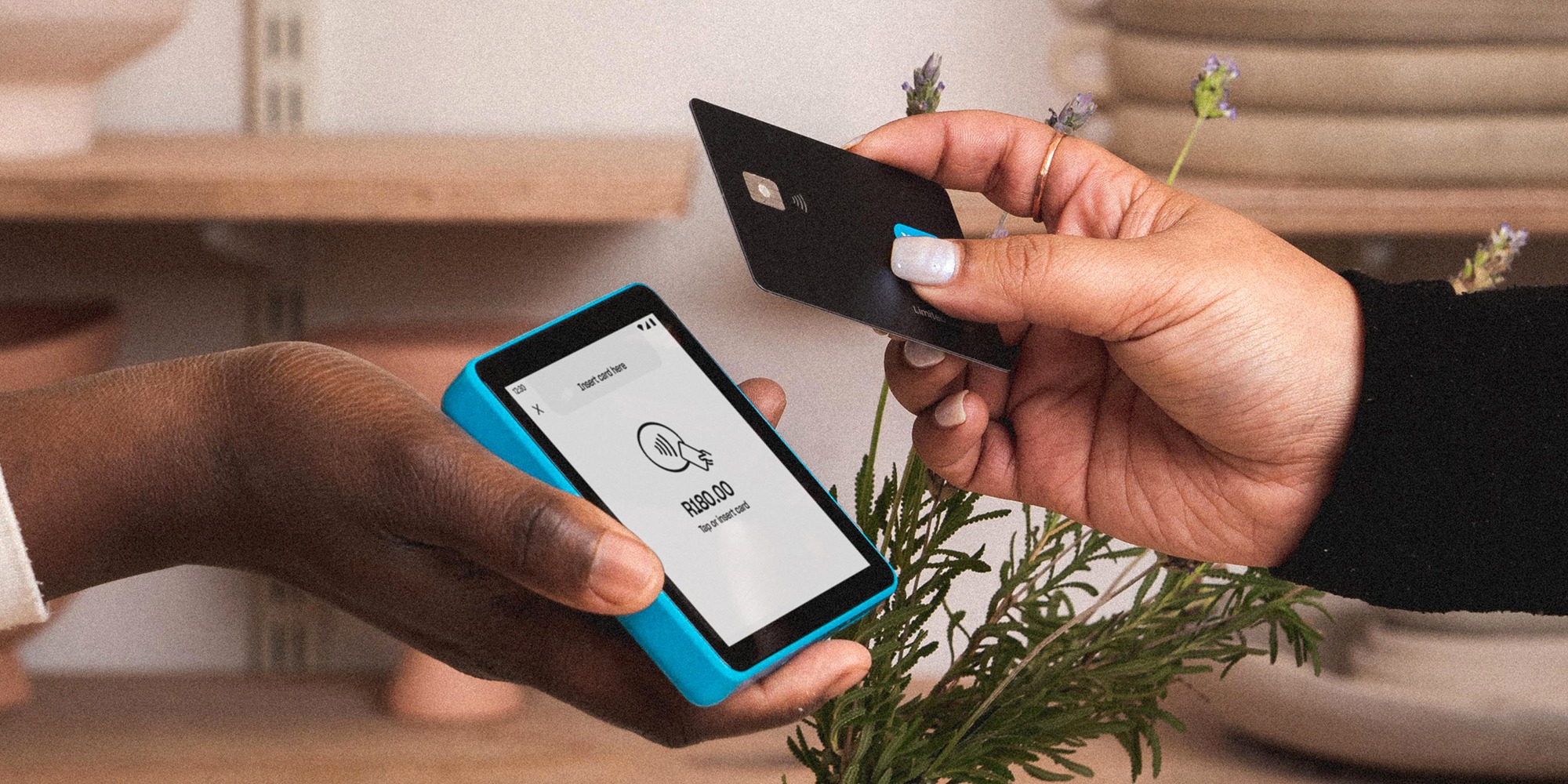
 A Yoco card machine. (Photo: Supplied / Source)
At a gathering of international clients of BPC, a payment processing company, the tension was palpable between conference attendees who can afford to buy their own lunch – but meals will be catered – and the uninvited people who need food, clothes, shelter and access to basic amenities and whose problems the conference attendees are there to solve.
Based in Switzerland, BPC is a firm whose services you have probably encountered without realising it.
Their SmartVista software is running in the background of daily life: when you pay for something, your bank – the issuer – needs to communicate with the bank of whoever you’re paying – the acquirer.
Tech such as BPC’s facilitates that process; it’s there while you’re waiting for your online purchase to be verified, when your banking app asks you to approve a transaction, when it detects a payment that goes over your spending limit, and more.
South Africa is just one of the roughly 150 countries it serves, but it happens to be “the fastest-growing region in the company”, Craig Albertson, the company’s country manager for SA, told Daily Maverick.
The company was also kind enough to host us at its expense to see the future of digital payments in Africa.
Changing the payments landscape
The finance buffs who spoke at BPC’s conference provided an interesting look into what the corporate world sees in an “emerging market” such as ours.
Essentially, we all understand that what we’re talking about is how to make money in regions where people generally don’t make very much money.
Less cynically, you could argue we were talking about how to help people who earn low incomes, or earn in weaker currencies, make their money work better for them.
What’s clear is that the modern payment landscape is messy and changing fast, even in countries where things tend to move slower. The guys in suits are looking for ways to benefit from untapped potential, but doing this in a way that is sustainable and actually benefits the communities they claim to serve is not straightforward.
As in all areas of life, it seems, a big question mark hangs over the role of AI in payment systems.
Avin Ruthipaul, chief information officer of lending products at Standard Bank, put it like this: “I think issuing is not ready for agentic AI.”
In the past, if card issuers, payment platforms or merchants detected bot activity, it would have been an immediate signal to pull the plug on a transaction.
Now, AI can be a legit player.
With instructions, it can do things like “book a seven-day itinerary for two people direct from San Francisco to Paris with refundable economy flights for under $2,000, and pay with the best credit card based on rewards,” as McKinsey & Co put it. Scary stuff.
Ruthipaul framed this as part of the pile of worries creating a kind of decision fatigue – or as he put it, “cognitive debt” – for those in the boardroom.
Brave new world of fraud
There are two sides of the AI coin when it comes to fraud. “AI-driven profiling” can be a helpful way of stopping it, and at the same time, bots have become much smarter about swindling both those making payments and those receiving them.
The advent of technology has also made everything more immediate, especially as account-to-account (A2A) payments, in which money is transferred directly, rather than through a card network, take hold.
“To our customers and to your customers, all payments are instant…Instant payments are final, so fraud must be stopped before money moves,” noted Geoffrey Tunbridge, BPC’s Asia-Pacific head of presales.
The fraud issue brings us to trust, which goes both ways. Banks might be more powerful than their customers, but they are still worried that many South Africans do not trust them.
According to the South African Reserve Bank, about 55% of South Africans earning a monthly salary of R1,250 use cash only, and 24% mostly use cash. In a 2026 report, the SA Reserve Bank predicted that “in the future, cash will still be preferred by 40% of consumers”.
A huge part of this is, of course, avoiding bank fees when every cent counts. The likes of GoTyme would argue that they offer free bank accounts to all.
Still, Jimmy Sounes, GoTyme’s managing executive of Card Strategy, said that though it has 13 million registered customers, only about five million are actively transacting.
GoTyme also needs to turn a profit, and when questioned, simply says “it’s a volume game” and cites “lower margins” as the reason it is profitable, despite positioning itself as radically different to your average bank.
Sounes told conference attendees that any transactional income GoTyme can get, including from loans, has appeal.
As a result, lending is set to become a big part of the business, particularly after GoTyme acquired a lending JV with Sanlam last year. BPC’s payment tech will underpin the new offering, which is expected to go live next year.

The trajectory of GoTyme as a full-fledged lender will be a big test of its commitment to economic empowerment. Given that GoTyme actively targets lower-income customers, it needs to be very careful about the way it frames loans.
Besides attracting previously unbanked customers, banks are stressed because they need to hold on to old customers looking for greener pastures in the world of fintech.
“People are leaving banks because they want added-value services that fintechs offer, like invoices, stockkeeping… The siloes and barriers of payments are gone,” BPC’s Tunbridge added.
Tier-one tie-ups
In that landscape, companies need to offer convenience that works, which demands the sometimes painful process of modernisation.
BPC has designs on becoming a “household name” and setting up a new legal entity in South Africa. Business has been boosted by contracts with “tier one” banks, which it will name in December or the first quarter of next year, Albertson told Daily Maverick.
“The projects that we’re doing with our new customers are mega-complicated,” he said, as some of the banks in question have been running on 30-year-old technology.
“They’re so complicated that just getting off the old stuff to the new stuff is, roughly speaking, a two-year journey.”
Albertson said that “it’s our other customers, the digital guys, the innovators, that have forced the traditional guys to change their business models and become much more flexible, be able to take products quicker to market.”
On top of that, the workforce which knows how to operate the old systems is reaching retirement age.
One of the ways things could change for SA cardholders is the way our accounts are categorised:
“We might see a product moving from a financial tier system that we’re quite familiar with in South Africa. You’ve got a standard card, you’ve got a gold card, a platinum, whatever your tier, usually based on income levels or your spend patterns. I think you’re going to start seeing things like lifestyle-based products. And this is very similar to what e-commerce is doing, but coming into banking products.”
Things going well for payment processing companies can be an indication that things are going well for normal people. But not necessarily. High payment tech adoption rates do not equal widespread financial stability.
Tap and go
BPC is keen to communicate that its services go beyond banking. O-City is “the SmartVista platform, but geared for the transit fares collection marketplace”, Albertson explained.
That means using an issued token (read: a pre-approved transaction fee) on something like a card, phone, QR code or smartwatch to tap in and out of a public transport network, paying fares on the spot.
Through a partnership with a company called Calmex, O-City is already used in Johannesburg’s on-again-off-again Rea Vaya metrobus system. Albertson explained that BPC is in discussions with other municipalities too, though he was not at liberty to say which ones.
“They are interested in scenarios like capacity planning for taxis,” he said, with the potential for a payment processor like BPC to be involved in fare collection.
“The taxi industry – a very hard nut to crack. That’s a nut that many people have tried to crack in South Africa,” he said.
If this were to happen, it’s important that payments are compatible with the informal economy as it already exists.
Albertson adds that payment should not be tied to cards which you load with money.
He argues that people should not be at risk of machines malfunctioning and not allowing them to top up their cards. They also cannot afford to lose money loaded on to a transport card that could be lost or stolen.
“Account-based means it’s on your phone. It can be on an instrument,” he said, circling back to the idea of a token we mentioned earlier.
Municipal authorities would benefit from digitised transport data, he argued. Cities are “trying to understand commuting pathways…the only way they can do that is follow the money”.
In his view, this could help improve South Africa’s wider public transport system. We should keep in mind that the taxi market is a big target for many players in the payment industry, because of its favourable opportunity cost.

Identifying the beneficiaries
Another important thing to remember is that the cost of transport itself is a major burden for many South Africans, especially those living in neighbourhoods that developed from segregation. Having better data on how people move around will not automatically make it more affordable for them to do so.
We also have to be careful not to cast the township economy as a mass of untapped potential, where trading has remained informal simply because people “prefer” it that way.
As Daily Maverick reported previously, a Competition Commission report published in March shows that roughly half of rural and township households spend their money outside of eKasi, citing limited supply in local shops as an issue.

Those shops, in turn, have struggled to carve out spaces for themselves in more formalised trading environments, like shopping malls, not out of preference, but as a result of prohibitive rental costs.
BPC acknowledges that there is more to digitising transport fares than making taxi commutes simpler.
“Think about the percentage of revenue City of Cape Town gets from tourism. How incredibly easy for a tourist to land, download the app, get a wallet and exchange it anywhere you want. It’s not cash, you’re safe. It’s got all the securities or biometrics behind it. And you can use any City of Cape Town service immediately off your wallet.”
This sounds genuinely great – the only thing is, we still need to think about who is being left out of the equation, and if the reason they are being left out is that the improved systems we propose are not financially accessible.
What the payments sector can see when it looks at SA is this: “Here are ways to make more money. Let’s do it!”
They see opportunity in communities far from the softly lit halls of a five-star hotel. That is okay, in theory, and it’s not particularly helpful to paint big business as simply nefarious when its services have the potential to help small businesses grow.
South Africans need to keep an eye on whether the structures we are setting up, and the players setting them up, are actually going to make everyone’s lives better, or just the lives of the people who already have what they need. DM
Comments
Scroll down to load comments...