


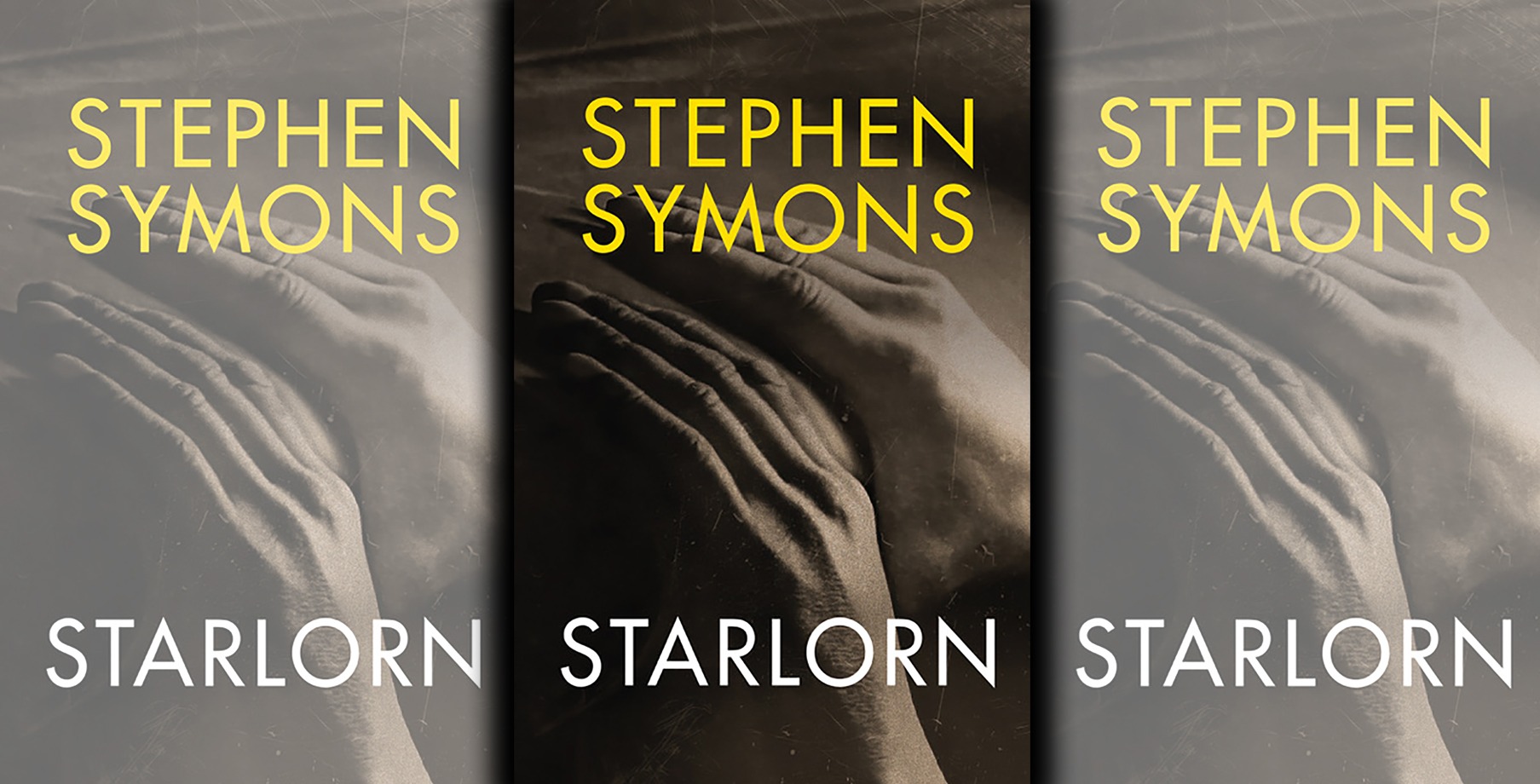
 Starlorn by Stephen Symons. (Photo: Karavan Press)
Starlorn is broadly based on the true story of a famous a 22-year-old ace fighter pilot and the youngest captain in the Luftwaffe, Hans-Joachim Marseille, and his friendship with a black South African prisoner of war, Corporal Mathew “Mathias” Letulu.
Nicknamed the “Star of Africa” and known to “disdain authority”, Marseille flew during World War 2 in the north African campaign and claimed more Western Allied aircraft than any other pilot. His friendship with Letulu, who served with the Native Military Corps, was “in direct contradiction to the Nazi mandate”.
“Where I go, Mathias goes,” Marseille told his commanders, having requested Letuku as his batman or personal assistant.
Marseille’s story garnered one movie and more than 10 books focusing on his flying prowess, but none focuses on this relationship.
Then again, Symons is adamant that Starlorn is “a work of imagination” rather than fact. “The story is just the scaffolding,” he says. “It’s really a story about one man’s conscience and how he meditates on those moral fractures of the 20th century.” Starlorn requires that you “let go of your preconceptions of what is right”.
Working with the original story, using imagination and many hours of painstaking research into the times, Symons breathes life into the complexity of humanity and the nature of war, focusing on the relationship between two highly unlikely characters, Hans Muller and Jacob Makwetu (he changed their names because he “didn’t want readers to have any preconceptions that I was writing a novel that’s necessarily based on historical facts”).
The result is a restrained and beautifully balanced story that is both dimensional and believable, in which Hans and Jacob bond over Cuban rumba, jazz and swing records, chess and a joke that Jacob was born in a South African town called Berlin.
It all started with an article
The idea for the book came to Symons through an article on Marseille by the late Peter Dickens, sent by a friend who thought he would be interested in it. “And I was, I was blown away by it,” he says.
As for the unusual title, Symons was “thinking of words around forlorn, and somehow starlorn crept into my thoughts”. He also discovered the word in The Dictionary of Obscure Sorrows by John Koenig.
“I’ve always been fascinated by the way in which humans have taken this supposedly uninhabitable space and turned it into a space of conflict.”
Beyond that, “there’s something very technically alluring about flying fighter aircraft”.
Symons had also always wanted to fly and thought that joining the South African Air Force was “the natural order of things during apartheid”. His mother quickly disassembled that romantic notion, but he did eventually learn to fly single-engine aircraft.
More important than the history
Starlorn has a definitive cinematic feel, and Symons wanted “seemingly insignificant moments to be highlighted”.
“Firstly, instead of chapters, there are numbered sections and interspersed between these sections are factual notes,” he says, adding that these notes provide a grounding element of context and also pull the reader out of the narrative momentarily to provide respite, given that Starlorn is “a fairly heavy novel”. The purpose is to disrupt the formal structure of the novel in keeping with the disruptiveness of war.
In Symons’s poetry, language has greater precedent than the topic. The topic is merely a framework for language. In Starlorn, however, the relationships between the characters are more important than the history, or the fact that it is a novel set during war. “And actually,” he points out, “half the novel is set post-war.”
As it shows remarkable tenderness between men in a time of war, Starlorn is a beautiful antidote to this time of extreme violence, hate, fear, misogyny and the manosphere.
“The novel is about – or my attempt at least – to create real human beings,” Symons explains. He believes “these manosphere individuals have nothing to be angry about. Their anger is a fabrication. Whereas men at war have everything to be angry about. They’re often unwilling participants in the most violent of human activities, yet they find humanity in it.”
Deep research
Symons’s writing is equally at home in small details and the bigger picture, drawing on deep, meticulous research.
He tells the story of going to the Imperial War Museum at Duxford in England and, quite by chance, meeting one of the mechanics who worked on the restoration of aircraft, who invited him to one of the hangars where they restore fighter planes. There, he got to sit in a cramped Spitfire cockpit and to put his hand on the joystick and press the fire button.
“I wanted to write a novel that was technically accurate to the circumstances and not according to a 21st-century perception of how characters would act. I wanted the humans to act according to the times. I did a tremendous amount of reading. The most important thing is I wanted to try and allow those air combat scenes, and scenes from the cockpit, to be as authentic and believable as possible,” he says.
“This is not a novel for 21st-century sensibilities,” he adds. “I used accounts written by German pilots and Allied pilots from during the war.”
Lionel Read, an ex-South African Air Force pilot and co-author of The MiG Diaries about the South African Border War, was the technical adviser for the book.
Symons felt “it was important to get a feel for the period”, hence the inclusion of beautiful, evocative period photographs, which provide a potent visual sense of the times.
He also listened to a “tremendous amount of music”, which had the ability to take him directly into another time. In fact the book includes a playlist of popular period music (the likes of Marlene Dietrich’s Lili Marlene and the German military marching song Erika), as well as a list of aircraft and weapons, which the author has treated as dramatis personae.
A literary conundrum
There is one big question authors like Symons grapple with, which is central to contemporary South African literature, particularly regarding race, history and colonialism: who has the authority to tell whose story?
South African novelist Claire Robertson, for example, bypasses the minefield of current mores in her later novels, including The Immortalites, by setting them in her own past as they concern her own ancestry.
“I was warned that this might be a dangerous venture if I was telling the story through the eyes of a black man,” Symons explains. But “we all have the authority to tell the story”, and “no one has ownership over your imagination”. The idea that it might be viewed as “cultural appropriation” is also problematic for him because “we’re actually all humans”.
“So, at what point do we draw these lines? At what point do we set boundaries and draw the map to contain the creative act?” he asks. He follows this with a wry aside: “Well, you know, we live in the age of absurdity.”
The question remains: “Have I ticked all the necessary boxes?”
“I’m not sure,” he says.
Yet, as Symons points out, he isn’t telling the story through the eyes of a black man but a white man. In fact, the reader “is getting a second-hand view of Jacob through the eyes of Hans”.
“This is not me (the author) describing Jacob. This is Hans Muller’s view of Jacob. And at the same time it is romanticised because this guy’s falling in love with him.”
‘Humanity shines through’
It is clear from the two men’s interaction that it “is one in which Jacob holds his own. He has a life and he speaks of his own life. He has dreams and ambitions. As a character he is firmly placed. He has a foundation. Jacob is not romanticised either. He understands his position.” This is subtly but clearly expressed in his comment: “We had to train with assegais. But when Tobruk fell, they gave us rifles.”
Hans may be a Luftwaffe pilot “but is not a zealot”, Symons says. Instead, “he’s actually caught in this ethical interstitial space”. Yet “strangely enough, his humanity shines through – he knows what’s right and wrong. And he knows when he’s erred on the side of wrong.”
Of his relationship with Jacob, “it’s impossible to categorise, it’s impossible to label. And that is why their relationship is never, in a sense, sexually consummated in the novel.”
The desert too functions almost as a character in Starlorn. This approach came from Nicholas Monsarrat’s book The Cruel Sea, a book Symons’s grandfather urged him to read.
In Monsarrat’s book, Symons says, “the real enemy is not the man you’re fighting, it’s the sea. I incorporate the desert into the post-war part of the novel.” The desert makes its way back, like the residue of sand in Muller’s pocket on his return to civilian life.
Asked if he feels Starlorn is timely, given the current state of the world and that it is the story of two unlikely individuals who defied the racial and ideological norms of their time, Symons says: “This is really a novel about trauma. It is vitally important because it allows us to really drill down to what it is to be human.”
And what would he like readers to take away from Starlorn? “In a sense, I want people to understand that the novel is both intimate and expansive.” DM
Starlorn is published by Karavan Press. It launches at BookBedonnerd in Richmond from 29 to 31 October 2026.
Comments
Scroll down to load comments...