


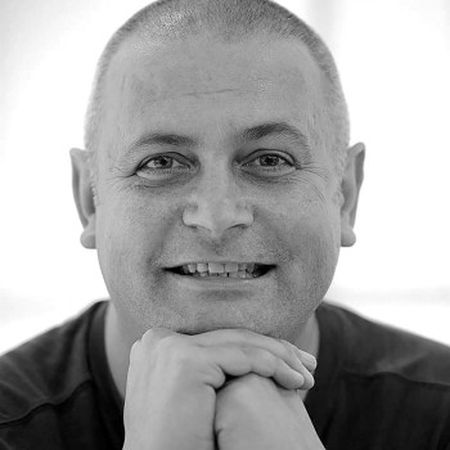
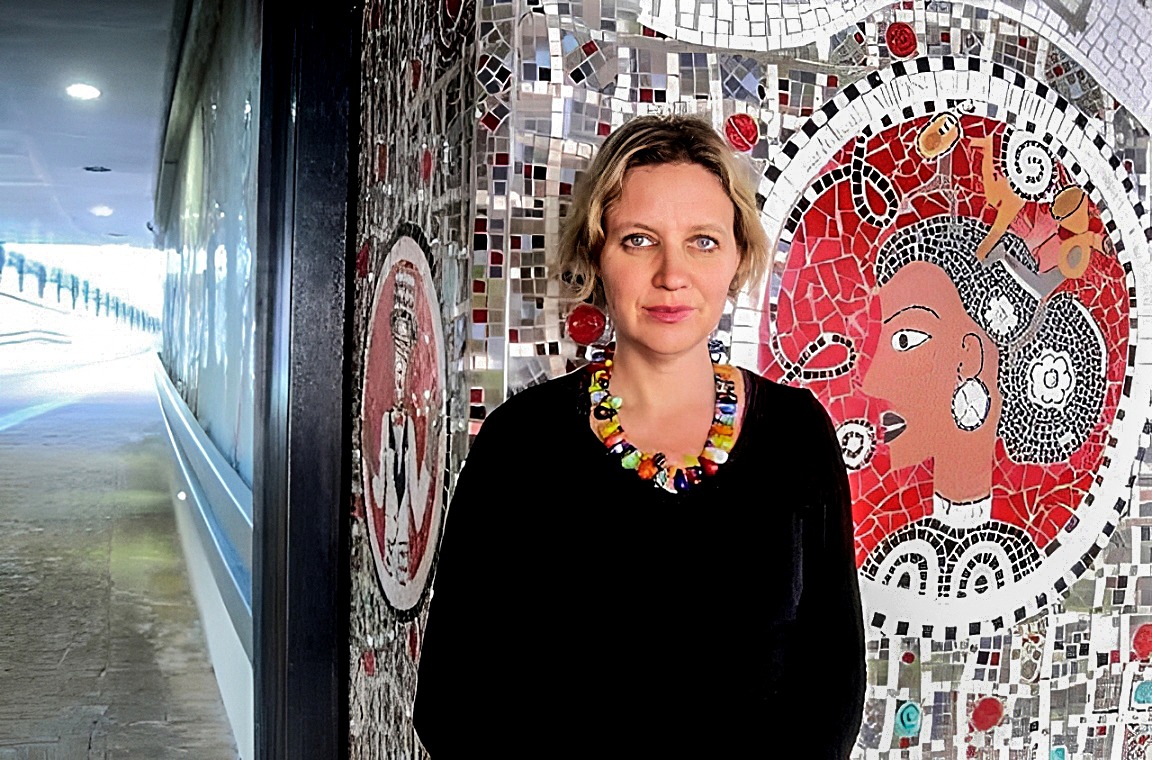
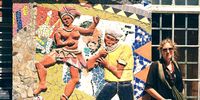
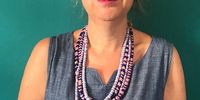
 Lovell Friedman beside one of her public mosaic works. (Photo: Lovell Friedman / Facebook)
The ceramic sculptor, mosaic artist, activist and humanitarian Lovell Friedman died unexpectedly in Cape Town on 11 October 2026 at the age of 63. She was born in Cape Town on 17 February 1963 and grew up in Oranjezicht. Friedman still lived in the same house where her family had been for four generations.
The house is adorned with her many mosaics, sculptures and plates, reminders of the artist whose work was woven into the fabric of her family life, as well as that of Cape Town.
In reflecting on her life, her husband, the psychiatrist Dr David Kibel, says he met her in 1996 through their close friend Lindsay Rabinowitz, a psychotherapist, and they married in 1999. He remembers a woman who gave generously of herself, the kindest, most loving and life-affirming person he had ever known.
She kept friendships and family ties alive across years and distances. Her care extended to the mosaic artists she trained. She worried about their wellbeing, took a deep interest in their lives and encouraged them until many had established creative projects of their own.
Her mind, Kibel says, spun in a million directions. Ideas and solutions arrived constantly, alongside an endless stream of people and possibilities. Her thinking could be kaleidoscopic and somewhat chaotic, but it was imaginative, abundant and directed towards other people’s wellbeing. Kibel believes this combination helps explain the sheer volume of her work.
Art was part of her life from a young age. Her mother, Shirley, kept materials around the house and brought home offcuts of blank paper rolls from the Cape Times. The little girl would spread them across the floor to sit on and draw, mostly in crayon.
Empty boxes that had once contained the metal type used to print the newspaper came next. She filled their compartments with tiny sculptures of colourful birds and animals.
Once, also still as a small child, she watched raindrops on a car window and told her mother excitedly that they resembled her own drawings. Shirley took her to galleries and surrounded her with art books. Later, she studied sculpture at the Michaelis School of Fine Art, the University of Cape Town’s art school, and completed a master’s degree in ceramic sculpture, graduating cum laude.
Teaching shaped her commitment to community work, Kibel says. At the Cape Technikon she discovered how much she valued helping students grow as artists. In the 1980s, she also taught children’s ceramics part-time at the Community Arts Project (CAP), the Cape Town organisation founded in 1977 in the aftermath of the Soweto Uprising.
CAP brought art, drama and dance together with political conviction at a time when apartheid determined who could study, exhibit or occupy cultural space. Kibel says Friedman had always cared about people who were poor, disadvantaged or overlooked, and that violence against women and girls particularly troubled her.
Legacy
Liane Visser, an interior stylist, curator and creative director, met Friedman at Michaelis and sold her early ceramics at her gallery on Long Street during the 1980s. The work, Visser says, looked simpler than it was: “Lovell’s work was deceptively naïve, but her whimsical, childlike qualities belied her fierce intelligence and formidable activism.”
On what would last, Visser points to the public commissions: “There are not many artists whose work will continue to inspire and be enjoyed by the very audience it was intended for. Lovell’s legacy is her body of public work and the community upliftment projects she was involved in. And her beautiful family, of course.”
Her most enduring image of Friedman combines humour, colour and defiance: “A delicious confection of wry humour and lyrical colour concealing an iron fist, always sweetly giving the middle finger!”
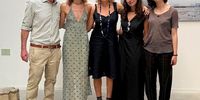
(Photo: Supplied / Mira Friedman)
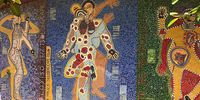
/file/attachments/orphans/Obit-LovellFriedman3_117115.jpg "Detail of Lovell Friedman mural "One Thousand Shards of Light" at the Cape Jewish Cemetery in Pinelands.
<br>(Photo: Lovell Friedman / Facebook)
<br>
<br>")
Kibel says that Antoni Gaudí, the Catalan architect whose nature-inspired designs transformed Barcelona, was an influence. Friedman became fascinated by the possibility of bringing broken pieces together to make something new. For Kibel, the idea of joining fragments into a new whole fits her approach to both art and community.
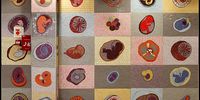
Her public commissions expanded in the early 2000s. Among them was Mother Courage, a 150cm-high mosaic sculpture made for the children’s play park at the Red Cross War Memorial Children’s Hospital in Mowbray. At the same hospital, she made a ceramic mural for the Research Centre for Adolescent and Child Health, based on the metamorphosis of butterflies.
Triangular forms turn into cocoons, butterflies and birds. She drew on the transformations in the work of MC Escher, the Dutch graphic artist known for woodcuts, lithographs and mezzotints, many inspired by mathematics. She also drew on research into art in hospitals, arguing that healing art should use nature to turn children’s attention from fear and illness towards tranquillity, flight and hope. Professor Heather Zar, a close friend, was among her collaborators.
She and her team later made the mosaic mural at the entrance to the Learning Centre of UCT’s Faculty of Health Sciences. Friedman said its concept was the healing power of hands: “Hands speak of intimacy, identity, action as well as anatomy, physiology and biomechanics.”
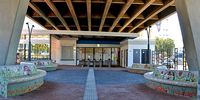
tasked with creating the urban furniture for the new station. (Photo: Lovell Friedman / Facebook)
She designed a mosaic for a South African Post Office stamp marking the centenary of UCT’s Medical School. Issued in 2012, it showed the struggle for and celebration of life for a person living with HIV.
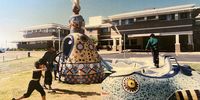
Art Times reported that she ran workshops producing mosaic pylons and murals at the Mitchells Plain Hospital, a project whose scale Kibel recalls as extraordinary. She also spearheaded the mosaic collaboration at the Guga S’thebe Arts and Cultural Centre in Langa, training local young people with architect Carin Smuts and her team at CS Studio Architects.
Extraordinary output
Jonathan Shapiro, known as Zapiro, says: “Lovell was really well known for being the most considerate person to the people she worked with in many community projects. She ran community projects where she imparted all her skills as a brilliant ceramicist to people all over, and she was known for arriving with deli food and making sure that the conditions where they were working were good.
“She was hugely known for that. Lovell did the ceramic work in the (Cape Town) stadium underpass about the history of sport in Green Point. That was Lovell. Also, the Red Cross Children’s Hospital, community centres on the Cape Flats, the benches for safe spaces for women, the anti-rape initiatives.”
The fine artist, etcher and ceramicist Ellalou O’Meara saw Friedman’s method at close quarters. Friedman arrived with boxes of bright pastels and sketched at speed on the full-scale drawing for their mosaic, which lay across a dining room floor. She brought ideas, quick understanding and generous support, and had a knack for turning up with unexpected gifts, sometimes small household delights from Giovanni’s, sometimes a practical solution to a problem, such as medicine. O’Meara recalls how fiercely Friedman cared about the people who worked for her. She made sure they were valued and that their wellbeing and transport were taken care of.
At home, Kibel says, the order was looser. Friedman often lost things, and administration and paperwork were difficult for her, although the two of them generally found ways around it together. The disorder did not interrupt an extraordinary output.
She cooked by instinct and rarely followed a recipe. She liked to feed friends on plates and platters she had made herself. The ocean gave her lasting pleasure, as did the hot springs at Citrusdal and Warmwaterberg and the tidal pool at Camps Bay. She became a supporter of the English football club Tottenham Hotspur and eventually knew more about the team than her husband did. Johann Sebastian Bach, too, entered her life through their relationship.
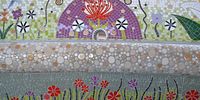
Kibel names We Are Still Here among one of the many projects that may have meant the most to her. Made with the mosaic artist Leora Lewis in the Longmarket Pedestrian Mall, beside the Cape Town Central Library, We Are Still Here commemorates about 7,000 children advertised as destitute in the Cape Government Gazette between 1841 and 1921.
Some were as young as eight. If no one claimed or supported them after the notices appeared, they could be sold as indentured labourers. Ceramic tiles form the image of a child, each printed with a copy of a notice, while the surrounding drawings and writing were contributed by present-day children experiencing homelessness.
Water ran beneath another commission. For the Mill Street station of the city’s bus rapid transit system, Friedman and mosaic artists trained through the Community Mosaic Project made urban furniture in the form of a ceramic-and-mosaic river. It recalls Camissa, the network of springs and streams that once flowed from Table Mountain to the sea and now runs through channels beneath the city. The Reclaim Camissa project describes the work as a functional public artwork.
One of her longest collaborations was with BRAVE Rock Girl, an organisation that creates safe spaces for girls and women. The first of its safe-space benches was installed at Red River Primary School in Manenberg. When BRAVE Rock Girl named Friedman its Unsung Hero, the citation said she “always works side by side with community members to translate their stories and dreams into a lasting work of art”.
Last year, she worked with young women trained through the Daring Disa project to make the 66th bench (she made 10 herself) beside the lower station of the Table Mountain Aerial Cableway.
The bench bears the message “Building Strength and Resilience Through Adventure in Nature”, alongside red disas, a leopard and a protea. As part of the Daring Disa project, the women who made it are introduced to the Cape Floristic Region and trained as conservationists.
Friedman described mosaic as a labour of love, in which broken pieces are cut, placed and assembled into something new. The work, she said, took patience and daily effort within the community. After her death, BRAVE Rock Girl, which called her its co-founder, wrote: “Lovell was a fearless activist, a selfless artist who created beautiful things that amplified the voices of girls, women and all South Africans who wish for safety and justice.”
Asked for help, it recalled, her answer was always “yes, but”. The “but” was that the community had to be an equal partner. “It is too soon and too sudden for us all (her death). The world needs more Lovells. She was everything BRAVE.”
‘A true Warrior Woman’
She also worked on Wire Woman, a 2m sculpture made with Sue Kramer and built by Streetwires to commemorate the Women’s March of 1956 and address the shortage of statues of women in Cape Town. Woman Zone CT called Friedman “a true Warrior Woman” and said she and Kramer were the figure’s “birth mothers”.
The organisation described it as “the 2m statue that stands at Artscape to represent all the women of Cape Town”. Woman Zone CT is a nonprofit organisation and community movement that brings together women from diverse backgrounds through storytelling, performance, literature and shared experiences
One of her later commissions stands in the cemetery where her funeral took place. In May 2024, a mosaic she made for Tahara House at the Cape Jewish Cemetery in Pinelands was unveiled, replacing a tapestry too badly damaged to repair. Tahara House is a dedicated ceremonial building located at a Jewish cemetery where the sacred Jewish ritual of tahara, the physical washing, ritual purification and dressing of a deceased person before burial, is performed
Working with landscape architect Tarna Klitzner and donors Suzanne Ackerman and Kathy Ackerman Robins, Friedman retained some of the old tapestry’s themes, including plants and roots, as well as its tassels, a reference to the tzitzit, the ritual fringes on a Jewish prayer garment.
The South African composer and sound artist Philip Miller, one of her best friends who attended her funeral at the Pinelands Jewish Cemetery, says: “I met Lovell around 15 years ago, although I had first encountered her work much earlier, at the home of (the late) Neville Dubow (Michaelis Professor of Fine Art at UCT and director of the Michaelis School of Fine Art). There were these extraordinary ceramic figures, some with multiple outreaching arms, angels, some half-animal or plant forms.
“My next actual meeting with Lovell, I have a vivid picture of her laughing on the street outside her home (in Oranjezicht), with golden curly hair, barefoot, words just tumbling out and gesticulating with her hands as she got more and more enthusiastic about whatever we were talking about. And then there was this shining, radiant smile.
“My description of meeting Lovell, I believe, would probably be very similar to that of many other people who met her and instantly fell in love with her. There is so much to celebrate about her. The tremendous care she took with all those around her.
“It starts, of course, with her family, holding [...] generations together in her family home in Oranjezicht. No one would ever be turned away. Between rushing off to meet her incredible team of mosaic artisans to work on a mosaic mural, she would be rushing to have a quick, icy Camps Bay tidal-pool swim (she said it was her best therapy), or quickly preparing her Friday-night Shabbos supper for family, her beloved friends and the odd stranger who had just arrived in town.
“Lovell’s care was borne out of her student days as an artist, teacher and activist, and continued unceasingly and fearlessly. She often worked in tough neighbourhoods of Cape Town, with a clear sense that the work mattered to the communities with whom she engaged.
“Her sculptures drew on personal experience and universal themes. Her close friend, the architect Johnny Jacobson, saw in them symbolic archetypes from mythology that connected her experiences of motherhood and loss to something larger, making her both a personal and a public artist.
“Lovell’s work with communities was equally profound. Her lifelong friend, the psychotherapist Lindsay Rabinowitz, described how she created spaces in which people could find words and images to express their lived experiences while also extending their imaginations. [They are] abstract yet expressive, retaining their connection to the figurative, [there is an] economy and clarity. The author and cultural theorist Ashraf Jamal defines her work as an ‘empathic revolution’,” says Miller.
“She never made big statements about what she did. Lovell was modest to a fault, and creating was simply something she did, without attaching undue significance to it.
“She never stopped believing in the goodness of people, in the human heart. This was reflected in her heart sculptures in the last few years. The shock and grief of her family, friends and colleagues are testament to how much she was loved,” he says.
‘Then a sudden ray of light appeared’
Philip Miller continues: “At her funeral, her casket stood in front of her mosaic mural, I believe one of her best works, at the Pinelands Jewish Cemetery. Its myriad colours of glass mosaics, from gold and amber to deep blue and turquoise, her favourite colour, were interspersed with ancient Hebraic prayers and edged with white stones, like the ancient tapestry that had previously hung in this sacred space.
“Then a sudden ray of light appeared, illuminating the mural and reflecting back on the mourners, as if to remind us that Lovell’s work shines a light on us all and the city of Cape Town.”
Lovell Friedman, whose name means “young wolf”, has left Earth, but her footprints remain across the city she loved. They are set in glass and ceramic, in murals that give voice to the forgotten, in benches that offer sanctuary and in art that brings solace to the vulnerable.
As a wolf leaves its tracks on the earth, Lovell left hers on the mosaic fabric of Cape Town, where the light she gathered from broken pieces will reflect our shattered city and our shadows – right back to us.
Friedman is survived by her husband, their daughters Mira, Lila and Emma, and her mother. DM
Some of Lovell Friedman’s works in and around Cape Town
Guga S’Thebe, Langa: community arts centre
Mother Courage, Red Cross War Memorial Children’s Hospital, Mowbray
Body Maps (2007), UCT medical campus, Observatory
Harare Library, Khayelitsha
Mitchells Plain Hospital
BRAVE Rock Girl safe-space benches
2010 World Cup projects, including MyCiTi stations, stadium and gardens, and the Fan Walk
We Are Still Here, a memorial to missing children in Cape Town, near the library, created with co-artist Leora Lewis
Comments
Scroll down to load comments...