



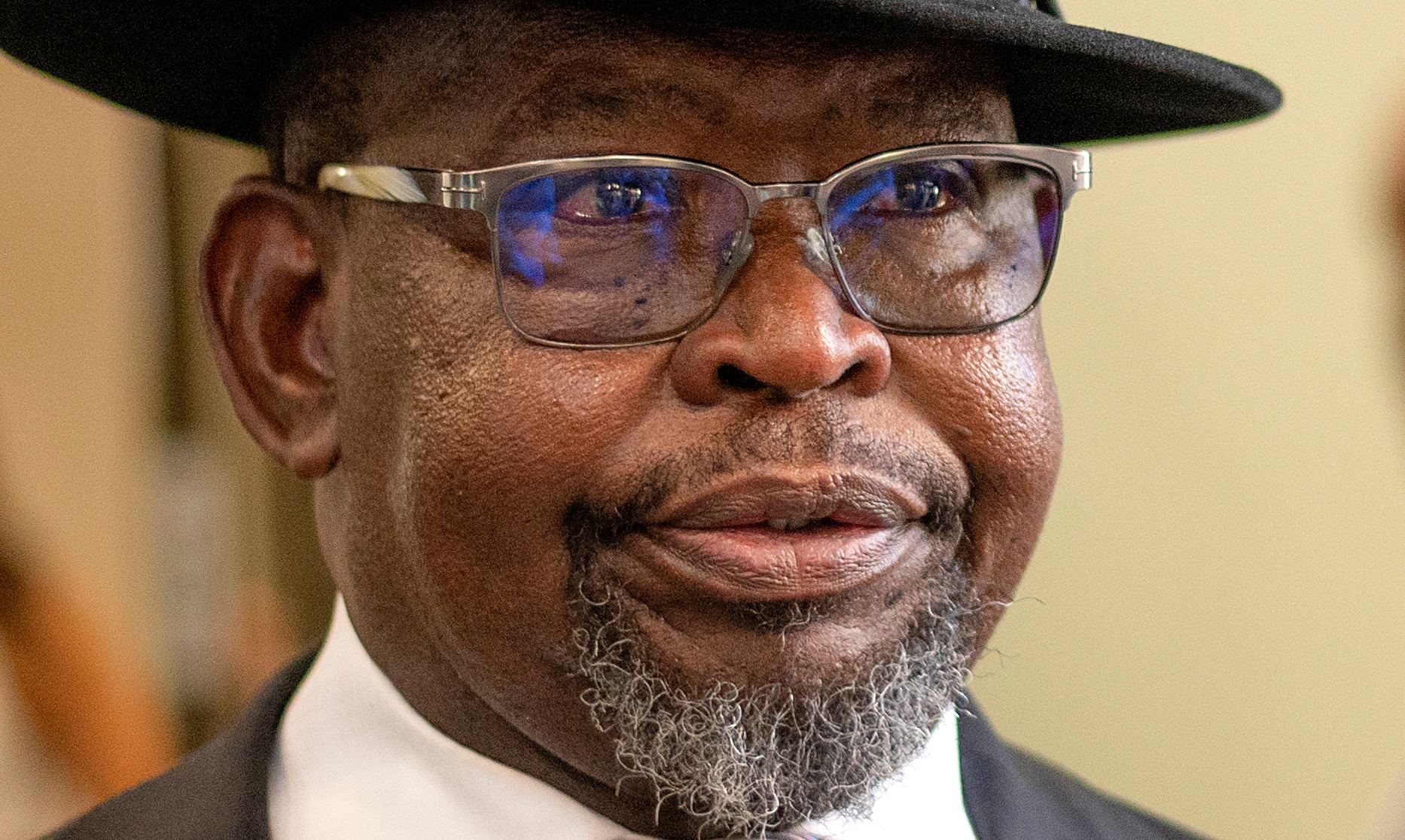
 Finance Minister Enoch Godongwana. (Photo: Gallo Images / Brenton Geach)
On Wednesday afternoon, South Africa will be treated to another speech – and if we’re lucky, another cool hat – courtesy of Finance Minister Enoch Godongwana.
Godongwana will table the Medium-Term Budget Policy Statement (MTBPS), or mini budget, in Parliament at 2pm. This lays the groundwork for the National Budget, coming to cinemas near you in February.
Why it matters
You may be wondering whether we actually need a separate statement before the main event, but it turns out mini budgets can have pretty major effects.
Four years ago, ex-UK prime minister Liz Truss’s career torpedoed after a disastrous mini budget of mass tax cuts freaked out finance bros and eat-the-rich campaigners in equal measure.
The government gives us a peek behind the curtain with this kind of check-in. Members of Parliament, along with traders, bond markets and executives, can see where the Ministry of Finance’s head is at, which parts of their current spending plan are working and which are not.

What to expect
The MTBPS will let us know how much the government has spent in the first half of the financial year and how much it expects to spend in the remainder.
We can see whether it is on track to hit the targets it set in February’s annual budget, or needs to hike any of its forecasts – for money going out, coming in or borrowed.
The way that Parliament deals with budget-related matters is via Section 77 Bills, appropriately nicknamed “money bills”.
Key bills covered by the MTBPS include: the Division of Revenue Amendment Bill, which allows for any changes to spending by individual provinces or municipalities, and the Adjustments Appropriation Bill, where existing budgets can be altered.
Overall, markets expect a relatively upbeat update, with analysts from Parisian bank BNP Paribas telling Reuters they see South Africa’s debt-to-GDP ratio on its way down, which is important, considering that last year’s mini budget made stabilising debt a priority.
Happily, South Africa has been doing pretty well on that front.
What happened last time
In October 2025, Godongwana acknowledged “intensifying global competition and mounting economic and political divisions” in his mini budget.
Back then, we were blissfully unaware that the US was a few months away from starting a war with Iran which would disrupt key shipping routes and send the price of oil skyrocketing.
Instead, Godongwana addressed a different US-related headache, specifically the fact it had falsely accused South Africa of a so-called white genocide and was threatening tariffs as a result.
US shenanigans aside, the finance minister last year highlighted South Africa’s welcome exit from the Financial Action Task Force’s grey list.
Since then, our global credibility has been boosted by credit rating upgrades from S&P Global, Fitch and Moody’s, moving us closer to being seen as “investment grade” by international financiers.
Notably, last year Godongwana unveiled a new inflation target of 3%, with 1% leeway in either direction, compared with the previous target of 3% to 6%.
“Over time, the lower target will decrease inflation expectations and inflation, creating room for lower interest rates,” the finance minister said at the time.
How inflation fits into the picture
Inflation is a bit of a hot topic at the moment, mainly thanks to the spike in oil prices, and before Wednesday’s mini budget main course we can expect aperitifs in the form of consumer price inflation and retail sales data – yum.
Inflationary anxiety was part of the South African Reserve Bank’s September decision to bump up the repo rate from 7.00% to 7.25%, making your loan repayments more expensive.
Headline consumer price inflation is forecast to peak above target at 5.7% next month. The Sarb’s move, which took from central banks across the world, aimed at bringing that number down, and we can expect the mini budget to reflect how the view on inflation has shifted since the US-Israeli war with Iran kicked off.
But it’s not all doom and gloom, when you consider that inflation was stuck in the double digits just a few years ago.
On Monday, a report from the South African Chamber of Commerce and Industry showed that business confidence slipped in September, when compared with August, but again, it’s not all bad.
Businesses were more optimistic than they were a year ago, citing tourism and car sales as big contributors. They will look to the mini budget for cues on where things are headed.
How to spend it
Last year’s statement was pretty upfront about the government’s strategy of partnering with the private sector to increase investment in logistics infrastructure.
Something to look out for is the budget allocation to Transnet. In 2025, Treasury upped the contingency reserve to fund Transnet’s rail freight projects.
Whether or not it increases Transnet’s slice of the pie once again will signal whether it sees Transnet needing extra public funding to deliver on its goals, in addition to what the private sector is willing to offer.
Of course, the mini budget is not all numbers and jargon for bureaucrats and business people. As professors from North-West University have pointed out, it is a concrete measure of how much the government is willing to commit to goals like ending child stunting by 2030, which President Cyril Ramaphosa laid out in February’s State of the Nation address.
And that is, of course, the other side of the coin in cutting debt – spending less on things people need. A tricky balance to strike. All in all, we have plenty of reasons to tune in. DM
Comments
Scroll down to load comments...