



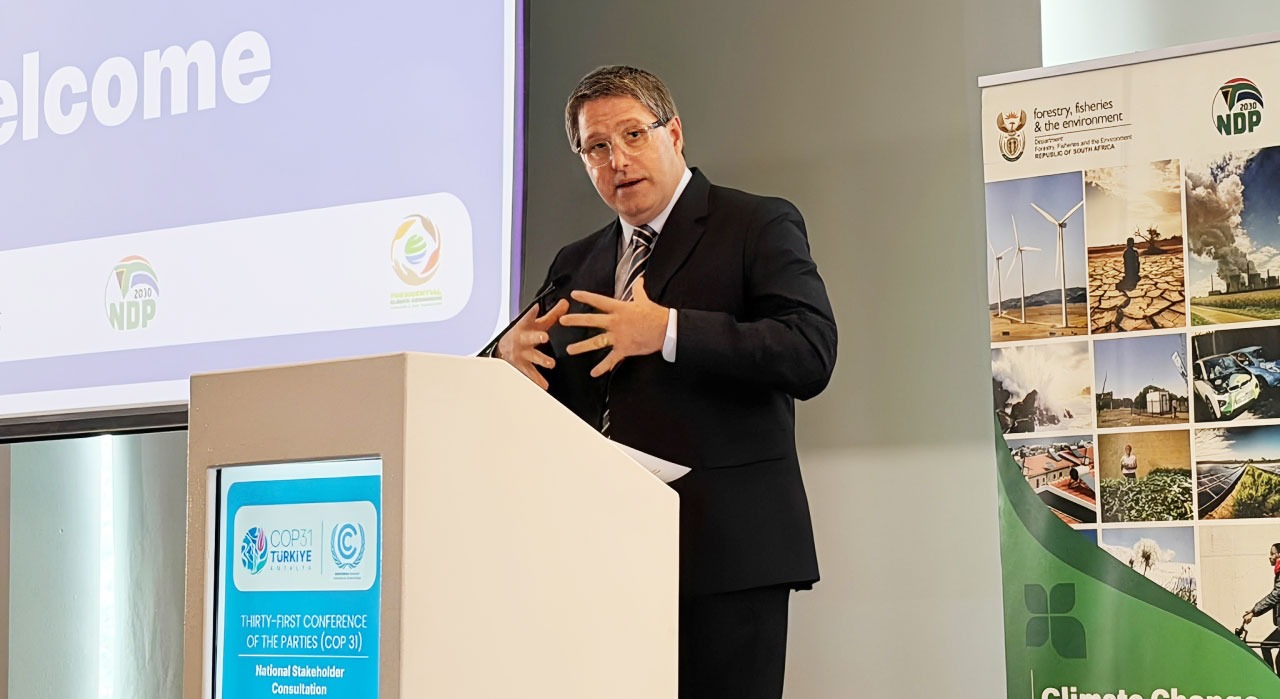
 Minister of Forestry, Fisheries and the Environment David Maynier delivers the keynote address at a national stakeholder consultation on South Africa’s negotiating mandate for COP31 on Friday, 16 October 2026. (Photo: Facebook / Minister David Maynier)
Severe climate shocks, record-breaking temperatures and devastating weather events worldwide have marked 2026 as a standout year for extreme climate events globally.
South Africa has not been spared. In January, historic floods swept through Limpopo and Mpumalanga, killing at least 30 people, damaging thousands of homes and causing billions of rands in infrastructure damage. Four months later, the Western Cape was hit, causing 11 fatalities, displacing over 200,000 people, and battering the province’s agricultural sector.
An unfolding Super El Niño threatens a hotter, drier summer marked by drought, wildfires, water shortages, food insecurity and heat-related illness, placing the responsibility on the government to safeguard residents from a warming world.
That is why, as South Africa heads to the 31st United Nations Climate Change Conference (COP31) in November, increased adaptation finance is among the country’s top priorities in the climate negotiations.
Adaptation and resilience
Forestry, Fisheries and the Environment Minister David Maynier said that the fact that, at only 4%, Africa’s emissions paled in the face of global greenhouse gas emissions made adaptation and resilience one of the main priorities for South Africa, given the country’s severe experience with storms, floods and drought.
Speaking at a national stakeholder consultation on South Africa’s negotiating mandate for COP31 on Friday, 16 October, Maynier said that South Africa’s negotiators would push for a benchmark to triple adaptation finance by 2035, the operationalisation of the global goal on adaptation, and adequate loss and damage funding.
/file/attachments/2999/co-emissions-per-capita_434814.png)
While the country’s negotiation team will focus heavily on adaptation, South Africa still has a case to answer for regarding the reduction of emissions. Granted, the country’s global emissions sit at 1.1% to 1.14%. However, the nation is Africa’s biggest emitter, accounting for roughly 33% to more than 40% of the continent’s total emissions.
Maesela Kekana, the DFFE’s deputy director-general responsible for climate change and air quality, and the person who would lead the charge during the negotiations, said that nations had clear directions on what needed to be done on mitigation; however, the same could not be said for adaptation.
/file/dailymaverick/wp-content/uploads/2025/11/Day-1-Pic-4.jpg "Maesela Kekana, now the head of the South African delegation after the firing of Dion George, at COP30 in Belém, Brazil on Monday, 17 November 2025. (Photo: Dianah Chiyangwa)")
“On adaptation, we don’t really know where we are. Hence this Belém to Addis vision becomes quite important because it deals with key indicators that will tell us exactly how far we are in building resilience.”
Established during COP30 in Belém, Brazil, in 2025, the Belém–Addis Vision on Adaptation is a negotiation process intended to help countries put global adaptation goals into practice and measure progress towards them.
Loss and Damage fund needs a boost
South Africa is one of 119 countries that have submitted more than 170 funding proposals to the Fund for Responding to Loss and Damage (FRLD). Maynier said that after the floods in January devastated the Kruger National Park and surrounding areas, the country submitted a $20-million proposal to restore the flood-affected and associated conservation landscapes.
/file/attachments/orphans/Letaba_141764.jpeg "The floods swept through Letaba. (Photo: SANParks)")
While progress has been made with a dedicated FRLD, Kekana said that South Africa sought greater support for the fund, adding that “there’s quite a big gap between what is required to deal with these permanent losses and damages and what is on the table”.
The FRLD supports developing countries and communities affected by climate-related disasters; however, the fund faces a massive budget and liquidity shortfall.
Responding to questions from Daily Maverick about the likelihood of South Africa receiving funding, given the sheer volume of requests and the money available in the fund, Maynier said he hoped the proposal would succeed, adding that bilateral talks had already taken place to advocate for it.
Kenana said that South Africa’s negotiating team would call for more resources for the fund, but would also seek assistance from other financial institutions outside the United Nations Framework Convention on Climate Change (UNFCCC) financial mechanisms, such as the Clean Investment Fund.
/file/attachments/orphans/ED_592344_107185.jpg "David Maynier Western Cape Minister of Education. (Photo: Gallo Images / Luba Lesolle)")
Dipak Patel, deputy chairperson of the Presidential Climate Commission, said South Africa’s request would prove to be a test for the loss and damage fund.
“South Africa should treat this as a test case of what South Africa can actually present [to the summit] that would meet or pass muster with respect to what is required.
“I see the potential for loss and damage to be extended to climate-impacted events, whether that be severe flooding in Durban or severe warming in other parts of the country.
“But let us be aware that in a context where we might not be suffering the most damage, any global fund would have to prioritise on the basis of vulnerability and on the basis of their own socioeconomic position,” Patel said.
/file/attachments/orphans/RC29YCATRIZB_710596.jpg "A drone view shows houses flooded after heavy rains in Durban, South Africa, February 20, 2025. (Photo: REUTERS/Rogan Ward)")
Nations to take stock on climate action
The second Global Stocktake (GST) will begin during this year’s summit. The process serves as an inventory of the planet, where countries and stakeholders assess where they are succeeding and where they are falling short in meeting the Paris Climate Agreement. The GST, which takes two years to complete, aims to inform the next round of climate action plans (nationally determined contributions, or NDCs).
The GST, which takes place every five years, could not come at a more significant time. In September, the United Nations Environment Programme released a report that found a 1.5°C overshoot is now widely unavoidable and would occur within years, bringing more frequent extreme weather events globally.
/file/dailymaverick/wp-content/uploads/2025/01/GettyImages-2162690208.jpg "The Greenland Ice Sheet, Facing Intensifying Global Warming, Is Melting")
The report, titled Limiting Overshoot: Navigating Exceedance of 1.5°C and Pathways Towards Return, found that best-case projections peaked at 1.8°C and others exceeded 2°C, and it proposed an “overshoot, peak and decline” strategy to minimise the risks of extreme weather, ecosystem loss and irreversible tipping points.
The strategy, which includes immediate emissions cuts, transformational adaptation and governed carbon dioxide removal, would theoretically bring the world back below 1.5°C warming.
/file/attachments/2999/Overshoot_signature_figure_1756pxpng_886267.jpeg)
Decades of insufficient action have locked us into three compounding challenges to limiting temperature overshoot, with an urgent need for action now. (Source: United Nations)
According to the UNFCCC, the stocktake can help policymakers and stakeholders strengthen their climate policies and commitments in their next round of NDCs, paving the way for accelerated action.
Referring to the stocktake, Maynier said it should assess progress beyond emissions reductions and focus on advancing climate finance, technology transfer, capacity building for developing countries and addressing loss and damage. DM


Comments
Scroll down to load comments...