





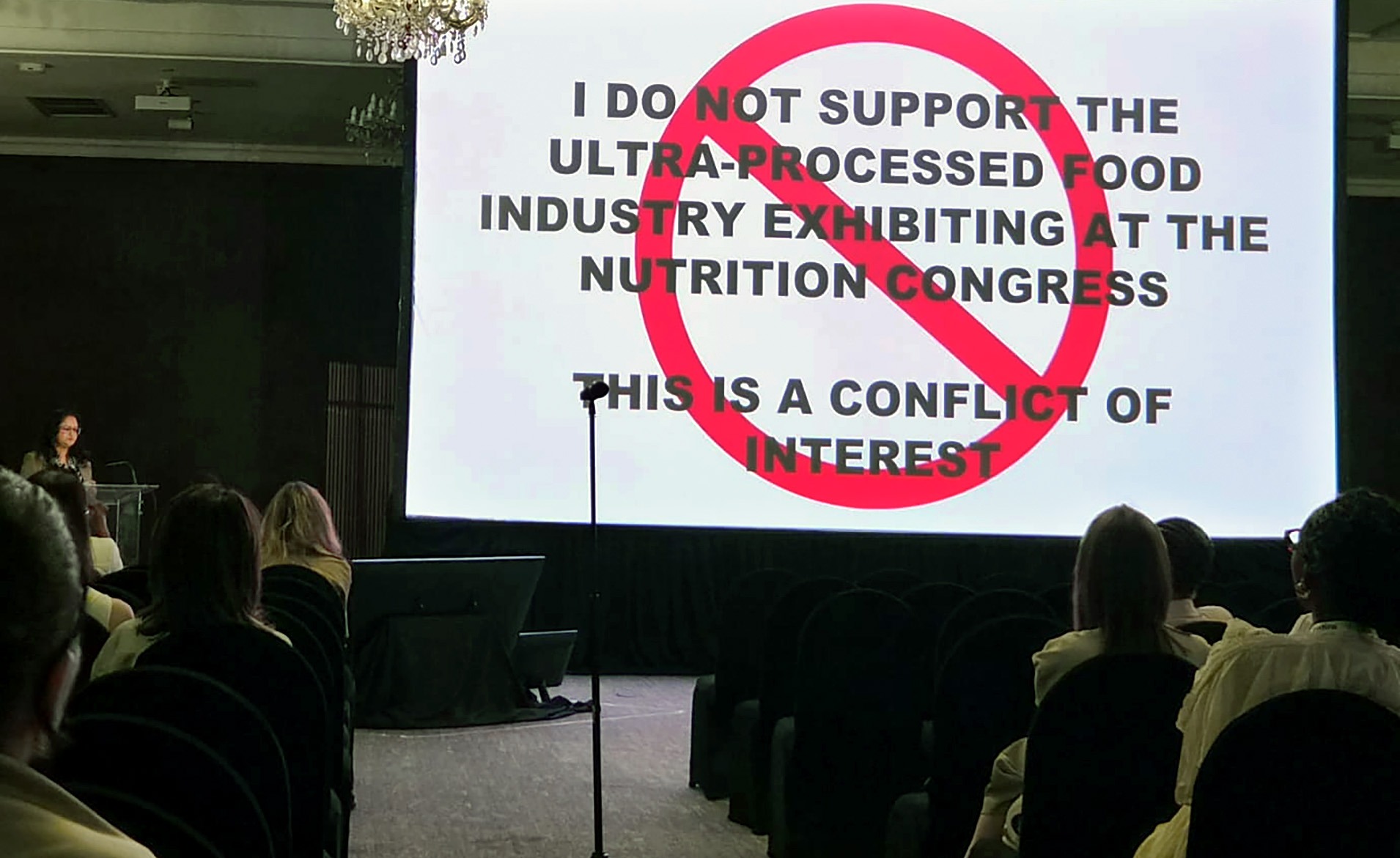
 Nutrition expert Tamryn Frank included the above slide during their presentations in protest against the ultra-processed food industry’s involvement in the congress. (Photo: Supplied / Tamryn Frank)
Nutrition experts have called for a ban of “big food” from future SA Nutrition Congresses following an alleged conflict of interest at this year’s event.
From 7-9 October the Nutrition Society of South Africa (NSSA) and the Association for Dietetics in South Africa (Adsa) hosted their biennial Nutrition Congress, a platform for researchers, healthcare professionals, policymakers, practitioners and other stakeholders to share and discuss current evidence and developments in nutrition.
This year companies Danone Southern Africa (Danone SA), Unilever South Africa and PepsiCo were exhibitors at the event, which nutrition experts said was a conflict of interest.
According to Tamryn Frank, a nutrition expert and senior lecturer at the University of the Western Cape’s School of Public Health, it is a conflict of interest for an event that aims to improve nutrition in South Africa to have companies like Danone, Unilever and PepsiCo, which produce and sell ultra-processed foods, sponsor it and exhibit at it. Frank added that there was increasing evidence that ultra-processed foods were linked to poor health outcomes like obesity and non-communicable diseases.
/file/attachments/orphans/Iman-NutritionCongress2_353064.jpg "PepsiCo's exhibition stand at the 2026 Nutrition Congress. (Photo: Supplied / Catherine Pereira-Kotze)")
If the ultra-processed food industry was allowed to sponsor and exhibit at the Nutrition Congress, to the layman it created the impression that the congress endorsed these companies as part of a solution to SA’s nutrition crisis, Frank said.
Nutrition expert and consultant researcher at the South African Medical Research Council, Catherine Pereira-Kotze, noted that since South Africa was characterised by undernutrition and micronutrient deficiencies, together with overweight and obesity, and high levels of poverty, inequality, unemployment and various other social problems, families should not be spending the little they had on ultra-processed foods. Rather, families should be prioritising fruit, vegetables and whole foods in accordance with national food-based dietary guidelines.
“The term ‘healthwashing’ comes to mind where by being aligned with this event it indicates that they are part of the solution. Because if you see the Nutrition Congress’ logo alongside the sponsors or the logos of these ultra-processed food companies I think it gives the impression that they are healthy options,” said Frank.
To protest against the alleged conflict of interest, Frank, Pereira-Kotze and other nutrition experts shared protest slides during their presentations and created a petition.

Nutrition experts take a stand
Concerned about the alleged conflict of interest, Frank created a slide to use in her presentation condemning the ultra-processed food industry’s involvement in the congress. The slide stated:
“I DO NOT SUPPORT THE ULTRA-PROCESSED FOOD INDUSTRY EXHIBITING AT THE CONGRESS
THIS IS A CONFLICT OF INTEREST”
Frank saw it fit to make this the third slide of her presentation as the second slide was a mandatory funding disclosure slide, she said. Frank shared the slide with other concerned speakers who also incorporated it into their presentations.
Zandile Kubeka, the Department of Health Deputy Director of Dietetics in the Child and Youth Health Directorate, shared a similar slide inspired by Frank’s during her presentation. The slide stated:
“THE DEPARTMENT OF HEALTH DOES NOT SUPPORT THE ULTRA-PROCESSED FOOD INDUSTRY EXHIBITING AT THE CONGRESS
THIS IS A CONFLICT OF INTEREST”
Kubeka also noted the presence of ultra-processed food industry sponsors and exhibitors at the Nutrition Congress, and raised concerns regarding potential conflicts of interest in relation to their participation, according to Department of Health spokesperson Foster Mohale.
To further protest against the alleged conflict of interest, Frank had created a petition with the help of Amandla.mobi, she said.
The petition first called on the Nutrition Society of SA and the Association for Dietetics in SA to announce that no companies connected with ultra-processed foods would be allowed to sponsor or exhibit at future congresses or events. Second, they must issue an apology for allowing the ultra-processed food industry to participate in the congress.
Safeguarding integrity
The Nutrition Society of SA and the Association for Dietetics in SA shared a collective written response by NSSA representative Elize Symington and Adsa president Maria van der Merwe in response to questions sent by Daily Maverick.
According to the Nutrition Society of SA, Danone, Unilever and PepsiCo complied with NSSA and Adsa’s criteria to participate.
All applications for participation as sponsors or exhibitors at the congress were accompanied by the information entities wanted to share and products to be exhibited, and an illustration of the exhibition stand, all of which had to be approved prior to the congress, it said.
It added that the congress organising committee also reviewed exhibition applications against healthy eating guidelines, compliance with applicable regulations, and alignment with the values and principles of the congress as guided by international consensus.
All congress exhibitors were allocated a stand in one of the exhibition areas to display the brands and products at a fee, and exhibition and sponsorship income was paid into pooled congress funds, according to the organisers.
/file/attachments/orphans/Iman-NutritionCongress1_442725.jpg "Danone's exhibition stand at the 2026 Nutrition Congress. (Photo: Supplied / Danone SA)")
Although the Nutrition Society of SA and the Association for Dietetics in SA recognised that commercial sponsorship of nutrition-related scientific and professional activities may create actual, potential or perceived conflicts of interest, they did not agree that participation under the safeguards described compromised the independence or integrity of the congress, they said.
For this congress, exhibitors and sponsors were screened and had no role in determining the programme or in the selection of abstracts or speakers, according to the organisers. Private sector participation did not constitute or imply endorsement of any exhibitor’s products or practices, and all speakers declared their affiliations and funding during presentations, they added. The congress’ commitment to open debate on this topic was demonstrated by the inclusion of two sessions specifically addressing conflicts of interest in the programme.
Feedback received this year, including differing perspectives from across the nutrition community, would form part of the host organisations’ ongoing review. Any future policy decisions would be guided by the best available evidence and made through the governance structures of the Nutrition Society of SA and the Association for Dietetics in SA, they said when asked if companies connected to the ultra-processed food industry would be excluded from future congresses as demanded in the petition.
Exhibitors respond
According to Dudu Mthuli, Nutrition and Health Lead at Unilever Southern Africa, there was no conflict of interest. Unilever was involved only in hosting an exhibition stand and in no other elements of the congress, she said.
Unilever’s stand communicated how their brands fitted into healthy eating. Unilever applied to exhibit at the event, because they were committed to partnering with like-minded stakeholders in educational and sponsorship activities that supported their view of making nutritious, balanced diets accessible, affordable, and enjoyable through science and expertise, Mthuli said.
She added that Unilever’s registered dietitians and food scientists also used the opportunity to keep up to date with science as presented at the sessions.
/file/attachments/orphans/Iman-NutritionCongress5_915881.jpg "Unilever's exhibition stand at the 2026 Nutrition Congress. (Photo: Supplied / Catherine Pereira-Kotze)")
Danone saw its participation in the congress “not as a conflict of interest, but as a confluence of interest”, according to Head of Corporate and Regulatory Affairs at Danone SA, Leanne Kiezer.
Danone SA participated in the Nutrition Congress as a presenter in the scientific programme and as an exhibitor, she said. The FoodSAMSA Project published the report Inside our Food Environments South Africa 2025 that assessed the commitments and practices of 29 food companies in South Africa for supporting healthier food environments and improving population nutrition. The independent report ranked Danone SA as the leading food company assessed, with a score of 83/100 for its commitments and practices for supporting food environments and improving population nutrition, according to Kiezer.
She added that the Association for Dietetics in South Africa had invited Danone SA to submit an abstract to the Nutrition Congress scientific committee, to share the study results and to provide further detail on the commitments and practices that contributed to Danone SA’s score. Danone SA submitted an abstract that was independently reviewed by the congress’s scientific committee and accepted for an oral presentation as part of the scientific programme.
Danone SA also participated as an exhibitor, with a stand focused on sharing evidence on the health and nutritional benefits of yoghurt. The educational content was not brand or product specific and focused on yoghurt and its benefits from a category perspective, Kiezer said.

Danone SA believed that describing a food company or its portfolio through the single lens of “ultra-processed food” oversimplified the broader picture of nutritional quality, according to Kiezer. The overall nutritional profile of individual foods, and their contribution to dietary patterns, were also important considerations, she said.
Based on Danone SA’s assessment of total volumes sold in 2025, 74% passed the nutrient profiling calculator defined in draft Regulation 3337, while 71% would not carry warning labels under the current draft Regulation 3337 criteria, Kiezer claimed. These benchmarks provided important context on the nutritional quality of their portfolio, she said.
Daily Maverick contacted PepsiCo for comment, but had not received a response by the time of publication. DM
Comments
Scroll down to load comments...