


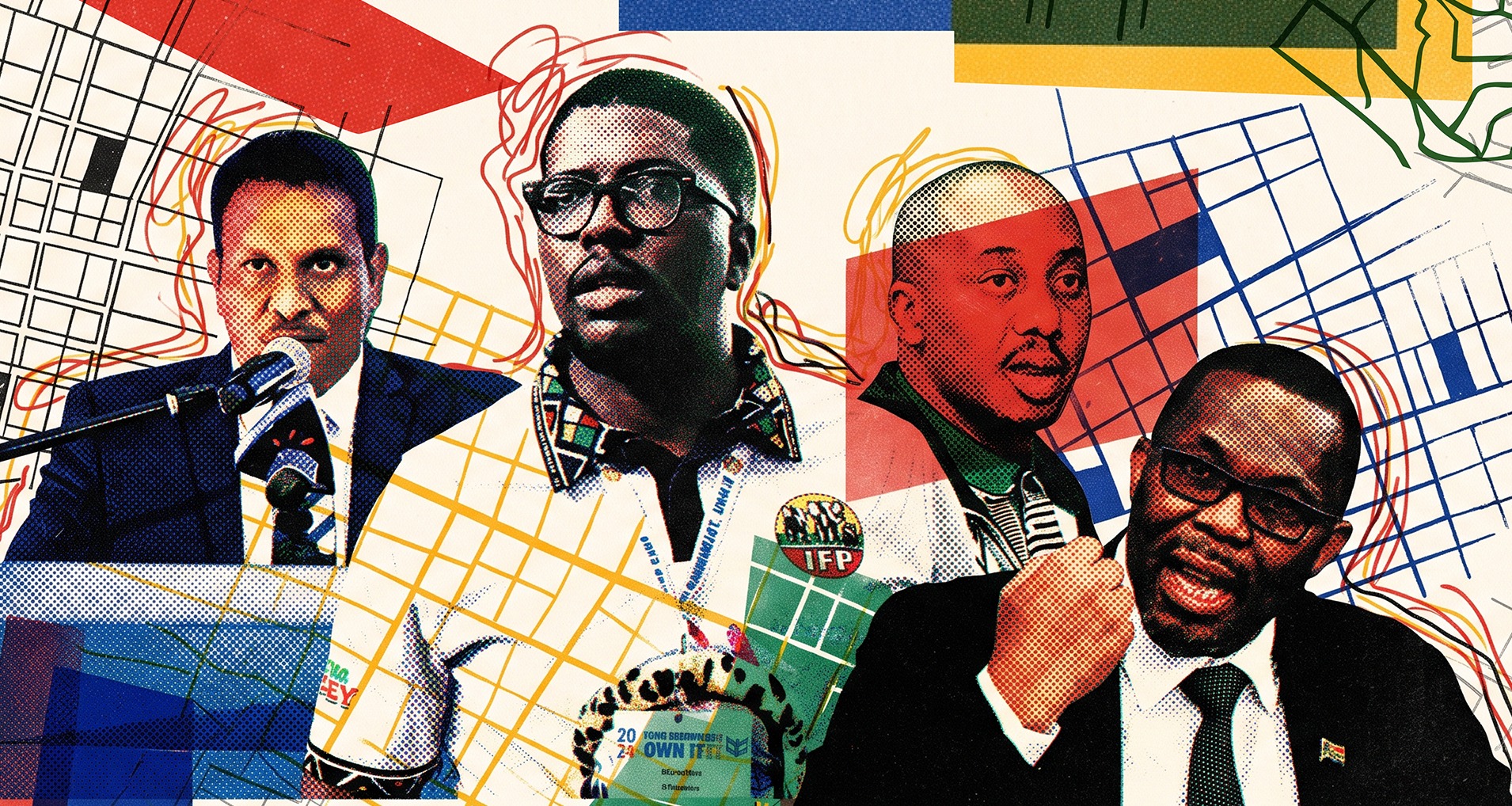
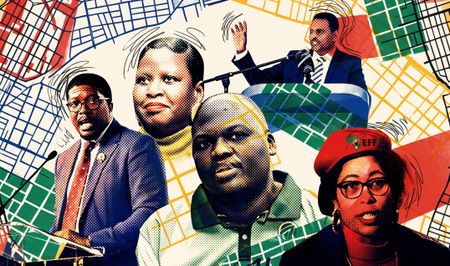
 From left: Haniff Hoosen, DA eThekwini mayoral candidate. (Photo: Gallo Images / Darren Stewart) | Mkhuleko Hlengwa of the IFP. (Photo: Gallo Images / Sydney Seshibedi) | MK eThekwini candidate Mxolisi Pakathi. (Photo: MKP) | Cyril Xaba, eThekwini mayor (ANC). (Photo: Gallo Images / Darren Stewart) (Illustration: Kevin Momberg)
/file/attachments/orphans/Election2026LogoInarticle_260133.jpg "LGE-2026-logo-signpost")
Pollsters are predicting a major shake-up in eThekwini as Jacob Zuma’s uMkhonto Wesizwe (MK) party threatens an upset in one of the country’s biggest metros.
But MK is one of 69 parties lined up to claim a stake in Durban, and party leaders pitching to run South Africa’s third-largest city with a R75-billion budget are mostly making similar promises.
With so many parties contesting, one might think the eThekwini electorate was spoilt for choice. Not really.
Barring a few exceptions, electioneering in Durban has been lacklustre, with big posters, big promises and little substance.
To many, MK represents something new. But even with an MK regime change, it is hard to predict exactly what the party will do.
MK promises ‘radical’ change
MK’s mayoral candidate, Mxolisi Phakathi, a pastor and former MPL for the African Transformation Movement in the KwaZulu-Natal Legislature, says to expect “radical” change.
But he can’t say exactly what change, just yet.
/file/attachments/orphans/Lunga-MKP-eThekwini5_107484.jpg "Apostle Mxolisi Phakathi. (Photo: Facebook/MKP)")
Water woes, crime, corruption and unemployment are pressing.
The billing system needs reform; some bad debt should be written off, and the rest recovered.
“You must pay for what you use,” he said.
If all this sounds monotonously like other parties’ priorities, Phakathi agrees: “I can’t make promises I can’t keep. After we audit the challenges, I will take it from there. The main issues are those we all know, but there will be more.”
MK vowed “transparency on everything”.
“It’s not Phakathi’s government; it’s a government of the people… If I get in tomorrow, we will do an internal audit to understand. We will conduct a thorough analysis and then assess whether the city organogram suits the challenges. And we will set a time frame to fix.”
Of the four big parties contesting in eThekwini, only Phakathi and Democratic Alliance mayoral candidate, Haniff Hoosen, spoke to Daily Maverick.
Repeated requests were made to incumbent African National Congress mayor Cyril Xaba and to the Inkatha Freedom Party’s Mkhuleko Hlengwa, directly and through their spokespeople.
The water priority
Hoosen set the pace for electioneering in Durban with a campaign calling for drastic water reform. A retired eThekwini councillor and DA MP, he has zig-zagged across Durban, inspecting sewers and potholes and trying to expand the DA’s appeal beyond the party’s traditional support base.
“We have walked the dusty streets of townships. It gave me great insight. I saw grannies carrying buckets of water up steep hills. Wherever I went, people spoke about water.”
More than 65% of the City’s water is non-revenue, lost to leaks or non-payment. Hoosen wants to spend R10-billion on water infrastructure.
The City has spent R345-million on water tankers to insource a service that props up its patchy water supply, after spending as much as R800-million on water-mafia tenderpreneurs, Hoosen claims.
“I have seen an invoice in one area where one company received R8-million to supply water to a small community. R8-million could probably fix all the water pipes there.”
Masterclass in mismanagement
Hoosen pointed to other egregious examples of waste and financial mismanagement in Durban.
The City’s annual budget is R75-billion. Xaba has described the City’s R48-billion in bad debt as “alarming”.
Aside from this and the water debacle in Durban, Hoosen cited the City’s R9-billion expenditure on Go Durban, a bus system (10 years in the making) that has yet to be launched due to resistance from taxi owners.
He said Durban Transport was a “masterclass in financial mismanagement”, given that the City sold its bus service to ANC comrades in 2003 for R70-million. The company floundered, prompting a 2008 rescue by the City that cost R405-million. A year later, the politically connected taxi family, the Gcabas, struck a highly contested deal to run the bus service, which was later declared unlawful.
/file/attachments/orphans/Greg-ethekwini-4Nov5_726132.jpg "DA mayoral candidate Haniff Hoosen protesting outside the unveiling of a statue at North Beach Precinct on March 03, 2026 in Durban, South Africa. The statues celebrate the historic contribution made by former President Nelson Mandela and former African National Congress President Oliver Reginald Tambo to the country’s liberation and democracy and are directed at enhancing the city’s cultural and heritage tourism offering. (Photo: Gallo Images/Darren Stewart)
<br>")
The City and the company have been at legal loggerheads since 2015, with each claiming the other owes money.
In this report, the City claims it is owed R346-million, and Gcaba says his company is owed more than R1-billion.
Arbitration has all but failed, and the parties are back in court.
Hoosen believes comprehensive financial probity could rescue the City’s battered budget.
The best way to do this is to livestream all tender meetings, he says.
“We will get responsive prices when all eyes are on government. Right now, supply chain management happens in the dark. When the public is informed, they will quickly identify the crooks. Anybody should be able to inspect the City’s bank accounts.
“It is dead simple. This doesn’t have to be complicated. Shine a light; make everyone the watchdog. And subject every politician and public servant to annual lifestyle audits.”
The TV debate
Phakathi, Hoosen and Hlengwa took part in an ENCA television debate on Sunday, 11 October 2026, but Xaba was a no-show, which is odd for a man seen as a turnaround mayor whose party secured 96 of 222 council seats in 2021.
During the ENCA debate, Hlengiwe Mkhalipi, the mayoral candidate for the Economic Freedom Fighters (also an EFF MP), vowed to “abolish” tenders, create more municipal jobs, “cancel” bad debt, improve the billing system and join any coalition that supported land expropriation without compensation to fix the City’s maladies.
In 2021, the EFF won 10% of the eThekwini vote and secured 24 council seats.
The IFP’s Hlengwa (also deputy national transport minister) said that if he were mayor, he would create an inclusive water crisis committee, focus on the city’s economic anchor, the port, and clean the “filthy city” to improve living conditions, boost tourism and attract investment.
The IFP won 7% of the vote in eThekwini in 2021, or 16 seats.
Hlengwa also promised to employ 5,000 more metro cops over five years, a promise other parties have roasted as ridiculously exorbitant.
/file/attachments/orphans/BhekieThekwinimunicipality4_840697.jpg ": Zwakele Mncwango, ActionSA KwaZulu-Natal Provincial Chairperson during a media briefing on measures to reclaim South Africa's township economy in KwaMashu on November 11, 2024 in Durban, South Africa. This comes after recent incidents in which about 300 children were hospitalised, while others died after they allegedly ate snacks purchased from the reportedly unregulated foreign-owned spaza shops across the country. (Photo: Gallo Images / Darren Stewart)")
ActionSA mayoral candidate Zwakele Mncwango has been a councillor for 15 years, one of four ActionSA councillors in eThekwini who expect to play a key role in the City’s inevitable coalition government.
“We will go into a coalition with any party that agrees to financial discipline. The rates base is shrinking and the number of people demanding free services is expanding.
“You can’t fix anything without income. You need proper debt collection. In many Ingonyama areas (rural tribal lands) within the city, there are mansions, and the owners don’t pay for rates and services.”
Mncwango said it was ludicrous to suggest the City could write off bad debt. It could save money by doing basic water and electricity repairs in-house, rather than through inflated tenders.
“How long does it take to fix leaks? We should scrutinise everything: performance, spending and coalitions. Our coalition discussions will be completely transparent. I also believe the City should have an informal advisory board that the city’s executive committee engages with every month. There is enough talent in this city to help.”
Wobbly coalition
All political parties are talking up their prospects. Phakathi says MK will walk the floor; Hoosen is hoping the DA can miraculously double its 26% share of the vote in 2021 (59 council seats).
That would give him an outright majority, but the most likely scenario is a wobbly coalition.
Political analyst Wayne Sussman says smaller one- and two-seat parties on the eThekwini council will command disproportionate power.
In 2021, aside from the ANC, DA, EFF, IFP and ActionSA councillors, 23 councillors represented 19 smaller parties.
“MK will hoover up a lot of seats,” Sussman predicted.
Political analyst Bheki Mngomezulu described MK’s prospects in Durban as good, but that didn’t mean the party would necessarily govern.
“I don’t think they will amass enough support to run the city alone. So many parties are contesting, and in all probability various parties will gang up against MK, as they did in the KZN legislature in 2024.
“All political parties, MK included, have not promised anything different in this election. MK did well in 2024 because of the Zuma factor, not their election manifesto. They don’t present anything different.
“They will attract disgruntled ANC voters. As to what they would do if they won, that would depend on the people they are fielding and who they employ. Cronyism has collapsed our municipalities. Will they have a meritocracy?”
Sussman predicted a post-election scramble for power.
“There will be a lot of little parties in Durban, and we don’t know what their stories are. Politics is a low barrier to entry business where people are in for the trappings of office.”
/file/attachments/orphans/Greg-ethekwini-4Nov1_435724.jpg "Mkhuleko Hlengwa of the IFP at the National Result Operation Centre (ROC) at Gallagher Estate on June 01, 2024 in Midrand, South Africa. South Africans voted in the country's seventh democratic general elections to elect a new National Assembly as well as the provincial legislature in each of the nine provinces. (Photo: Gallo Images/Sydney Seshibedi)")
In the ENCA debate, Hlengwa lashed out at Hoosen for being in opposition in eThekwini but also occupying three of the city’s executive committee seats.
“This DA whingeing and whining has just got to stop. You need to take responsibility for being uncooperative in eThekwini.”
Setting aside his grumbling with his provincial coalition partner, Hlengwa described the IFP-ANC-DA coalition running KZN as “solid”.
In Durban, the real gamble for voters may not be which party they choose, but whether the coalition that emerges can govern effectively without being held to ransom by small parties.
Political analyst Professor Susan Booysen said voters should demand transparency around coalitions.
“We should demand clarity on wild promises to write off debt and employ people. And parties should be held to account in their negotiations with single-person parties with ‘dinky’ constituencies that can be bought.” DM
Comments
Scroll down to load comments...