




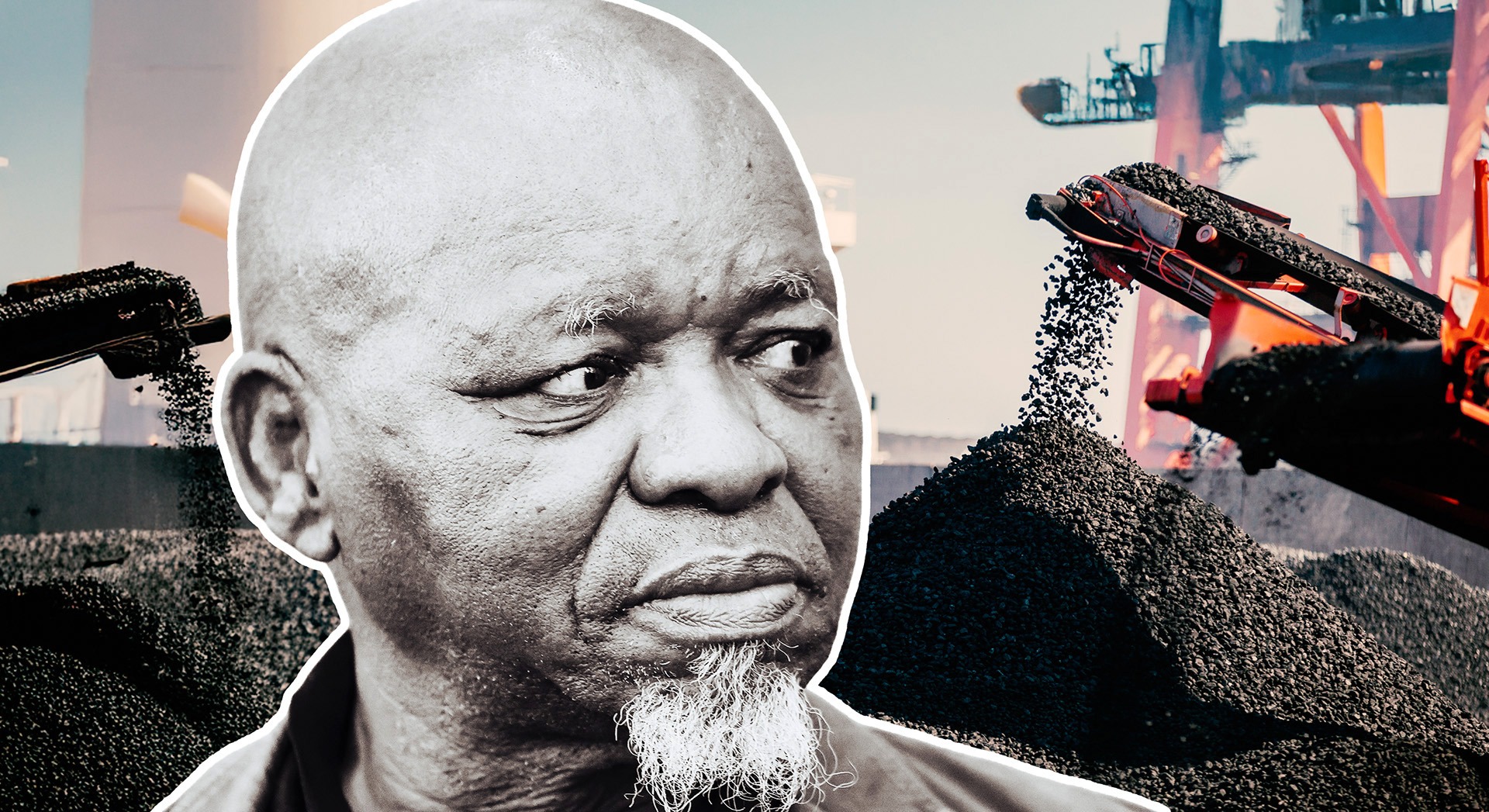
 Illustrative image: Minister of Mineral Resources and Energy Gwede Mantashe. (Photo: Gallo Images / OJ Koloti) | Coal. (Photo: iStock)
Mineral and Petroleum Resources Minister Gwede Mantashe proudly wears his label, “Old King Coal”, and he boosts the fossil fuel every chance he gets.
That has provoked a lot of understandable criticism from environmentalists, as the flames of climate change linked to the use of coal, oil and gas threaten to engulf our burning planet.
But what is often overlooked is that Mantashe’s affection for coal is in large part explained by one of his trademark political and policy priorities: transformation and raising the levels of Black ownership and management in the mining industry and the wider economy.
As such, it provides a revealing lens into African and non-African views of the green energy transition, economic development and the use of natural resources.
“Everybody in coal is a Black company, owned and managed by Black South Africans,” Mantashe said last week during his address to the Joburg Mining Indaba. “Today you find Exxaro, Seriti, Thungela and so forth. The old is dying and the new is emerging.”
That is indeed the case, with some caveats.
Into the weeds
For example, Exxaro, which has coal as its core commodity but is diversifying into manganese, bauxite and copper, is 31.47% “Black empowered”, according to its latest annual report. And its C-suite is predominantly Black, with Ben Magara as its CEO.
Thungela is 67.55% Black owned, according to its latest compliance report to the Broad-Based Black Economic Empowerment Commission and its executive team under CEO Moses Madondo is mostly Black. Unlisted Seriti is overwhelmingly Black owned and managed.
Viewing this transformed landscape, it is useful to recall that Thungela was demerged from Anglo American in 2021 against the backdrop of growing foreign investor aversion to coal because of the unfolding climate crisis.
Anglo’s removal of thermal coal from its portfolio was in response to investor pressure, including from the likes of the pension board for the Church of England.
The bottom line is that foreign capital has been ditching South African coal, and mostly Black, domestic investors have moved into this abandoned space.
This is surely a reflection of conflicting perceptions of the green energy transition, but the issue is seldom framed that way.
On one hand, the urgency of the climate crisis clearly calls for immediate action. The science is gin clear: the CO2 emissions unleashed by the Industrial Revolution are accelerating climate change and warming our planet at an unprecedented pace.
In the latest flashing red light, this past September was the second-warmest on record and was the second consecutive month in 2026 that saw global temperatures exceed 1.5°C above pre-industrial levels.
But historically, the majority of CO2 that has been pumped into the atmosphere has been from the “Global North” or the industrialised economies of Europe and North America. China, India and Indonesia have become big-league members of this club in recent decades.
By contrast, Africa – the world’s poorest continent and the one where climate change will probably have its worst impacts – currently accounts for only about 4% of global emissions.
Viewed through this prism, the “case for coal” in Africa boils down to the perceived unfairness of the region being constrained from using its resource endowment in the same manner that gave rise to industrialisation and high-income levels in advanced economies.
Rich vein
Mantashe is tapping a rich vein on this front and, politically, it speaks to a wide swathe of his base including the National Union of Mineworkers (NUM), which is staunchly opposed to shuttering South African coal operations for environmental reasons – a stance that is also clearly linked to its membership numbers.
South Africa’s ranking among global CO2 emitters is 15th – largely because of Eskom and Sasol – but it is dwarfed by the big guys, and Africa as a whole is hardly responsible for our warming world.
Many investors up North may not want coal in their portfolios, but the backlash against the commodity is more muted here for historical reasons. The reluctance to invest in or provide financing for coal projects has been melting like a polar ice cap up North as well.
In 2021, when Anglo was answering the Church of England’s prayers and spinning off Thungela, the UN convened the Net-Zero Banking Alliance (NZBA) – a move that captured the prevailing zeitgeist as a growing number of banks and fund managers were turning their backs on coal.
The NZBA ceased to function a year ago after a tsunami of banks left its shores, including heavyweights such as JPMorgan and Citigroup – and global coal demand reached a record high last year.
There is still a lot of hostility to coal from the finance sector outside Africa. Major European banks such as ING and BNP Paribas remain committed to rapidly reducing their exposure to coal. In South Africa, Nedbank is a leader in this regard.
But in the developing world, Mantashe is not an outlier, and his critics on this issue have often failed to grasp this point. In South Africa, the sector is clearly more “transformed” than most, which surely helps to explain Mantashe’s enthusiasm for it.
This does not mean that it should not be subjected to scrutiny and criticism. But context is important.
South Africa’s BBBEE policies are also widely seen as a deterrent to the foreign investment the economy desperately needs, given our low domestic savings rates, and that is a fair point. But with coal, foreign capital flowed out, and domestic Black investment flowed in.
It’s also the case that South Africa’s coal producers have embraced renewable energy projects. Seriti Green, for example, is focused on this sector.
/file/attachments/2999/Distribution-of-coal-exports-worldwide-in-2025-by-country-2026-Statista_583105.png)
For the record, I think the sooner we can dispense with coal, the better. But then, I still own and drive vehicles powered by internal combustion engines and don’t plan to trade them in for a horse and wagon anytime soon. My own lifestyle and standard of living are largely rooted in fossil fuels.
More broadly, this contested terrain over Africa’s resource wealth can be seen in other areas such as debates around the sustainable use and consumption of wildlife products and trophy hunting.
For example, the opposition to reopening the global trade in sustainably harvested rhino horn and trophy hunting in Africa is almost exclusively driven by affluent members of the middle and upper classes in the Global North.
But the scientific spoor of most peer-reviewed studies highlights the positive conservation and economic outcomes of regulated trophy hunting, which is pointedly sanctioned by democratically elected African governments such as Botswana’s and South Africa’s, and supported by rural Black communities that bear the brunt of living alongside dangerous wildlife.
Like Mantashe’s stance on coal, this does not mean that such policies should not be subjected to scrutiny and criticism. But it’s important to keep in mind that what makes greens see red in the Global North does not always press African buttons the same way. DM
Comments
Scroll down to load comments...