




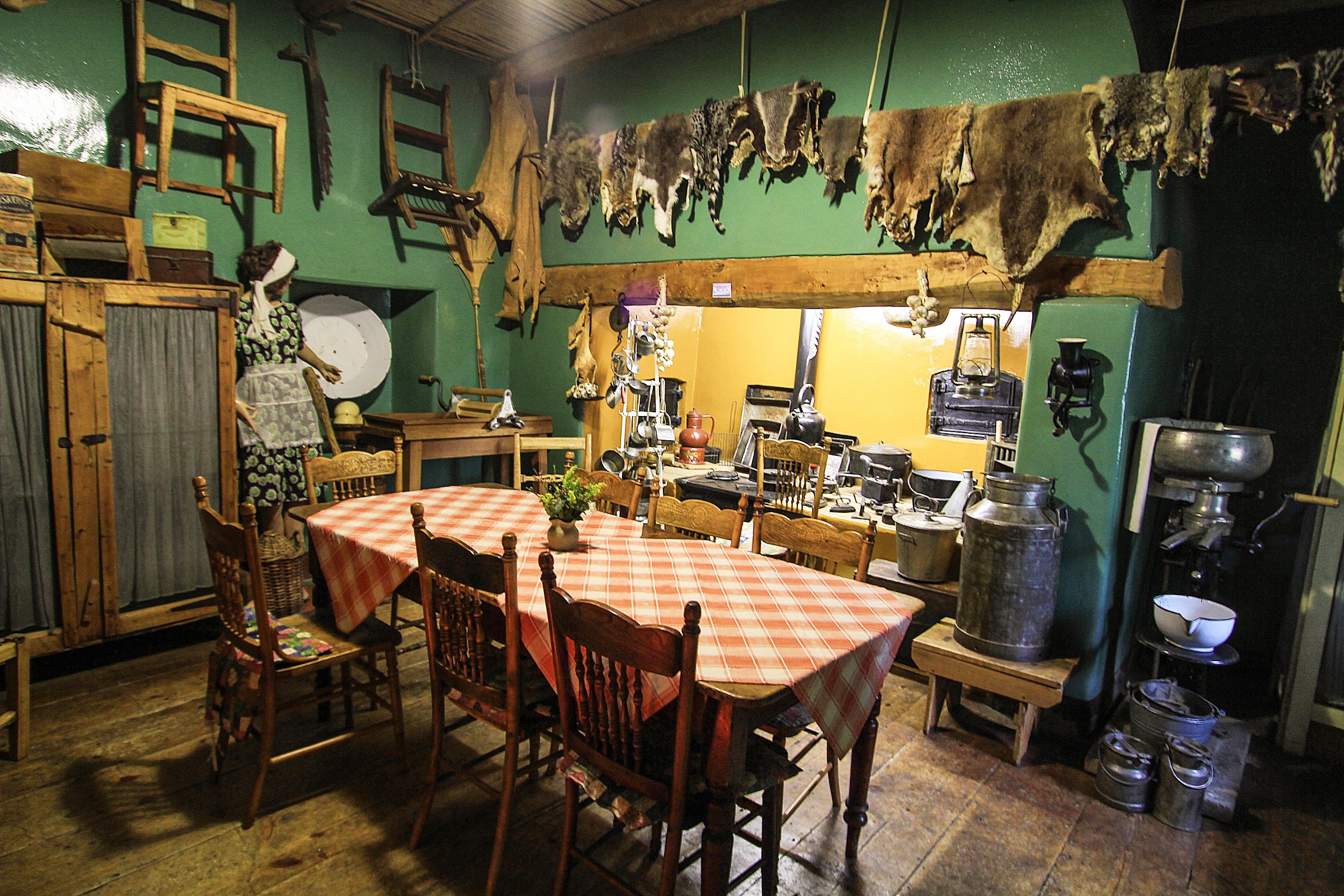
 The kitchen at Hantam Huis in Calvinia has the old arsenic-colour turquoise paint and displays old milk separators, milk churns and the old hearth. (Photo: Chris Marais)
All over the Karoo you’ll find “house museums”, and the most fascinating part is always the kitchen.
This is where you’ll discover cunning little peach peelers, raisin pip removers, nutmeg graters, sugar cane cutters, egg boxes, coffee roasters, candle moulds, mincers and copper water heaters that fitted neatly next to the hearth.
Urquhart House, part of the Graaff-Reinet Museum, has one of the best old-time kitchens where you can marvel at Victorian ingenuity and Karoo practicality. But the first thing you’ll notice is the floor.
Peach pips used to be embedded to strengthen clay floors across the Karoo, according to the late Helena Marincowitz of Prince Albert. In her book Karoostyle: Folk Architecture of Prince Albert, she writes: “They were placed in rows and beaten down with a wooden board to obtain a smooth surface. After six months, the floor was coated with a layer of aloe juice; this was to keep the insects away.”
These days, we can admire this uniquely South African flooring technique. So interesting to the eye, so easy to clean, so therapeutic to walk on, beetle-resistant, eco-friendly and warp-free, they enthuse.
Yet it’s hardly used nowadays. One of the rare exceptions is the Elandsberg Wilderness Cottages at Tankwa Karoo National Park, which features peach pip floors in the open-plan kitchens.
/file/attachments/orphans/marais-karoo-kitchens1_844835.jpg "Detail of a peach pip floor. (Photo: Chris Marais)")
/file/attachments/orphans/marais-karoo-kitchens9_664935.jpg "Urquhart House in Graaff-Reinet is full of half-forgotten innovations. The dark gleaming floor is made from peach pips, varnished with aloe juice. (Photo: Chris Marais)")
Cooking on rock
Of course, when the trekboere first started travelling across the Karoo in the 1700s, there wasn’t anything as modern and convenient as a kitchen, open hearth or even a proper floor for that matter.
These migrant farmers, following the rains with their animals, would live in their wagons or build corbelled houses from stone – the only available building material in the western Karoo. Any cooking happened outside in the kookskerms (cooking shelters), usually created by piling up semicircles of asbos, a succulent that grows in profusion in the dry land.
Elna van Schalkwyk, who runs a B&B in Williston, often takes people on tours including the various corbelled houses in the region and has compiled some of the old recipes of that time. One of the favourites (and just as good when reproduced today, she swears) was to heat up flat pieces of ironstone by steepling them over a fire. Then, when red-hot, one would be knocked flat onto the embers, a thick mutton rib laid on it, topped with the other hot rock.
You’ll see it made to this day, usually at the Hantam Vleisfees in Calvinia in spring every year. Only ironstone (dolerite) gets hot enough to do the job.
Count to 10
Later, outside ovens were created with clay in which bread was baked and meat was roasted. Some of the very first were hollowed-out anthills. Historian Marincowitz recounts that a thornwood fire was made and stoked inside and the cook would check the heat by holding her hand inside.
If it could be held in the oven for the count of 10 (but no more), the temperature was just right. Then the waiting bread mixture, leavened with sour dough, was pushed in, usually in earthenware pots. A stone was placed in the opening and everything sealed with clay. Only later were metal doors introduced.
Of course, while on trek, there was no time for ovens. Dough was baked in the ashes for asbrood, or on griddles for roosterkoek. Meat was mostly turned into biltong.
/file/attachments/orphans/marais-karoo-kitchens8_224984.jpg "There is nothing quite like that smoky flavour of a bread baked in an outside oven. (Photo: Chris Marais)")
/file/attachments/orphans/marais-karoo-kitchens7_880840.jpg "Although many corbelled houses have smoke-blackened hearths, much of the cooking was done outside, in cooking shelters (kookskerms). (Photo: Chris Marais)")
A coffee jones
And then of course, there was the traditional old boeretroos – coffee, to which the Boers developed a powerful addiction after the Dutch East India Company started importing it in the 18th century.
You’ll find all kinds of coffee roasters in museums. But coffee, coming from tropical countries across the seas, was sometimes difficult to obtain deep in the Karoo. Undeterred, the Boers made a plan. The root of the shepherd’s tree – the witgatboom – was one of the most popular (if somewhat purgative) alternatives until the tree became a protected species.
Author Lawrence Green records farmers using roasted peas added to coffee. Others would mix it with roasted peaches or prickly pear peels, carrots or dried figs for flavour. During the South African War, Boer soldiers had to make do with roasted mielie coffee.
/file/attachments/orphans/marais-karoo-kitchens2_151617.jpg "An old Union Stove in excellent condition. They are still used today. (Photo: Chris Marais)")
An indoor hearth
Actual kitchens were an addition onto old Karoo houses, says Marincowitz, usually leading off the voorhuis (lounge). The hearth was massive, often stretching across the whole wall. This is where giant pots were perched over fires, where hams were smoked and biltong dried.
It was only from the 1930s that stoves like AGAs, Unions, Dovers and ESSEs took their place in the fire hearth.
Keeping food fresh and free of pests was another issue. If you visit the kitchen in Olive Schreiner’s old house in Nxuba (formerly Cradock) or the Hantam Huis kitchen in Calvinia, you’ll notice the walls are a distinctive blue-green – the result of arsenic being added to the paint to repel flies.
/file/attachments/orphans/marais-karoo-kitchens4_894946.jpg "The old kitchens, like this one in Cradock’s Olive Schreiner Museum, were often an interesting greenish-turquoise – the result of arsenic being added to the paint. (Photo: Chris Marais)")
/file/attachments/orphans/marais-karoo-kitchens_352816.jpg "Corner of an old Karoo kitchen. (Photo: Chris Marais)")
Keeping cool
The kitchens always faced south to keep food cool. But in the heat of summer, more was needed. Sometimes you’ll see a small box-like building outside an abandoned Karoo farmhouse kitchen or a deserted railway station. These were evaporative fridges, the walls made with charcoal or pumice trapped between chicken wire. Water trickled down the walls and the evaporation made for a discernibly cooler storage space.
People think that, as time goes by, we become more modern and sophisticated. But time spent in a Victorian kitchen museum can reveal an era of innovation – and being completely “unplugged” too DM
Chris Marais and Julienne du Toit are the authors of the five-book Karoo Heritage Collection (R1 300, including courier in SA). For orders, contact julie@karoospace.co.za
Living overseas? The Karoo Heritage eBook Collection (R500) can be bought online: The Karoo Heritage Collection Ebook - Karoo Space.
/file/attachments/2998/KarooHeritageCollection_159903.jpg)
Comments
Scroll down to load comments...