




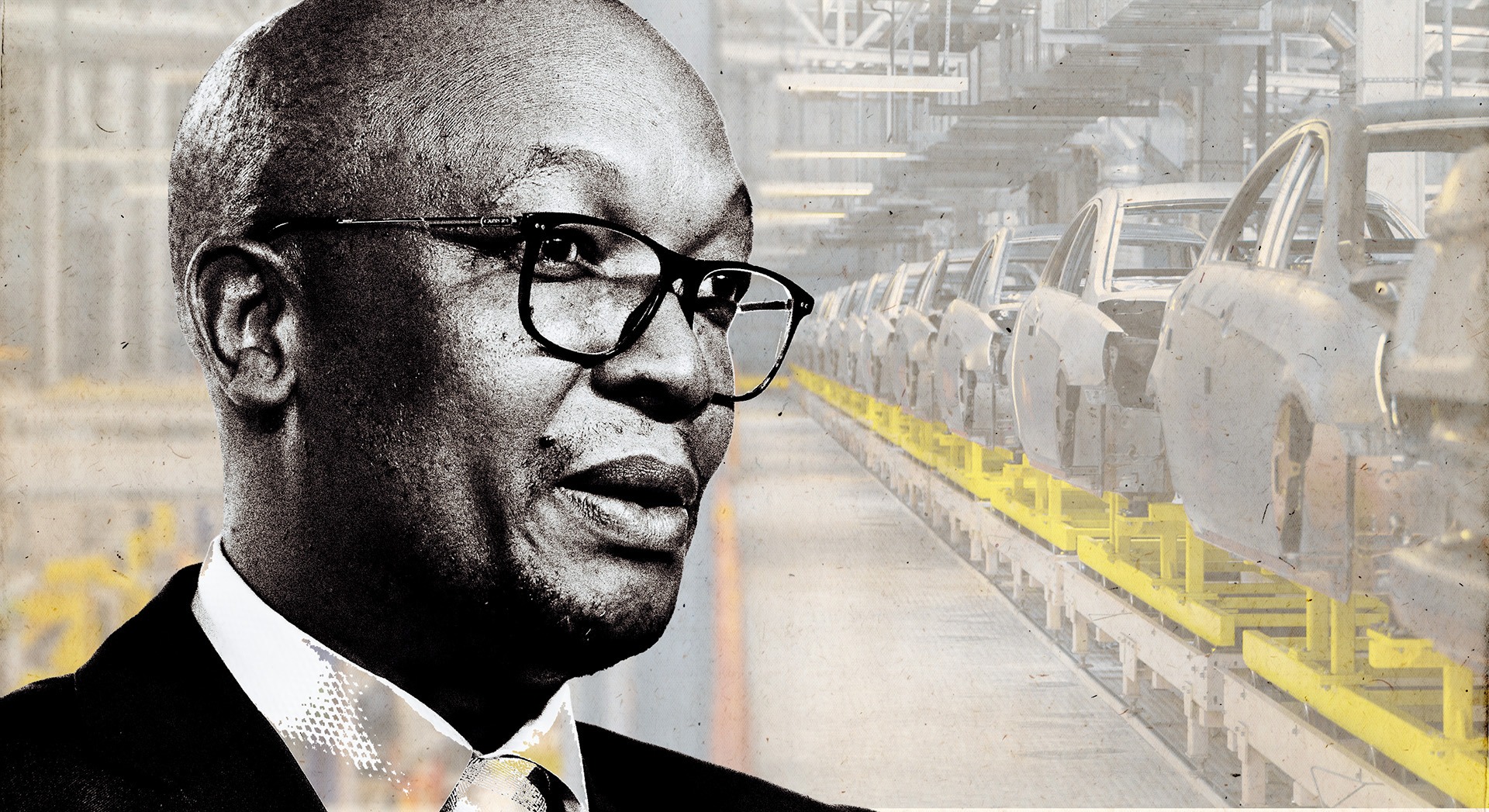
 Illustrative image: Minister of Trade and Industry Parks Tau. (Photo: Sharon Seretlo / Gallo Images) | Automotive assembly line. (Photo: iStock)
It started with the keynote address. Trade Minister Parks Tau established that transformation is an essential structural requirement for long-term industrial competitiveness rather than a peripheral compliance exercise.

“That’s why we’re giving transformation a full day of its own at SA Auto Week, to send a clear signal that transformation belongs at the centre of how this industry thinks about the future,” he said, name-checking black industrialists.
“Empowering people means the workers, engineers, managers and owners of this industry should look like South Africa. That includes women, who remain badly underrepresented across the value chains.”
He then laid out a series of strategic connections, beginning with an approach to growing supplier networks, meaning a deeper, more competitive and more inclusive component base.
“Building a new energy vehicle [NEV] economy means making sure that the industry of the future is not built on the same narrow base as the industry of the past.”
Not an agenda
Tau rejected the notion that equity transformation compromises global standing, saying:
“Transformation and competitiveness are not in tension. An industry that draws from all of its people and on a broad and capable supplier base is a stronger industry.”
In perhaps his most audacious move, he framed imported components as an industrial opportunity.
“Localisation is where transformation becomes real. The R151-billion in imported components is not only a statistic; it is the size of the opportunity in front of us.”
Then he addressed the emerging automotive technologies elephant in the room: “Batteries, electric drive units, power electronics, thermal systems, and charging equipment are new value chains. They are still being built. Black-owned and women-owned firms can enter them at the start as owners and partners rather than at the margins.”
Because, even with all that bluster, our man in charge of the trade levers can get real and had a sober review of performance against the South African Automotive Industry Master Plan to 2035 targets.
/file/attachments/orphans/GettyImages-912982160_424462.jpg "A worker carries out a quality control inspection inside the boot area of a VW Polo automobile on the production line at the Volkswagen AG plant in Uitenhage, South Africa, on Thursday, Jan. 25, 2018. Growth in European car sales will slow after reaching a 10-year high last year, an industry group said, as consumer worries about Brexit and future regulations on auto emissions curtail purchases. (Photo: Waldo Swiegers / Bloomberg via Getty Images)")
Local content, for instance, slipped from 38.7% in 2015 to 38.1% – remaining well below the 2035 target of 60%. Furthermore, while vehicle original equipment manufacturers (OEMs) imported R151-billion worth of original equipment components, this massive outlay presents a key growth opportunity.
Then he stuck that knife of reality into the gut of the industry: most OEMs and Tier 1 suppliers remain foreign-owned, leaving domestic black-owned suppliers confined to low-value tiers or excluded entirely.
Demanding outcome-driven action, he said:
“We do not need more statements of good intent. We need commitments that can be measured and that we can report on when we meet again next year.”
A Trojan horse?
But the uncomfortable truth is that the transformation agenda relies heavily on the Equity Equivalent Investment Programme (EEIP). The scheme allows foreign OEMs to satisfy BBBEE ownership requirements by contributing equivalent financial capital toward localised industrial development, black industrialist funding, skills development and supply chain transformation.
And all of Tau’s smoke was fed by the fire of alignment with the structural mechanics of EEIPs under the Automotive Production and Development Programme Phase 2 (APDP2) regulatory review. Which is not a bad thing; it just cheapens the defiant tone.
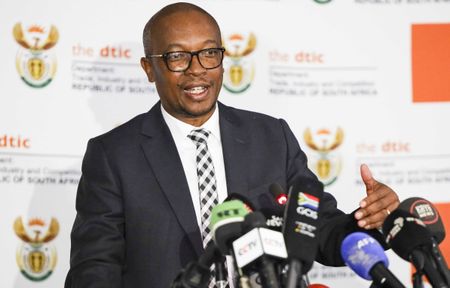
A practical example of him shifting incentives is his stance on APDP2 reform that “must reward manufacturing in South Africa, not assembly alone, and must support component manufacturers”.
This aligns with recent draft amendments to APDP2 regulations, which expand standard material definitions to include critical minerals from the Southern African Customs Union and the Southern African Development Community for EV battery production, allowing a 50% Standard Value Added rate and a 150% tax allowance for qualifying EV and hydrogen production investments.
Under APDP2 regulations, a “qualifying entity” eligible for production incentive benefits must be BBBEE compliant or contribute directly to the Transformation Fund managed by the Automotive Industry Transformation Fund (AITF) – which is basically a prototype for the broader BBBEE reforms the minister is proposing.
Wait, what’s with the transformation fund?
Historically, multinationals executed EEIP obligations individually. The creation of the Automotive Industry Transformation Fund (AITF) by vehicle manufacturers under APDP2 introduced South Africa’s first collective EEIP mechanism.
“What makes AITF unique is that we are the first collective EEIP, and the rationale behind a collective EEIP, really more than anything, is impact,” the fund’s corporate planner and strategy coordinator, Princess Mashamahite, explained to Daily Maverick.
“Where you have just close to a billion in cash but then you see R8-billion in access to market unlocked – no one OEM can do that on their own. So that collaborative effort really helps.”
OEMs sit on the board of the AITF to align funding deployment with their global platform conversations and local factory sourcing requirements, and the AITF manages both the OEM EEIP Fund and the APDP Transformation Fund for component manufacturers, ensuring coordinated Tier 2 and Tier 3 development across the entire sector.
But while OEMs have made progress in Tier 1 transformation, localisation at Tier 2 and Tier 3 levels faces scale challenges, raw material cost pressures, and global head office sourcing restrictions.
Can’t fight gravity
No matter how many incubated black component manufacturers naamsa | The Automotive Business Council) parades on stage, structural fragmentation persists.
Policy incentives currently operate across separate channels: APDP2 (Department of Trade, Industry Competition and the International Trade Administration Commission of South Africa) rewards production/localisation. BBBEE and enterprise and supplier development reward ownership/transformation, and the Black Industrialists Scheme provides capital grants.
Tau can only cast the albatross from his neck when there is alignment into a single integrated framework.
Instead of clapping for their internal hard work, OEMs should leverage the AITF to issue joint procurement off-take agreements for black industrialists (read: standardising stampings, polymers and aluminium components across multiple vehicle platforms).

And when it comes to the NEV term that is thrown around more than AI at a pitch competition, the minister should look at building a bigger moat by requiring that a minimum percentage of all new NEV supply chain investments (battery pack assembly, thermal systems, charging infrastructure) be allocated to majority black- and women-owned entities.
“The local automotive manufacturing industry will be dead in 20 years,” was the judgement of a jaded conference attendee who paid his own way to get to Durban. Tau can help ensure that does not become reality. DM
Comments
Scroll down to load comments...