



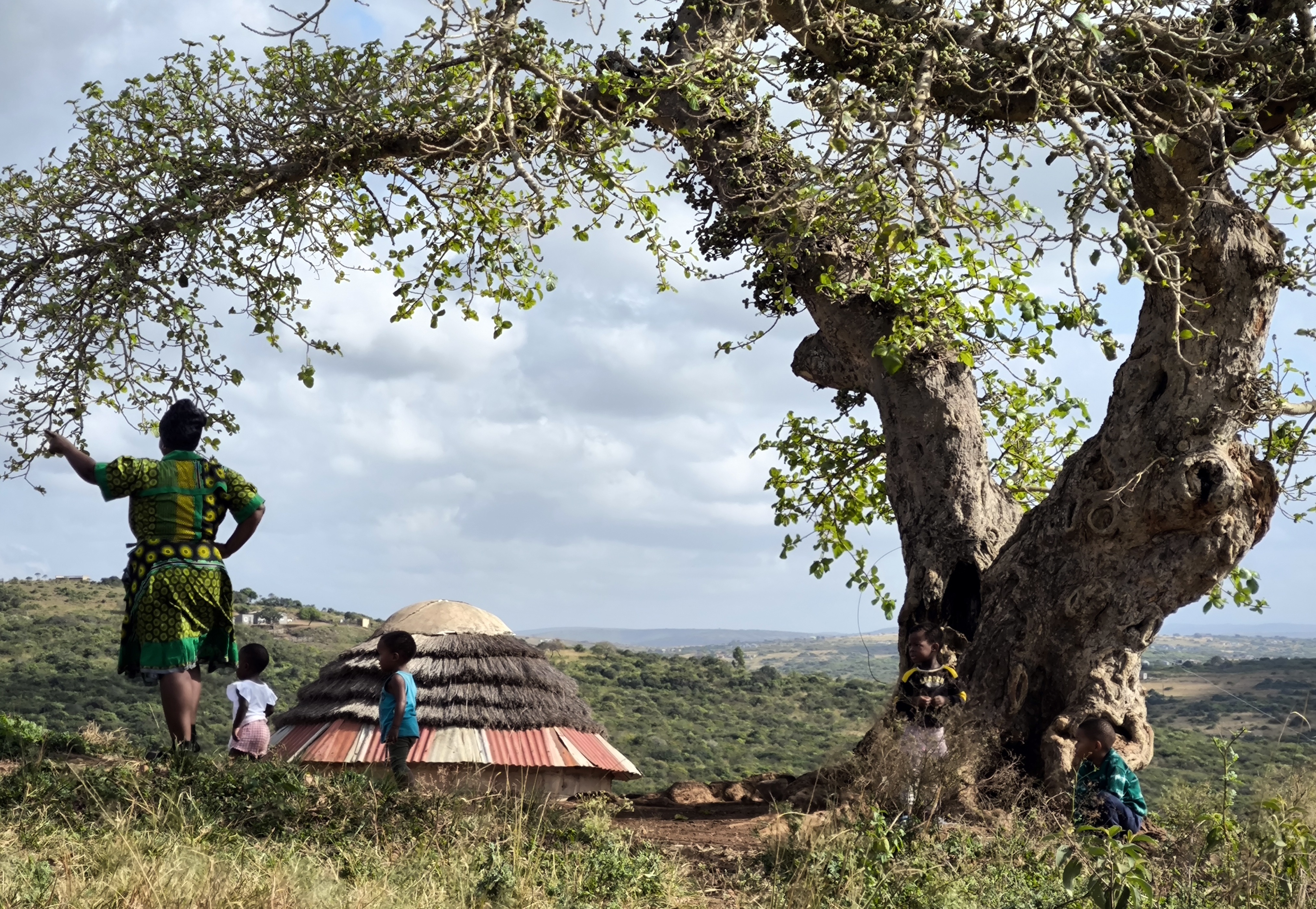
 A mother and her children shelter from the sun under an indigenous umkhiwane (fig tree) in the Somkehle area. (Photo: All Rise)
“When calculated accurately, the economic effects of this coal mine are clearly negative, depriving a rural community of their future, while effectively transferring resources to the private owners of Tendele mine. Even if the fiscal contribution of the mine is factored in, it remains an unconscionable and irrational extraction of value from the many to the few.”
That’s the blunt conclusion of Professor Sarah Bracking (King’s College, London) and Dr Danford Chibvongodze (University of KwaZulu-Natal) in a new study entitled Just Compensation: Accounting for Lost Assets and Livelihoods in Mining-Affected Communities in Somkhele, KwaZulu-Natal.
Researchers estimate that rural households near Mtubatuba have lost more than R80-million in land, crops and livestock since full-scale commercial extraction began in 2007 at the Somkhele Coal Mine. This accumulated loss stands in stark contrast to the compensation given to residents, which covered a mere 4.7% of their total damages.
Owned by Tendele Coal Mining (Pty) Ltd, the mine originally broke ground and commenced initial, smaller-scale anthracite and coal operations in 2006 within the Mpukunyoni Traditional Authority Area, before expanding to full production the following year.
/file/attachments/orphans/tonyland2_462970.jpg "Goats are an integral asset for many rural families in the Mpukunyoni area (Photo: All Rise)")
Invited to comment on the findings, Tendele Mining noted that the company was involved in litigation and regulatory proceedings involving the further expansion of the mine.
“Given the ongoing litigation, we do not intend to comment further at this stage. We will properly review the report, its methodology and underlying source material and will decide thereafter whether any substantive response is appropriate.” (See Tendele’s full response below.)
Accounting method
According to Bracking and Chibvongodze, the Just Compensation report was commissioned by Durban-based All Rise Attorneys and uses data from 115 directly affected households surveyed in 2018, and measures loss and damage using an asset-based livelihoods approach.
“It measures the loss and damage to land, crops, livestock, cultural assets, ecological systems and health, both immediately and over 20 years.”
They note that in the context of mining compensation, most calculations for loss and damage use a market-replacement price model.
“At best, this pays the owner – of the field, cow, sheep, etc – the local market price for the thing that will be lost at the time it is lost.”
/file/attachments/orphans/tonyland3_333951.jpg "A woman returns to her homestead adjacent to coal mining pits at Somkhele (Photo: All Rise)")
“Some economists also sometimes use income and production approaches, which add changes to future income streams or production functions to show more aggregated economic effects. Our new method is more holistic than these.
“In our ongoing research, we have piloted a fairer, more realistic accounting method that focuses on treating what people lose as an asset underpinning a livelihood with future income streams – an asset-based livelihoods approach.”
Based on surveys conducted by All Rise (the pro bono attorneys representing several community members in Somkhele), they estimated that households had lost more than R80-million in land, crops and livestock, but only 22% of the 115 affected households they spoke to reported receiving any compensation at all. Reported compensation to date totalled about R3.6-million, or 4.7% of the losses they counted.
“A mining company will value compensation by estimating the market price of what is visibly destroyed for the mine to open on a given day: a demolished structure, a field taken, a pig. This doesn’t include the ongoing human costs, for example, the cost of ill health from pollution, and all the loss of future income.
“We counted differently, using a model that a bank might use if it viewed the households as ongoing commercial businesses – which they are. This values things as assets that can be used to provide income into the future. A cow is not just one animal that can easily be replaced. It contributes to the future herd, with calves, milk and sales compounding over decades. Lose 15 cattle, as the average affected household here did, and many years of future income are lost.”
/file/attachments/orphans/tonyland4_201011.jpg "An extract from the Just Compensation report. (Source: Bracking and Chibvongodze 2026)")
They conclude that affected households collectively held 270 hectares of land before mining began, but were left with just 68 hectares afterwards.
“That’s a 75% reduction worth around R60.6-million. Crop yields collapsed by 94% on average. Yields of maize, the staple, dropped by 97%.
“Livestock numbers of cows, goats, pigs, sheep and chickens fell from 7,574 animals to 2,643. More than 200 houses and rondavels were lost. People were forced to buy water that was once free.
“Valuation is never neutral. Our calculations based on costs and compensation in Somkhele make some of the missing income visible. But some things cannot be priced: the relocation of ancestors’ graves, the loss of 15 [types of] indigenous plants used for food and medicine, the ill health and psychological trauma people experienced. Numbers cannot be put on these ongoing losses.”
Legacy of apartheid
As one example of differences in methodology, they note that communal land is generally valued lower than commercial land due to formal zoning classifications, which were retained as a legacy of apartheid.
“Due to these classifications, customary communal land is often excluded from formal land markets, resulting in official valuations that substantially undervalue its economic and social functions.
“In Somkhele there is indeed an absence of recorded direct market transactions – often called ‘willing buyer/willing seller’ transactions – and reliable official valuation data on land.”
So instead, they incorporated land valuations from nearby Mtubatuba (the nearest formal settlement) as well as the adjoining Kwamsane low-income node.
Rather than just measuring current livestock and standing crops at the time of relocation, they also projected losses over the longer time horizons of mining the area.
/file/attachments/orphans/tonyland5_428138.png "An example of crop loss calculations. (Source: Bracking and Chibvongodze 2026)")
In a foreword to the report, SA Human Rights Commission commissioner Philile Ntuli writes: “Too often, the impact of mining is measured through production, employment and revenue, while the deeper relationships between people, land, water, culture, memory and belonging receive less attention.
“The value of this report lies not in determining legal liability or substituting the functions of courts, regulatory authorities or other statutory institutions. Rather, it provides a carefully researched body of evidence that enriches public understanding and contributes to informed dialogue on the relationship between mining, development and human rights.”
/file/attachments/orphans/tonyland6_767676.jpg "Young goats rest in the doorway of a local homestead (Photo: All Rise)")
Tendele’s full response
In his response, Tendele Mining business development director Nathi Kunene said it was important to note that the surveys with community members were conducted by All Rise Attorneys rather than by UKZN and King’s College researchers.
“All Rise has represented MCEJO [Mfolozi Community Environmental Justice Organisation] in litigation and regulatory challenges concerning Tendele for many years. There has also been considerable public debate about whether MCEJO represents the views of the broader Mpukunyoni community.”
“For the avoidance of any doubt, prior to your approach, Tendele had never seen or been provided with this new report. Neither the researchers nor All Rise shared it with us, and we have never been provided with the underlying 115 surveys or the methodology by which those households were selected.
“We can also confirm unequivocally that not a single Tendele employee or representative was contacted or approached by the researchers for information, verification or comment. Equally, not a single representative of the Mpukunyoni Traditional Council was approached or consulted.
“This is particularly surprising given the extensive legal, regulatory and public participation processes concerning the mine. More than 15,000 pages of documentation are presently before the minister, following a comprehensive public participation process involving more than 32 meetings with affected communities and stakeholders.” DM


Comments
Scroll down to load comments...