



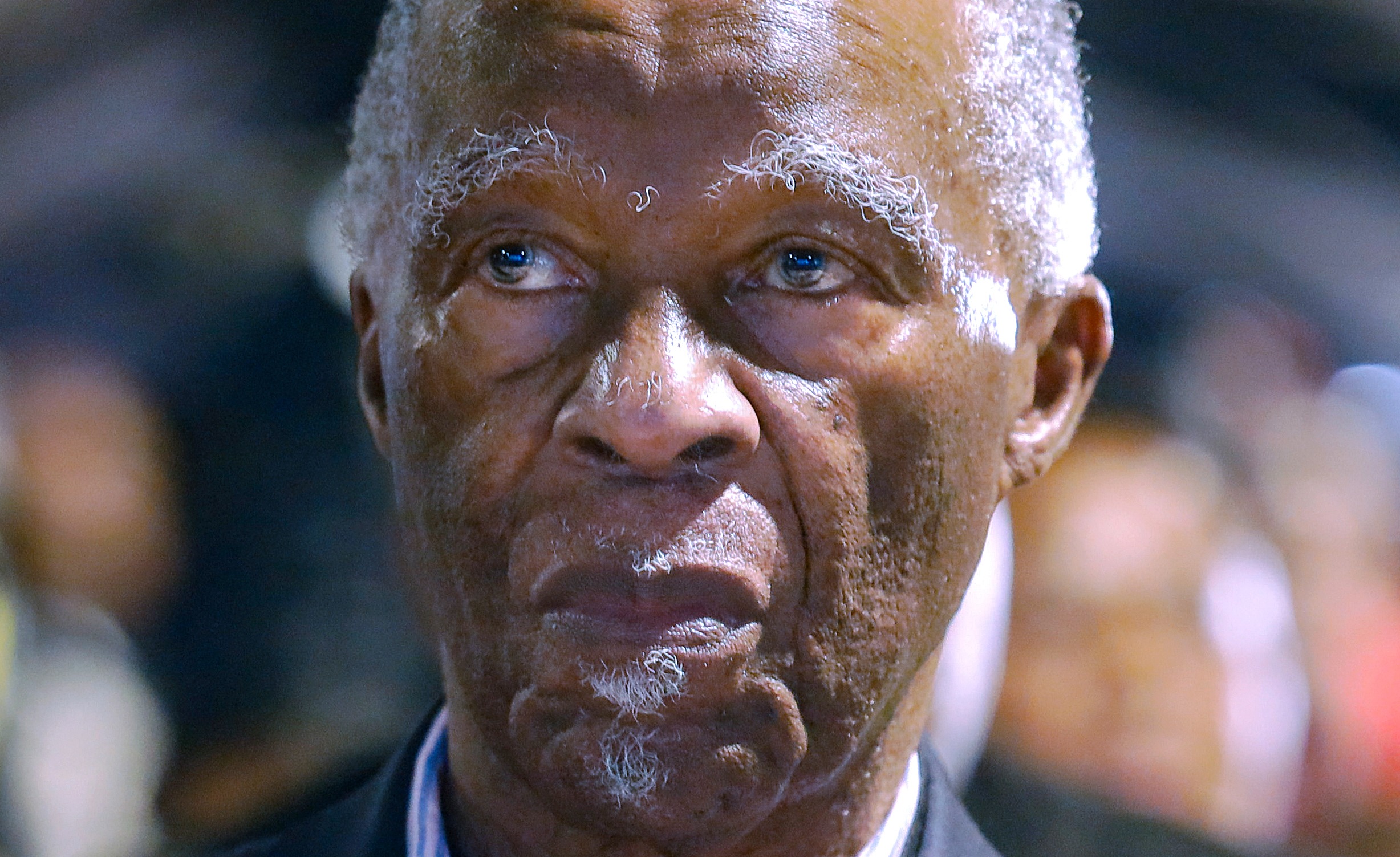
 Former president Thabo Mbeki Mbeki has denied suppressing TRC prosecutions and blamed the NPA for failing to pursue the roughly 300 TRC-referred cases. (Photo: Gallo Images / Sharon Seretlo)
The much-anticipated appearance of former president Thabo Mbeki at the Khampepe Commission set down for two days from 19 October is a significant moment in the inquiry’s almost year-long sitting.
The former statesman has been accused by the families of victims of human rights abuses, known collectively as the Calata Group, represented by Lukhanyo Calata, the son of murdered Cradock Four activist Fort Calata, of actively suppressing TRC prosecutions.
Mbeki, in a statement filed with the commission on 5 October, has categorically denied this, placing the blame squarely at the door of the National Prosecuting Authority (NPA).
Recalling British wartime president Winston Churchill, Mbeki noted “the elaborate steps” the Allies had taken during World War 2 to mislead the Germans, thus protecting Normandy with “A Bodyguard of Lies”. This, he added, was the strategy deployed by the NPA.
In failing to “discharge its duties” and seeking to blame the executive “it would seem to me that some in our country have spent a considerable amount of time and energy to manufacture a Bodyguard of Lies to hide the truth about why the cases referred to the NPA by the TRC were not prosecuted and who was responsible for this gross misdemeanour”.
He also said his attempts to delay his appearance at the Khampepe commission were not because he was hostile to the process, but because this was “a necessary legal consequence while judicial review of the recusal ruling was pending”.
“I recognise the profound importance of these matters to the many victims’ families and people of our country who have waited many years for answers,” he told the commission.
He said that he did not “direct, authorise or approve the suppression of the investigation or prosecution of the cases referred by the TRC to the NPA. I had no reason to do so.”
/file/attachments/orphans/GettyImages-91120664_669351.jpg "South Africa. Tuinhuiys. Nelson Mandela, Thabo Mbeki and FW de Klerk, May, 1994. (Photo: Media24 / Gallo Images / Getty Images)")
Blanket denials
Mbeki also denied all claims that he attended meetings with former president F W de Klerk and his security chiefs to deliberate on a “political solution” to stop prosecutions.
He denied having agreed “at any meeting, that a political solution be found to avoid the prosecution of the members of the security forces”. Mbeki also denied that there was any agreement that prosecutions would be halted and that he had, in fact, rejected a general amnesty.
“I did not attend a meeting with former President de Klerk, the SADF, SAP and the ANC for any purpose,” said Mbeki.
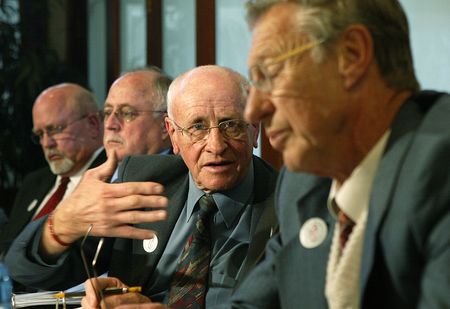
He noted that this allegation, made by advocate Anton Ackermann, former head of the Priority Crimes Litigation Unit to the inquiry, was “double hearsay” evidence provided by Jan Wagenaar, the attorney who acted for the generals and other security officials.
The former president charged that post-TRC prosecution delays were rather caused by former apartheid-era prosecutors inherited by the NPA who may have been “unmotivated” to prosecute their former “comrades” among the security forces, as this would have “exposed their leaders”.
He said he denied Ackermann’s characterisation of his April 2003 address to parliament as “classical Machiavellian”.
“It is not clear to me what he means by this.”
/file/attachments/2989/Gemini_Generated_Image_dx2mz9dx2mz9dx2m_910686.png "Advocate Anton Ackerman testifying at the Khampepe Commission")
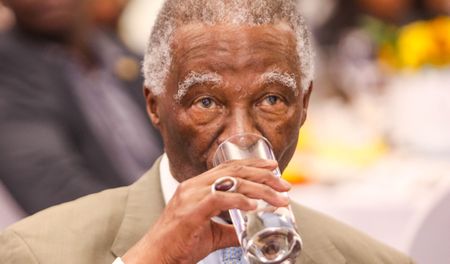
This was not to say that he did not have dealings with the NPA, said Mbeki, but these had been on “operational matters reported to me by the NPA as requiring my attention. I gave an account of one matter concerning the investigation of the former national commissioner, Mr Jackie Selebi, in my founding affidavit.”
Alleged failures
The Calata group have accused Mbeki of failing to instruct his ministers of justice, national directors of public prosecutions and police commissioners to investigate TRC cases, opening the door to interference in an address the president made at the opening of Parliament on 15 April 2003.
Mbeki was accused of personally halting the planned 2006 arrests of former minster of police, Adriaan Vlok, and former police commissioner Johan van der Merwe, for the attempted murder by poison of Reverend Frank Chikane.
/file/attachments/orphans/ED_519487_879407.jpg "Lukhanyo Calata (son of Fort Calata) during the Cradock Four Inquest at the Gqeberha High court on September 02, 2024 in Gqeberha, South Africa. Fort Calata, Matthew Goniwe, Sicelo Mhlauli, and Sparrow Mkhonto died at the hands of the apartheid regime on June 27, 1985. (Photo: Gallo Images / Die Burger / Lulama Zenzile)")
The creation also of a Special Dispensation for Pardons, the Calata Group have charged, accommodated the generals’ demand for admission of crime without full disclosure.
Mbeki denied this categorically, saying that neither he nor his administration ever adopted a policy, issued instructions, or made any attempt to halt, delay or suppress the investigation or prosecution of TRC cases.
/file/attachments/orphans/Fer-ANCfederation5_513612.jpg "Reverend Frank Chikane testifies at the Khampepe Commission Of Inquiry at Sci-Bono Discovery Centre on May 19, 2026 in Johannesburg, South Africa. The inquiry was established to investigate allegations of political interference in the investigations of apartheid era crimes. (Photo: Gallo Images / Fani Mahuntsi)")
Mbeki denied also authorising or directing the suspension of planned arrests in the Chikane matter, stating that he was unaware of the planned arrests and that the allegation rested on hearsay.
While as president he held broad executive authority, he had possessed no constitutional or statutory power to instruct prosecutors or police regarding individual criminal investigations or prosecutions, he told the inquiry.
Improperly interfering with the NPA was a statutory offence under Section 32(1)(b) of the NPA Act, punishable by up to 10 years' imprisonment, he noted.
Dedicated machinery
Mbeki noted that three weeks before his parliamentary speech he had issued a presidential proclamation establishing the Priority Crimes Litigation Unit within the Office of the National Director of Public Prosecutions (NDPP) to handle TRC-related prosecutions.
In the speech, he said he had explicitly declared there would be no general amnesty and had reaffirmed that those who were refused amnesty or who had failed to apply to the TRC “remained fully accountable”.
He had also exclusively dealt with “pardon cases"” (convicted offenders seeking presidential pardons under Section 84(2)(j) of the Constitution) and not the 300 cases referred by the TRC directly to the NPA for prosecution, he noted.
Mbeki argued that the creation of this dedicated prosecutorial machinery for TRC cases directly contradicted allegations that his intentions had been to suppress these prosecutions.
/file/attachments/2999/Screenshot2026-10-12132400_205901.png)
The ANC 37
The former president said that the ANC’s collective “Group of 37” amnesty application had been “an effort to accept moral/political responsibility and lead by example” and had not been “a bid for blanket immunity”.
Mbeki contended that the failure to prosecute TRC cases lay with the NPA’s failure to discharge its “exclusive statutory mandate, rather than any executive obstruction”.
Mbeki added that any meetings he might have had with former South African Police and SA Defence Force members had been requested by them while the TRC was under way in the mid-90s.
/file/dailymaverick/wp-content/uploads/2021/11/000000151.jpg "Brooks-FW-ComplexLegacy-inset-11")
The generals had informed the ANC, he told the inquiry, that they had not volunteered to appear before the TRC because De Klerk and his Cabinet had refused to do so. They had considered it “unfair that subordinate officers and generals were left alone to account”.
On the back of these discussions, said Mbeki, the ANC offered to approach De Klerk and his Cabinet to appear before the TRC.
Mbeki clarified that discussions mediated by Namibian-born businessman Jürgen Kögl involving various Afrikaners had nothing to do with past criminal liability, focusing exclusively on political demands regarding a “volkstaat” and the “right to self-determination”.
He ended his statement with “I hope that the commission will, at last, cause the truth, the whole truth and nothing but the truth about the matter of the TRC cases to be known.” DM
Comments
Scroll down to load comments...