




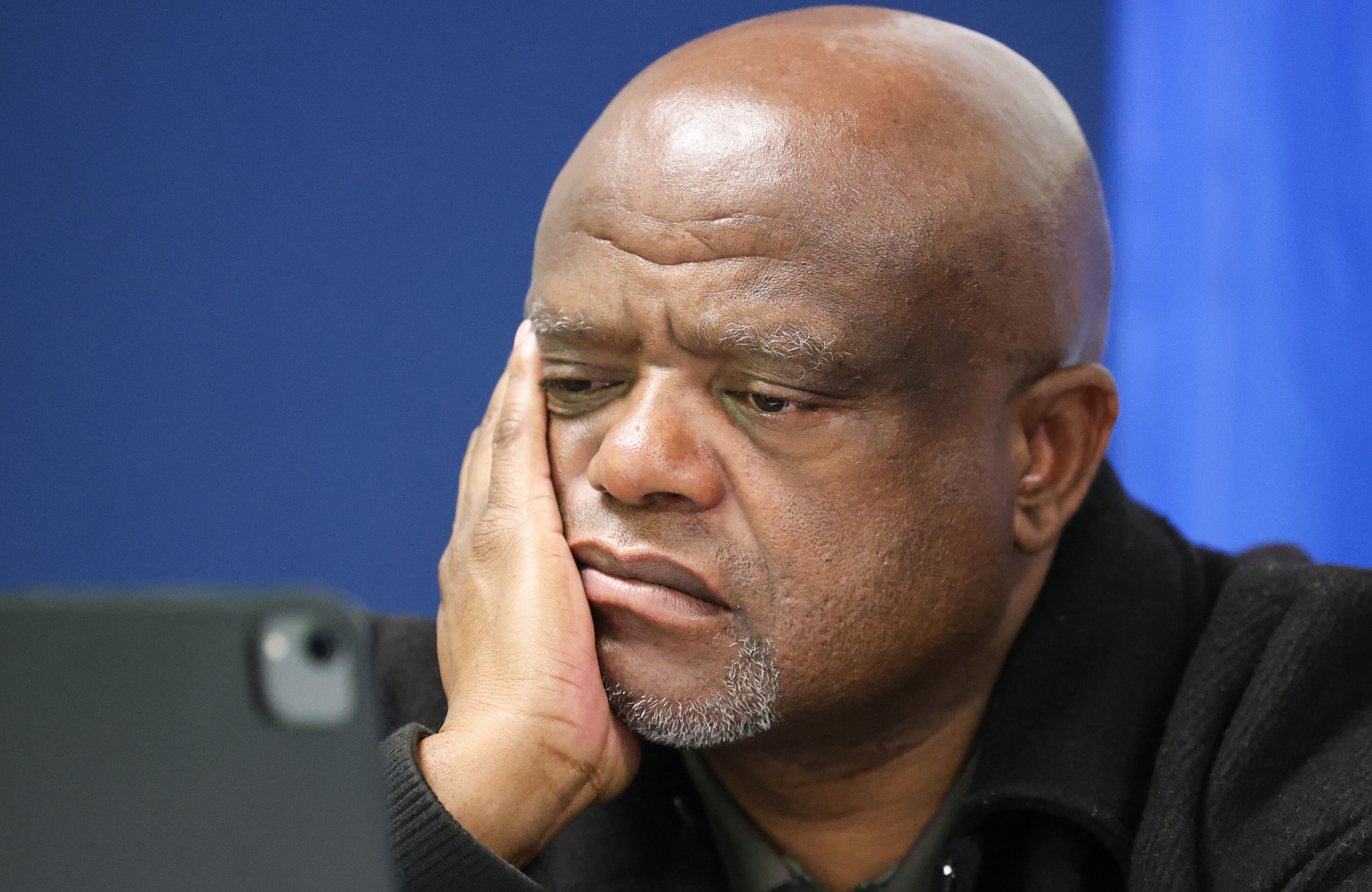
 Joburg Mayor Dada Morero at the 6 October gathering where he pledged that officials who misused public money would be held accountable. (Photo: Luba Lesolle / Gallo Images)
Addressing senior municipal officials, political leaders and representatives of the Auditor-General and Gauteng Provincial Treasury at a financial accountability gathering in Brixton last week, Johannesburg Mayor Dada Morero declared that his administration would not hide financial misconduct, that officials who misused public money would be held accountable regardless of rank, and that residents deserved to know how their money was spent.
“We cannot fix what we refuse to name,” he told the gathering.
But while the mayor was making these promises, his administration was facing questions over its failure to provide Daily Maverick with records concerning billions of rands in alleged financial misconduct, sought through an application under the Promotion of Access to Information Act (Paia).
When Daily Maverick asked Morero’s office to explain the apparent contradiction, it failed to respond by the deadline of 5pm on Thursday, 8 October.
Separately, the City’s Paia office acknowledged on the same day that the application for financial misconduct records had become what the law calls a “deemed refusal”.
In simple terms, the City had failed to communicate a decision within the time allowed by law. Paia therefore treats the request as having been refused.
The City has neither provided the requested records nor explained why they should be withheld. Instead, it has advised the requester to lodge a formal internal appeal under Paia – requiring another legal step to challenge its failure to decide on information first requested more than two months ago.
‘We will not hide those failures’
Speaking at the event – the signing of the Protocol on Interim Financial Statements at the Brixton Multi-Purpose Centre on 6 October – Morero placed financial accountability at the centre of his address.
“The City must be accountable to its citizens. Not to itself. Not to its officials. To the people who live here, work here and pay for the services we provide,” he said.
Morero acknowledged that Johannesburg had not consistently met the standards of good governance it had set for itself.
“So today, as host, I must ask honest questions. More than 10 years later, have we kept that promise? The truthful answer is: not always, and not consistently.”
He specifically praised the work of Johannesburg’s Disciplinary Board, which investigates allegations of financial misconduct.
“In Johannesburg, our Disciplinary Board has become one of our most important instruments of good governance,” he said.
Morero told the gathering that investigations had resulted in disciplinary action against officials, referrals to law-enforcement agencies and amounts identified for recovery.
“Let me be clear: we take no pride in these cases. Each one represents failure. But we will not hide those failures either.”
He added: “If officials, or anyone acting on behalf of the City, misuse public funds, they will be held to account, regardless of rank.”
These are precisely the matters Daily Maverick has been attempting to investigate.
Billions in questionable expenditure
On 3 August, a Paia application was submitted to the City seeking records relating to financial misconduct investigations, disciplinary proceedings, criminal referrals and the recovery of public money.
The application followed a Johannesburg City Council meeting on 22 July at which 13 alleged financial misconduct matters involving approximately R4.07-billion were considered behind closed doors.
The underlying forensic reports were not made public, nor were the identities of officials allegedly implicated in the matters.
A separate concern was the R45.16-billion in unauthorised, irregular, fruitless and wasteful expenditure recorded over five years.
/file/attachments/orphans/anna-Morero-billions2_422543.jpg "City of Johannesburg's presentation of the 2026/27 annual Budget Speech at the Connie Bapela Council Chamber on May 27, 2026 in Johannesburg, South Africa. The local government address outlines municipal spending plans and financial strategies under the theme \"Building Johannesburg Together: Investing Today, Securing Tomorrow\" aimed at improving infrastructure and service delivery across the metro. (Photo: Gallo Images/Lubabalo Lesolle)")
Investigations had also resulted in recommendations for disciplinary action against 68 officials.
The two financial figures relate to different categories and periods and cannot simply be added together.
What Daily Maverick wanted to establish was straightforward:
Who was implicated in the alleged misconduct?
What happened to the investigations?
Were officials disciplined or dismissed?
Were criminal cases opened?
Was any money recovered?
And, perhaps most importantly, what consequences followed for those found responsible?
These are questions of direct public interest in a municipality struggling to maintain infrastructure and deliver reliable services.
/file/attachments/orphans/ED_5950881_575745.jpg "Residents protest over water crisis outside Joburg Water Headquarters on February 08, 2026 in Johannesburg, South Africa. The group is calling on national government to urgently intervene, accusing both Rand Water and Johannesburg Water of failing to provide clear explanations or credible timelines for the restoration of supply. (Photo: Gallo Images / Fani Mahuntsi)")
From extension to refusal
Instead of receiving the records, Daily Maverick was initially informed that the City had extended its deadline for deciding the Paia application until 6 November – two days after the municipal elections scheduled for 4 November.
Daily Maverick challenged the extension on 2 October, particularly the City's calculation of the statutory deadline using “court days” rather than calendar days.
Paia ordinarily gives a public body 30 calendar days to decide whether to release requested records. In certain circumstances, that period may be extended by another 30 days.
On Thursday, 8 October, the City’s Paia office acknowledged that the period for deciding the request had expired.
In its written response, the City stated that “in terms of the provisions of section 27 of the Promotion of Access to Information Act 2 of 2000 (PAIA), it is regarded as a deemed refusal of the request”.
The City advised that an internal appeal could now be lodged under sections 74 and 75 of Paia.
It enclosed the prescribed appeal form and advised that internal remedies must be exhausted before approaching a court.
What does a ‘deemed refusal’ mean?
The legal terminology may be unfamiliar, but the principle is simple.
When someone asks a public body for information under Paia, that body must communicate a decision within the prescribed period.
It cannot simply leave the request unanswered indefinitely.
If it fails to communicate a decision within the legal deadline, the law treats that failure as a refusal. This is called a deemed refusal. It does not mean the public body has established that the information is confidential or that it has a lawful reason for withholding it.
Instead, the requester must now use the available appeal process to challenge the failure to provide a decision.
In this case, the City has directed the requester to lodge an internal appeal.
More than two months after the original application, the requested information remains undisclosed.
Mayor asked to explain
Following Morero’s 6 October speech, Daily Maverick asked his office to explain how his promise that financial misconduct would not be hidden could be reconciled with the City’s failure to provide the requested records.
It also asked whether the mayor would support their disclosure before the municipal elections on 4 November.
The mayor’s office did not respond by the deadline of 5pm on Thursday, 8 October.
The Paia office’s separate correspondence acknowledging a deemed refusal did not address the questions put to Morero.
The price of accountability
Morero’s speech was particularly emphatic about the responsibility of political leaders.
“First, leadership must own it. Political principals cannot delegate accountability and then claim surprise when things go wrong. We must read the reports, ask the hard questions and insist on answers.”
He also spoke about the burden carried by residents when public money is mismanaged.
“The residents’ money is not ours to waste, and it is not ours to take. Every rand a municipality spends belongs to a resident.”
And he made a further commitment:
“We must be transparent with residents. People deserve to know how their money is spent, in language they understand.”
The City’s handling of the Paia application raises a fundamental question about the difference between promising accountability and demonstrating it.
Investigating financial misconduct is one part of accountability. Disclosing what those investigations uncovered, what happened to those responsible and whether public money was recovered is another.
The City has acknowledged that it failed to communicate a decision on a request seeking precisely that information.
The records remain outstanding, and the requester has been directed to an internal appeal process.
Meanwhile, the mayor’s office has not explained how its public commitments to transparency are being implemented in this case.
For Johannesburg residents seeking answers about billions of rands in questionable expenditure, the question is whether the City will now provide the records needed to establish what went wrong – and who was held accountable. DM
Daily Maverick’s Joburg Bureau is for people who love this city. Get the latest Joburg news, events and conversations sent straight to your phone every Friday. Join the WhatsApp Community.
Comments
Scroll down to load comments...