




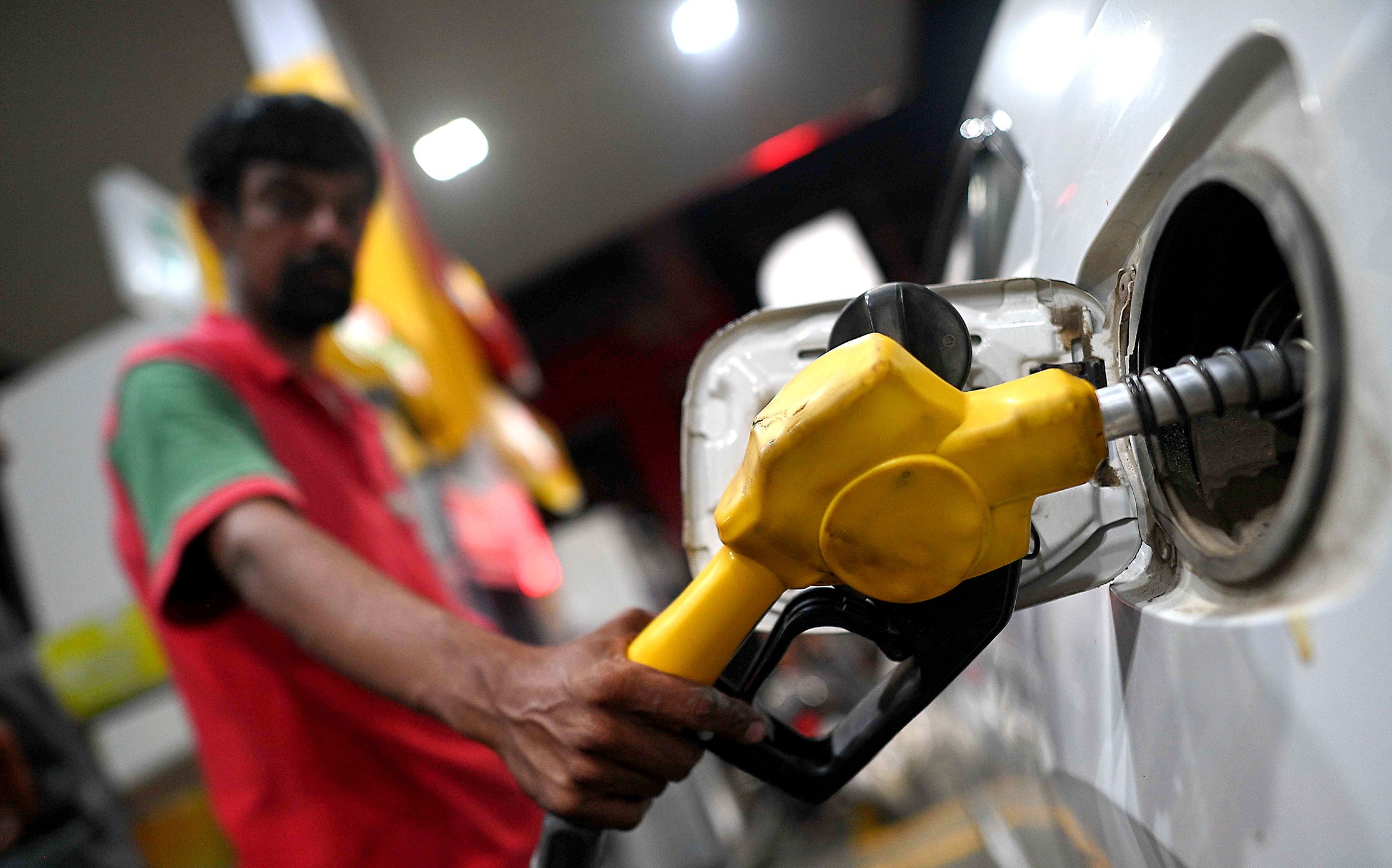
 A worker fills the tank of a customer’s vehicle at a fuel station in Karachi, Pakistan, on 30 April. (Photo: Shahzaib Akber/EPA)
The fuel shortage threats are real again. Because South Africa is heavily dependent on imported finished product, specifically diesel, our fuel providers are paying never-
before-seen premiums on getting it to the pumps.
“Some of the smaller guys who are paying cash are definitely getting screwed,” a fuel station owner in Khayelitsha, Cape Town, told Daily Maverick. It’s the third filling station we visited on the Saturday before the fuel increase on Wednesday, 7 October, because the other two in Macassar and Eerste River were out of petrol.
“We don’t get the benefit of the slate levy – the government does – but at least we don’t have the wholesalers putting up their prices mid-month.”
The slate levy is a variable, temporary charge added to (or subtracted from) the price of petrol and diesel to recover cumulative deficits (under-recoveries) or pass back surpluses (over-recoveries) over time.
Under the Self-Adjusting Slate Levy Mechanism, a slate levy is only triggered and added to the fuel price if the cumulative negative slate balance exceeds R500-million. At the end of August, the combined cumulative petrol and diesel slate balance stood at -R10.456-billion.
The subsequent 87.66c/litre slate levy in the recent fuel price increase is trying to claw that back.
Why now?
The Houthi attacks on Saudi oil infrastructure and maritime transit corridors affected fuel prices through three primary mechanisms: direct physical supply disruptions, astronomical shipping and insurance surcharges, and an explosion in the refining margin (the “crack spread”) for finished fuels such as diesel.
Direct attacks using drones and missiles struck critical processing facilities, such as the major Abqaiq and Khurais facilities in earlier escalations, as well as Yanbu export refineries and Petroline (the East-West Crude Oil Pipeline) pumping stations.
Although Saudi Arabia tried to bypass the vulnerable Strait of Hormuz by piping crude across the desert via the Petroline to Red Sea ports, drone strikes on pumping stations temporarily forced pipeline shutdowns. Now consider that Yanbu refineries consume more than one million barrels per day before crude can even be loaded into tankers.
With the Bab el-Mandeb Strait in effect choked by Houthi maritime strikes, tankers bound for Europe and Asia were forced to detour around the southern tip of Africa. This added 15 to 29 days to transit times, tying up global tanker capacity.
Supertanker daily charter rates soared from pre-crisis norms of $30,000 to $60,000 per day up to $642,000 to $1,300,000 per day. This increased raw maritime shipping costs from $3 per barrel up to $23 to $33 per barrel.
War risk insurance for ships navigating contested Red Sea waters jumped from less than 1% to 3%-7% of hull value, adding millions in surcharges per voyage.
Add all this together and it raised the delivered floor price of Saudi crude from its baseline operational extraction cost of $8.98 per barrel up to $29-$42 per barrel at destination ports.
Within range of the Atlantic
And the disruptions hit finished fuel product importers harder than those with refining capacity. The difference between the price of finished fuel and crude oil is called crack spread, and the cheeks were separated significantly over the past few weeks.
Because of regional refinery strikes, longer ping-pong shipping routes and global refining bottlenecks, the diesel crack spread exploded from a historical average of $20 per barrel up to $110 per barrel.
Combined with crude oil rising to $100 per barrel, the total price of delivered diesel tripled, jumping from $85 per barrel to $210 per barrel. Because heavy transport, trucking, agriculture and global shipping rely on diesel, this fuel price surge triggered widespread inflationary pressure across consumer goods, food and freight.
Although Saudi Arabia maintains the lowest base extraction cost globally at $8.98 per barrel, the required $20-$33 per barrel freight and war risk penalty for circumnavigating Africa elevates its delivered floor price in Europe and Asia to $29-$42 per barrel.
This surcharge basically erases the Persian Gulf’s traditional cost advantage, making delivered Middle Eastern crude roughly as expensive as Venezuelan Orinoco production ($39-$46 per barrel) and US Permian shale production ($40-$50 per barrel).
/file/attachments/2998/P17LindseyOilprice2_271057.jpg "Source: Lindsey Schutters. Graphic: Jocelyn Adamson")
Now consider that Venezuela’s September crude exports dipped to 1.08 million barrels per day, but flows to the US jumped to 629,000 barrels per day, representing 58% of total shipments. This means that nearly three out of every five barrels Venezuela exported last month went to US shores. Meanwhile, flows to India fell to 253,000 barrels per day, and Europe received just 86,000 barrels per day – a massive narrowing of Venezuela’s customer base.
There is enough circumstantial evidence to claim that US interests are served well through the continuing supply disruption in the Middle East, but much of it is nullified by the energy crisis in Venezuela, where electricity is out for almost 10 hours per day in some areas. But the price of sour oil out of a US-controlled territory has reached parity with a Brent barrel from Saudi, and that is not an insignificant development. DM
This story first appeared in our weekly DM168 newspaper, available countrywide for R39. The e-edition of DM168 is now free for readers who are signed into their Daily Maverick account. Click on the cover of the newspaper below to access the e-edition.
/file/attachments/2998/DM-091026_835322.jpg)
Comments
Scroll down to load comments...