






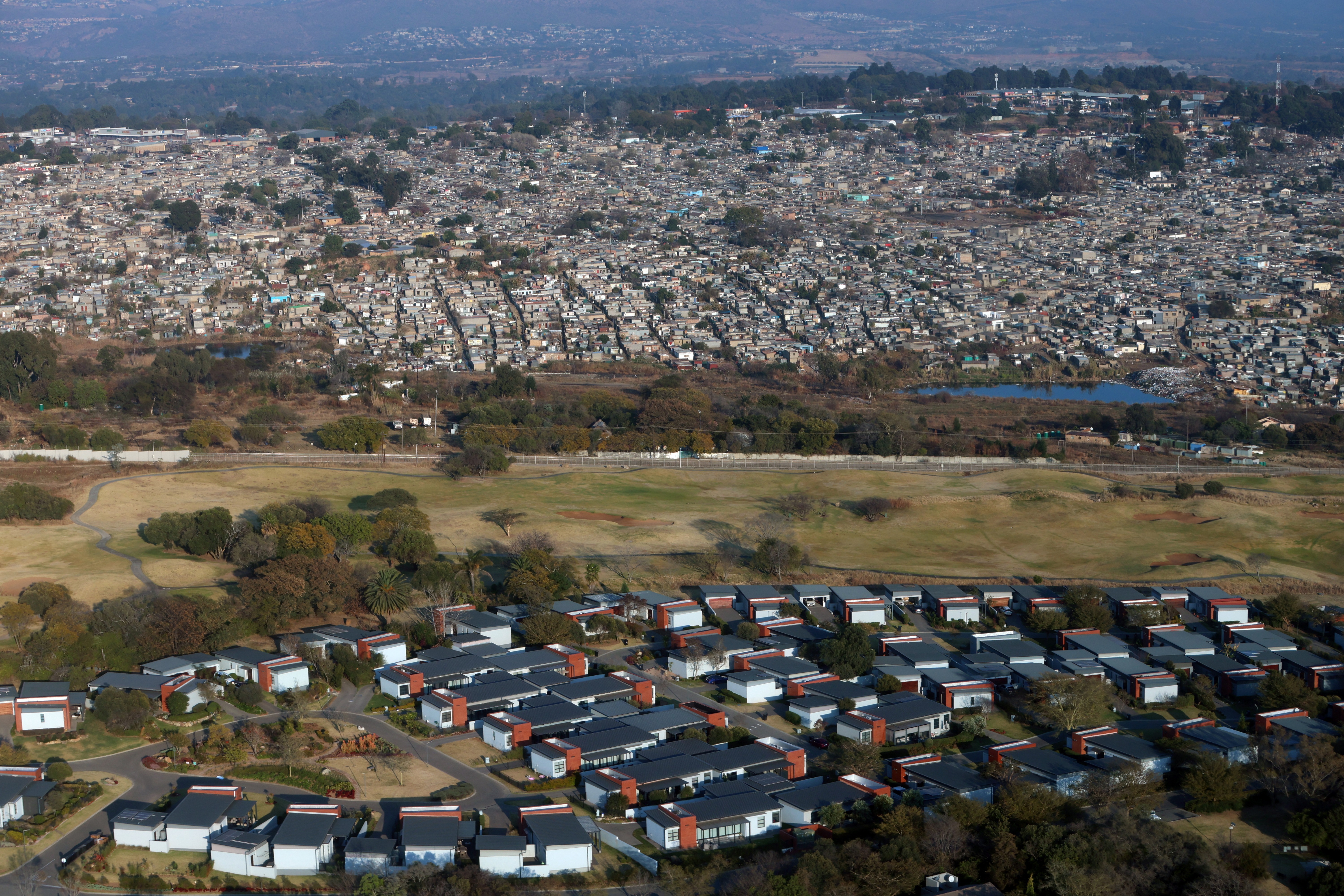
 A boundary wall separates the suburb of North Riding from Cosmo City in Johannesburg. (Photo: Felix Dlangamandla)
The National Food and Nutrition Security Plan (2018-2023) was supposed to address hunger, food insecurity and malnutrition.
“The first plan was largely not implemented, no budget was made available for implementation and there was no way to assess most of the objectives as the data was not collected,” Andrew Bennie, senior researcher in climate policy and food systems at the Institute for Economic Justice, told Daily Maverick.
The first of the plan’s strategic objectives was to establish a National Food Security (FNS) Council to coordinate government and stakeholders. It was established, but never met.
The FNS did not meet due to leadership changes and transition that “coincided with the development of this structure,” the Department of Planning, Monitoring and Evaluation (DPME) told Daily Maverick.
“The sub-committees were to be established once the fully-fledged FNS Council was in place. At a technical level, subcommittees were existent and functional, and provided technical monitoring and oversight of the plan in accordance with the seven objectives of the plan. They were led by sector experts from the line function departments, supported by other departments,” said the DPME.
The plan’s logic made the FNS Council and sub-committees the foundation for its other objectives.
/file/attachments/orphans/MC-NFNSP-failures3_571026.jpg "Strategic objectives and results of the National Food and Nutrition Security Plan. (Graphic: Iman Allie)")
Monitoring and evaluation
Objective six was to monitor and evaluate how the plan was working. No unified evaluation took place, and the plan’s progress was evaluated in 2023, in the Implementation Evaluation of the National Food and Nutrition Security Plan report.
The evaluation in 2023 found that none of the five Objective 6 indicators met their 2023 target.
There was no consolidated tracking mechanism, fragmented departmental reporting, indicators that did not align with routinely collected data, weak adaptive management and most impact indicators were unable to be assessed.
/file/attachments/orphans/MC-NFNSP-failures2_257202.jpeg "Nonkululeko Gwaza, from Snake Park, Soweto. (Photo: Lillian Roberts)")
The DPME told Daily Maverick that claims of a missing monitoring system were a “misnomer”, as other departments had existing systems monitoring food security and the nutritional status of South Africans. The department said impact indicators could not be reported on because a follow-up South Africa Demographic and Health Survey (SADHS) could not be conducted after 2016 due to funding barriers.
“Conducting an SADHS is a resource-intensive undertaking, and funding became a barrier. It still is.”
Asked how the lack of monitoring affected the implementation of strategic objectives, DPME said, “The so-called ‘late evaluation’ did not affect the implementation of the plan, because monitoring was happening consistently, with remedial action undertaken where necessary.”
They added that findings of the evaluation continue to inform the development of the new plan.
The original plan
The plan recognised the country’s “double burden” of malnutrition; undernutrition and micronutrient deficiencies, happening alongside overweight, obesity and non-communicable diseases.
/file/attachments/orphans/MC-NFNSP-failures6_685508.jpg "Important impact targets of the National Food and Nutrition Security Plan. (Graphic: Lillian Roberts)")
The plan estimated an R86.8-billion in funding would be required. This was not secured. Departments relied on existing budgets.
The plan had 17 SMART impact objectives, which would illustrate if it was working. It achieved none of its intended objectives. Or at least, none that could be measured.
According to the evaluation, “Leadership buy-in at the highest government levels, including in the Office of the Deputy President, is lacking, leading to a lack of political will for plan implementation trickling down to implementing departments.”
The DPME says this was an independent opinion of external evaluators and not the view of government. Government did not agree that there was a lack of political will, it added.
“Government departments that steered the development of the plan were held accountable by the national executive. To illustrate, the original FNS plan had only six objectives, but the executive directed that a seventh objective focusing on the role of SMMEs in ensuring food security should be established,” the DPME added. The seventh objective was added in 2021.
Within the plan’s six main objectives, there were 65 strategic objectives. It achieved only 11 out of the 65 strategic objectives by 2023.
National government
According to the evaluation, the FNS National Technical Task Team was consistent, providing stability, institutional memory and driving progress where possible. While the Task Team was instrumental, it did not have the mandate to do everything that the council was intended to do.
National departments were resourceful: using the existing budgets to execute aspects of the plan, the evaluation stated, but there was slow progress with objectives, and a fragmented approach.
The volunteer-based nature of the council’s role and absence of a structured recruitment process is believed to have added to why it did not convene. The plan’s Game Changers, requiring interdepartmental coordination, were not installed due to staffing shortages and a lack of strategic capacity, the evaluation outlined.
Limited engagement with the private sector and civil society organisations, along with the impact of Covid-19, affected the implementation.
Provincial breakdowns
By 2023, most provinces were in the early phases of establishing structures for implementation.
The Office of the Premier in each province was seen as the most appropriate to convene and lead the implementation of the plan, except for two provinces.
In Limpopo, the Department of Agriculture faced resistance when convening meetings due to a perceived lack of authority. In the Northern Cape, the provincial plan’s development was led by the Department of Social Development, and efforts for the Office of the Premier to take over the coordination role were challenging. A similar situation played out in North West.
In the Western Cape, while efforts in the Breede Valley Municipality to understand and support local needs were successful, replicating this across 29 municipalities was constrained by resources. The same occurred in Limpopo, with limited reach of food support initiatives.
/file/attachments/orphans/MC-NFNSP-failures5_848084.jpg "Provincial execution of the National Food and Nutrition Security Plan. (Graphic: Iman Allie)")
“Provinces will continue to play a critical and vital role in the implementation of the plan. No two provinces in South Africa are alike, and variations will occur due to factors such as context, capacity and resource availability,” the DPME said. They added that national government will continue have a role in the new plan.
The Southern Africa Food Labs was part of the team that carried out the evaluation of the Plan. The Food Lab used the National Policy as guidance for “Nourish to Flourish”, run from the Western Cape Premier’s Office, explained director Scott Drimie.
The Premier’s Office brought in the Western Cape Economic Development Partnership (EDP) and the Food Lab, with funding from the Centre of Excellence in Food Security at the University of the Western Cape, to keep the work moving, said Drimie.
In the Breede Valley, they facilitated learning journeys. Officials, municipal staff, councillors, community organisations, Early Childhood Development (ECD) practitioners and researchers went to where people actually got their food.
“The success was that what people learned, changed what [the] government did.
“The evaluation also found that the process gave officials room to experiment without being punished for mistakes. That is rare in a system that measures compliance.”
The limitation was scale and money. No one secured long-term funding for the arrangements that made it work.
/file/attachments/orphans/MC-NFNSP-failures4_661798.jpg "Provincial successes of the National Food and Nutrition Security Plan. (Graphic: Iman Allie)")
Health
There was a proposed comprehensive policy on pregnancy and maternity benefits within objective three. The revised plan is in draft form and remains subject to ongoing consultation, said Foster Mohale, spokesperson of the National Department of Health.
It proposes strengthening social and nutrition protection for vulnerable women, mothers and young children, including better referral to social support, and consideration of cash transfers and food vouchers, said Mohale.
It also proposes reviewing the Maternal Care Support Policy to strengthen nutrition support during the first 1,000 days. From conception to a child’s second birthday is critical because nutrition lays the foundation for longer-term health, he added.
Objective four focused on high-impact nutrition interventions. A goal was to have 90% of pregnant and lactating women receiving folic acid, iron and calcium supplements.
Supplements form part of routine maternal nutrition interventions. Data for women receiving these supplements were not routinely collected in the National Indicator Data Set (Nids). As a result, national performance against the previous plan’s 90% coverage target could not be determined, Mohale said.
The evaluation recommends working with maternal health stakeholders to establish a critical minimum set of maternal nutrition indicators for the next Nids review cycle.
The National Department of Health proposed priority maternal nutrition indicators for Stats SA’s Continuous Population Survey Health Module survey, though the final indicators are yet to be confirmed.
/file/attachments/orphans/MC-NFNSP-failures1_938702.jpg "Nomzamo Zintoyinto and Veliswa Dyubhele measure the height of a child during a routine health assessment in Xhora Mouth. (Photo: Felix Dlangamandla)")
Another goal within objective four was to have 90% of children under five years old with moderate or severe acute malnutrition receiving supplements.
Mohale told Daily Maverick that the target “could not be fully assessed”. The evaluation showed a monitoring gap, not proof that the 90% child malnutrition supplementation target failed, he said.
While improved monitoring is needed, this must be balanced against adding too many data elements to Nids, he added. The review of Nids is a consultative process, and any “additional nutrition indicators will need to be considered based on their priority, feasibility and practicality for routine reporting.”
Agriculture
Daily Maverick asked the Department of Agriculture how the insufficient funding affected objective two; establishing inclusive local food value chains, enhancing production and access to nutritious and affordable food, particularly through smallholder farmers.
The plan aimed to have 100 smallholder producers SA GAP certified (Good Agricultural Practice) – 105 were certified, a success.
The goal of 10% of 16,000 smallholder producers supplying food to institutional markets reached only 10 smallholder producers supplying the World Food Programme and 51 supplying Tiger Brands.
The department has not responded in time for publication, but its response will be included when it is received.
No date has been set yet for the finalisation of a new plan. DM
Comments
Scroll down to load comments...