




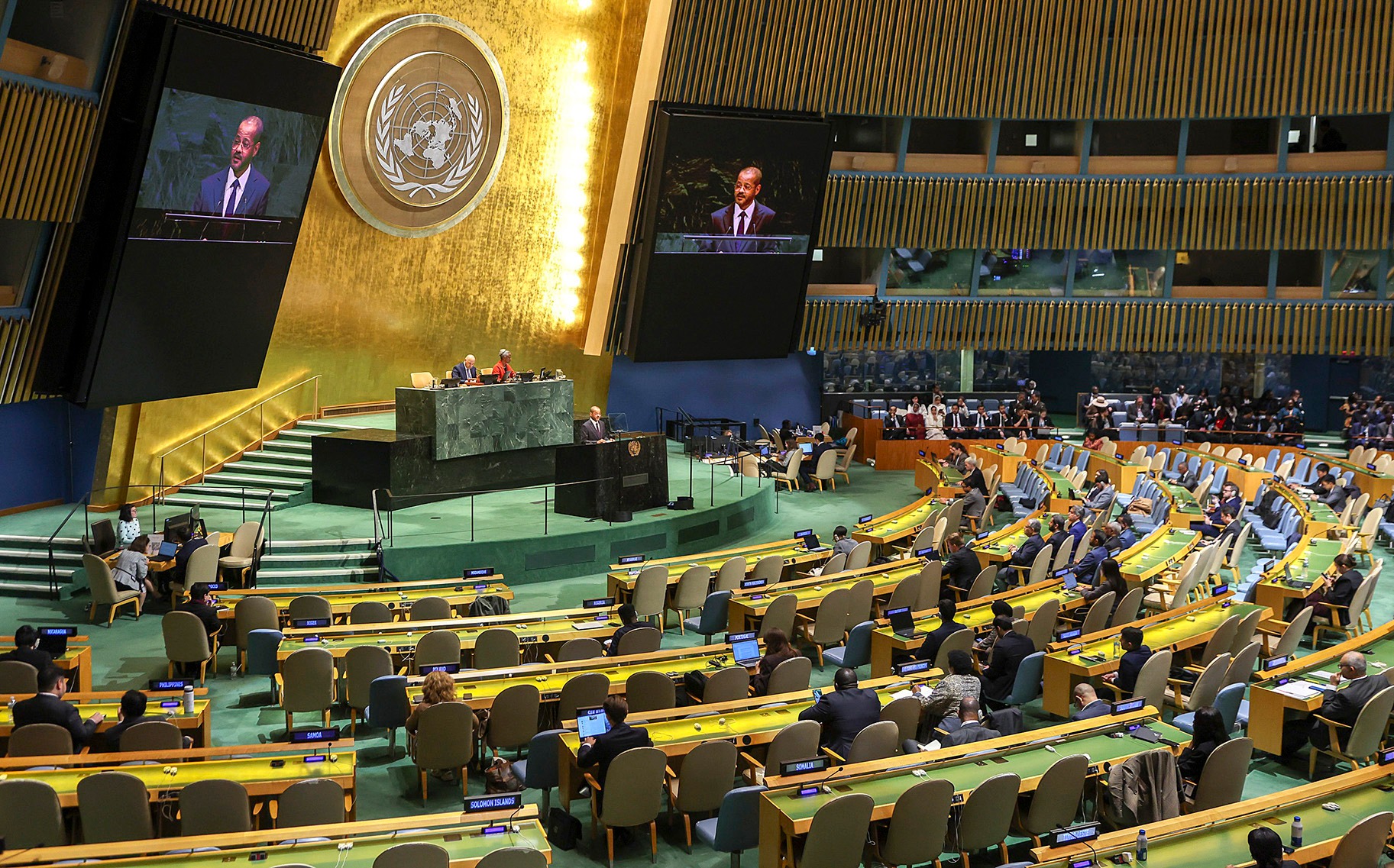
 Foreign Minister of Oman Badr bin Hamad Al Busaidi speaks during the General Debate of the 81st session of the United Nations General Assembly in New York on 26 September 2026. (Photo: EPA / Sarah Yenesel)
The week of the UN General Assembly offers a snapshot into the collective minds of the world’s leaders. This year, that mood was a tentative determination. A determination to solve collective challenges, to uphold international law – and to not let the opposition of a few, however powerful, voices get in the way of the will of the many.
What a difference to last year. The mood 12 months ago was anxiety and uncertainty. Faced by a multiplicity of challenges: high indebtedness, rising inequality and protracted conflicts, and by a dramatic reshaping of the world order with the new administration in the US, world leaders showed up at the UN as concerned custodians of a world that seemed out of control. Many questions were asked, but few solutions offered.
One year later, the challenges have not receded. If anything, they have become worse. The number of conflicts has gone up, geopolitical fragmentation has deepened and the institutions that are supposed to anchor global cooperation have been emaciated, starved of resources and power. Accelerating geopolitical rivalry on frontier technology has added another layer of complexity to the ever-evolving picture of great power tensions.
And the institutions that underpin multilateralism are feeling the strain. The UN and its agencies, funds and programmes today are forced to rethink how they operate and how they use reduced resources to have an impact on the ground. The Security Council is seen as having failed to fulfil its mandate of maintaining peace and security around the globe, and many have pointed out the absence of the UN in some of the peace processes currently under way.

Last year, this political and institutional reality added up to a widespread loss of confidence in multilateralism as the essential tool for enabling global cooperation and problem solving. There was a real risk of a collective step back from cooperation, following the lead of the new US administration.
This year was different. Leaders looked into the abyss and imagined a world without multilateral solutions and institutions in which to negotiate them. They didn’t like it, and they are working together to ensure it doesn’t happen. As the week went on, one leader after the other spoke to the need for multilateralism, the engine of global cooperation. They spoke to the abuse of power, to sovereign equality of each member country of the UN and for the need for respect of international law.
And they came with solutions which recognised the hard-headed reality that cooperation is necessary to defend sovereignty in today’s world.
‘Call for Control’
Nowhere was this clearer than in AI, the issue that dominated the week. Of the 194 leaders who spoke in the General Assembly Hall, two-thirds mentioned AI. And the majority of these insisted on the need for international cooperation. Faced with a technology that seems to be running out of control, most countries are clear that the solution lies in acting together.
At the start of the week, 20 countries signed up to a “Call for Control” of AI, outlining concrete steps at national, regional and global level. By the end of the week that number had grown to 30, including the President of South Africa. Others called for global standards, for action on children’s rights in the age of AI, for new rules or a new institution to bring countries together. Many voiced their support for what the UN has put together: a Scientific Panel to create a collective evidence base and a Global Dialogue to bring all countries and stakeholders together on an equal footing.
There’s no single solution to the many challenges we face in this moment. But what this UN General Assembly showed so clearly, on AI and on all the issues discussed this week, is a clear understanding that the world cannot wait for powerful countries to act. Leaders must work together to find pathways out of the moment we are in, and the UN is a place where these solutions can be found.
No one should confuse words with action. If the mood among leaders is one of determination, this needs to be carried through in agreements made, money spent and policies delivered. The UN General Assembly this year offered some hope and some intention – the job now is to make the change happen.
This time next year a new secretary-general will be in the hall of the UN General Assembly. They will need to hold leaders to their promise that, in the words of Kofi Annan, “whatever our differences, in our interdependent world, we stand or fall together”.
What a difference a year makes. DM
Mathu Joyini serves as distinguished diplomat-in-residence at the United Nations Foundation and was the permanent representative of South Africa to the UN from 2021 to 2025. Claire Melamed is the foundation’s vice-president of AI and digital cooperation strategy.
Comments
Scroll down to load comments...