




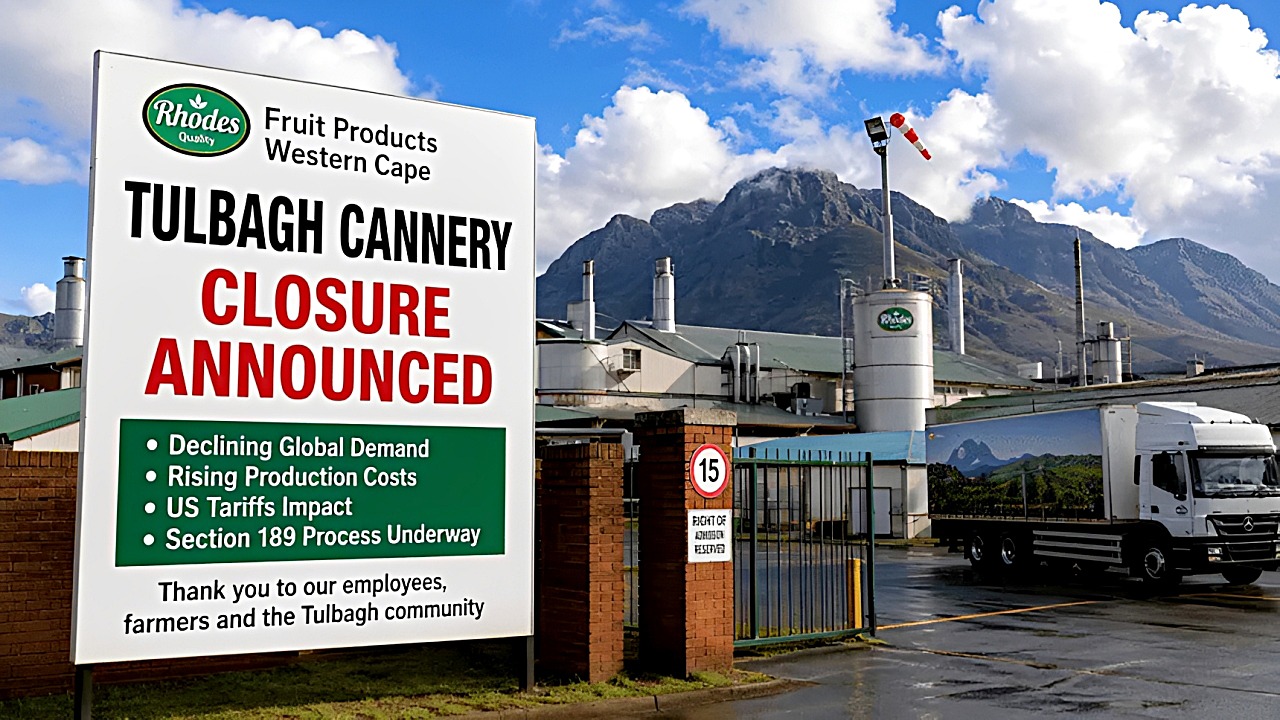
 Not telling the Competition Commission about plans to shutter the Rhodes canning facility in Tulbagh was a bad idea by the Premier Group. (Photo: Cape Town News)
The Competition Commission on Tuesday, 6 October, filed an application with the Competition Tribunal under section 16(3) of the Competition Act to revoke the tribunal’s conditional approval of the Premier Foods-Rhodes Foods Group (RFG) merger (initially granted on 6 March 2026).
If the tribunal finds Premier Foods in breach of merger conditions or competition regulations, the highest fine is 10% of Premier’s annual South African turnover and export turnover. Based on Premier’s FY2026 group revenue of R21.2-billion, that penalty could reach just over R2.1-billion.
And should the tribunal grant the commission’s section 16(3) application, the approval would be revoked, forcing Premier into an unwinding or divestment of the R6.5-billion RFG transaction.
The root of the drama tree
Before the merger was approved, Premier and RFG assured regulators that they had no plans to close any factories. However, an investigation (triggered by a union complaint) found that the companies had discussed closing the Fruit Processing Western Cape (FPWC) fruit-canning plant in Tulbagh before getting approval.
It gets trickier for the Competition Commission too because FPWC is one of only two fruit-canning plants in South Africa. Closing it leaves competitor Langeberg Foods as the only remaining cannery, effectively creating a monopoly in the country.
Not playing by the rules
When the merger was approved, the Competition Tribunal set explicit rules to protect jobs:
Clause 2.1 prohibits any merger-related retrenchments for a three-year moratorium period.
Clause 2.3 states that any retrenchments during these three years are automatically presumed to be caused by the merger unless Premier can prove otherwise.
Premier argues it did not break any rules. Responding to the Competition Commission, the company states that the decision to close the plant was made months after the merger, driven by a collapse in global demand for canned fruit - 90% of the plant’s output is exported.
The company also states that because most employees accepted voluntary severance packages, no forced retrenchments are taking place.
However, the commission and labour unions argue that withholding plans about closing the plant during approval talks violates the duty of full disclosure. Pushing workers into voluntary exits after announcing a plant shutdown is seen by unions as bypassing job protection rules.
The truth is on the bottom line
Premier completed its R6.5-billion acquisition of RFG Holdings on 30 March using a share swap, which brought significant financial scale to its business.
With RFG fully consolidated for the upcoming 2027 financial year, Premier expects that R21.2-billion overall revenue to jump by between 35% and 45%.
Focusing on the 2026 results, operating profit before interest and taxes (Ebitda) grew 18.2% to R2.8-billion. RFG’s business has been turned into Premier’s new Culinary division, which is expected to contribute about one-third of the group’s total Ebitda.
The combined company now owns 52 consumer brands, operates 44 manufacturing plants, and employs about 15,500 people.
But under the new entity, Premier is contractually required to pay local fruit farmers for any financial shortfalls on agreed fruit supply volumes for the 2026/27 harvest season (they have been offered R3,205/ton to walk away from their contracts, though).
Then there are the voluntary exit packages and legal retrenchment packages for the 424 factory workers. And Premier would also be on the hook to supply processing machinery to rival company Langeberg Foods so it can take over some of FPWC’s farmer contracts, alongside costs to repurpose the Tulbagh site.
Oh, and it will have to repurpose viable fruit into pulp and purée at the Groot Drakenstein plant.
Soften the economic blow
Premier argues that the commercial necessity to close the factory would have occurred regardless of whether the merger took place.
Because around 90% of FPWC’s production was exported, the business suffered from plummeting international demand, rising input costs, tariffs, and intense global competition, rendering the plant economically unviable.
The company says it remains committed to consulting in good faith under section 189 of the Labour Relations Act with the 424 affected workers (246 permanent and 178 fixed-term).
But GroundUp reported that during CCMA talks, Premier objected to non-employee representatives sitting at the negotiating table (such as a provincial Cosatu official and a seasonal shop steward), arguing that consultations must strictly follow statutory labour representation rules.
It’s funny how rules can apply selectively to different situations, though. A three-year retrenchment moratorium is still in place whether the market shifted or not - the cannery, of course, was part of the merger. DM
Comments
Scroll down to load comments...