



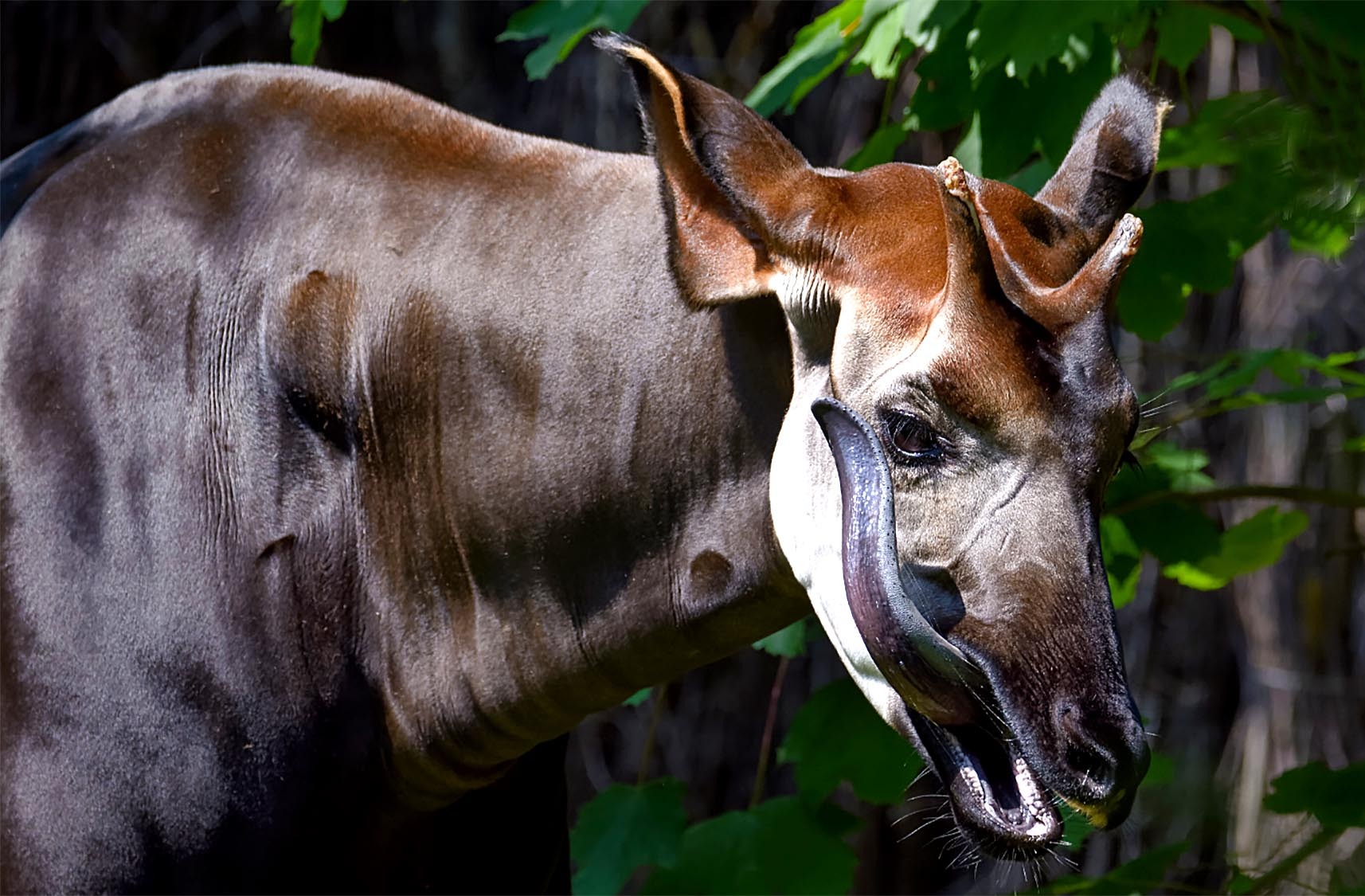
 The mysterious okapi was nicknamed the ‘African unicorn’ because Western scientists doubted its existence for a long time. But unlike the mythical, single-horned creature, male okapis have two skin-covered horns called ossicones. Females have no horns, but are physically larger. (Photo: www.okapiconservation.org)
Hands up if you’ve ever seen, or heard of, an okapi?
Older readers may remember this name from a well-known brand of penknives. But we’re talking about the original, living and breathing okapi – a creature once described as part donkey, part giraffe and with the stripey black-and-white hindquarters of a zebra.
It also has a very long blue-black tongue, huge ears and the ability to communicate via infrasound.
The remarkable beauty and unique colouring of the okapi were among the striking features that caught the eye of those who were lucky enough to see one, with Italian explorer and filmmaker Attilio Gatti immediately bestowing the name “Beautiful” on the first okapi he helped to capture in a jungle pit trap in 1934.
But “Beautiful” fought valiantly against his captors, ultimately head-butting and kicking his way to freedom from a makeshift wooden stockade.
Later, during a visit to New York, Gatti remarked that the young okapi he saw in the Bronx Zoo had lost its “magnificence”. In his opinion, such captive animals “cannot give you even the faintest idea of the majestic appearance, the large size and fearful might which such animals normally attain in their own natural world”.
/file/attachments/orphans/Tony-Okapi1_386439.jpg "The Azande hunter “Abawe” with an okapi bull he hunted for zoologist Herbert Laing. Its taxidermized remains are still on display in New York. (Photo: Herbert Lang, 1918)")
Dr Simon Pooley, author of a new book entitled Discovering the Okapi, describes the captive okapis he saw at London Zoo as having “gorgeous red-brown coats”.
Indeed, their beauty – and his boyhood memory of an okapi photograph he saw in an encyclopaedia – inspired Pooley to start writing a book about these animals in 2020 while he was recovering from a bout of dengue fever picked up during a visit to India.
Pooley, who grew up in the Ndumo Game Reserve in KwaZulu-Natal (but is now living and lecturing environmental sustainability at Birkbeck, University of London) was disappointed to find very relatively little information about the history of these animals, particularly in English.
So, he set out to “research and write the book that I had always wanted to read about okapi”.
/file/attachments/orphans/Tony-Okapi2_218503.jpg "Discovering the Okapi book cover. (Source: Wits University Press)")
He acknowledges immediately that the “discovery” title of his recently published book is a misnomer, considering that many Africans had known about, and hunted, these animals for thousands of years in the Ituri forest region of the current Democratic Republic of Congo (DRC).
“Pygmies” also feature prominently in the story, due to their deep knowledge of the animals with whom they have shared the forest environment (with Pooley agonising over whether to use a term apparently disliked by some of the people so named).
Pooley further acknowledges that he has never seen a wild okapi, nor visited their forest home in the DRC (formerly a Belgian colony notorious for human rights atrocities and the brutal system of forced labour to extract rubber during the rule of King Leopold II).
Further acknowledging that a more thorough history of okapi conservation in the DRC remains to be written, he nevertheless sets out to bring the okapi “back into focus” from its more recent obscurity.
But, be warned. Stretching to over 300 pages (excluding the index and reference section), Discovering the Okapi is not a light read.
Pooley recounts that, given the sense of astonishment and celebration following the initial “discovery” of this strange animal by Western scientists in 1901, he was nonplussed to discover that not a single okapi specimen remained on public display at London’s famous Natural History Museum.
/file/attachments/orphans/Tony-Okapi3_546900.jpg "The author Simon Pooley with four tattered okapi mounts in a storage vault in London. “Observing this beleaguered little group, once treasures of the museum visited by thousands but now disintegrating in obscurity in an off-site storage facility, I felt a pang of melancholy.” (Photo © Simon Pooley by permission Trustees of the Natural History Museum, London)")
Museums across the Western world (followed by zoos) clamoured to obtain specimens to put on display, triggering a collection spree that that would lead to the deliberate or accidental death of hundreds of these rare forest creatures – despite warnings as far back as 1902 that okapi were under growing pressure in their native range.
For more than 70 years, he says, zoos queued up for export permits from both the Belgians and DRC governors, resulting in horrific mortality rates for captured okapi – most of which died en route or shortly after arrival in the early days, before air transport cut the journey time and vets and zoo keepers began to understand some of the unique health and husbandry challenges.
/file/attachments/orphans/Tony-Okapi4_411606.jpg "A cartoon depiction of British zoologist and former director of London's Natural History Museum, Ray Lankester, riding an okapi. (Image: Punch, November 12 1902)")
One historical account from a 1949 collection expedition recalls that captive okapi were in transit for more than 50 days between Stanleyville (now Kisangani) and Antwerp.
Apart from getting seasick and losing their appetites, the indigenous leaves supplied before departure went mouldy, resulting in the animals being fed bananas, vegetables or oat porridge. During other sea trips, no straw was supplied in the capture crates, leaving okapi to lie in their own excrement.
Apart from being shipped or flown to London, Paris, Berlin or New York, two okapis were also delivered to the National Zoological Garden in Pretoria in 1956 (but neither survived beyond their first year there).
/file/attachments/orphans/Tony-Okapi5_193345.jpg "A one month okapi calf, reputedly the first live okapi to have been photographed. (Image: reproduced in Julien Fraipont, Okapia, 1907)")
As husbandry improved, survival rates gradually improved considerably (with a male named Chuma living for 29 years in the San Antonio Zoo).
However, Pooley notes, the 180 or so okapis still living in zoos across the world are descended from a very small pool, with very little genetic variation.
/file/attachments/orphans/Tony-Okapi6_175622.jpg "Congo, the first okapi to arrive at the London Zoo, munches on carrots supplied by his keeper, Ernie Bowman, in 1935. (Photo © F.W. Bond Zoological Society of London)")
Back home in the Congo forests, the first significant wildlife reserve for okapi was established in 1925 (now Virunga National Park), but it was not until 1992 that the 1.3 million hectare Okapi Wildlife Reserve was created in their largest remaining stronghold.
The reserve in the Ituri forest was proclaimed as a Unesco World Heritage Site in 1996, but listed shortly afterward as a heritage site in danger due to a multitude of threats – including civil war, gold mining and the bushmeat trade. Several conservation groups have also pulled out for safety reasons, while funding support is also reported to have been cut by the Trump administration.
According to the US-based Okapi Conservation Project, more than two million people have moved to the surrounding Ituri region due to conflict-induced migration, increasing pressure on the forest.
/file/attachments/orphans/Tony-Okapi7_923948.jpg "The disappearing homeland of the okapi © Simon Pooley. (Map / Jade Myers, 2025)")
Illegal mining and agriculture have also fragmented the forests of the Okapi Wildlife Reserve while poaching rates have also led to a significant decline in okapi numbers.
The species was officially declared “endangered” in the International Union for Conservation of Nature Red List in 2013, but there are currently no reliable estimates of how many survive in the wild. The union says that over the past three generations, the population is estimated to have plunged by more than 50%.
What can be done?
For the past 10 years, the Okapi Conservation Project has been celebrating World Okapi Day annually on 18 October to raise global awareness and public support.
/file/attachments/orphans/Tony-Okapi8_548175.jpg "The okapi is the only living relative of the giraffe. They are about the size of a small horse, but they don’t have long necks, which would get entangled in dense rainforests. (Photo: www.okapiconservation.org)")
There is also a closing plea from Pooley for people to do whatever they can to “resurrect the public profile of these beautiful beasts”.
“Wouldn’t it be good if all of us with smartphones and electronic devices made with Congolese cobalt and copper, together with some of the big brands like Apple and Samsung and Tesla and Daimler who have built fortunes on products incorporating natural resources from the DRC, could give something back?” DM


Comments
Scroll down to load comments...