




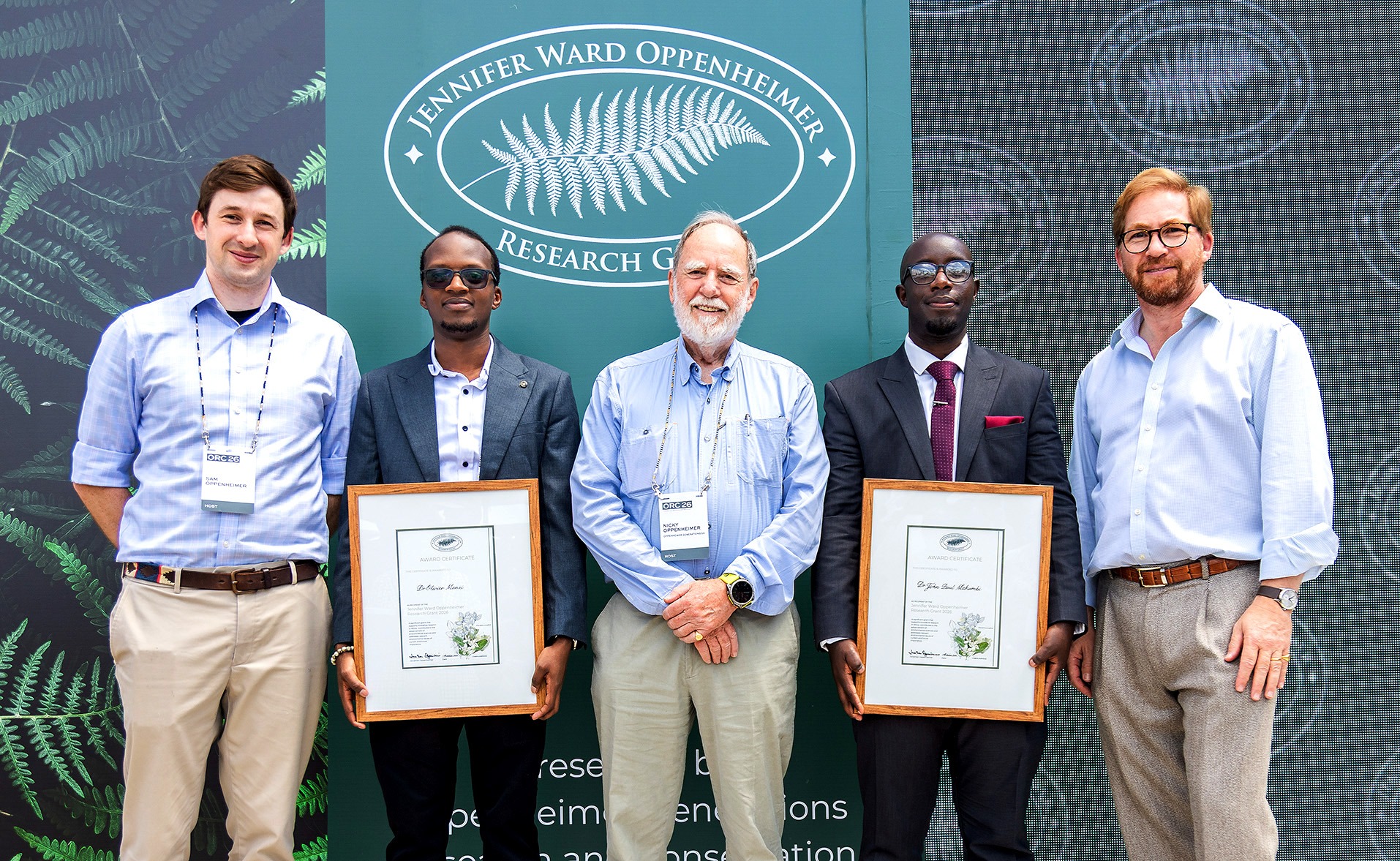
 A Rwandan tree physiologist and a Ugandan microbiologist have each been awarded a research grant of $150,000. The award, given in memory of the late Jennifer Ward Oppenheimer, supports transformative African-led research, and was presented today by three generations of the Oppenheimer family. From left: Sam Oppenheimer, Olivier Manzi (Rwanda), Nicky Oppenheimer, John Paul Makumbi (Uganda) and Jonathan Oppenheimer. (Photo: Supplied / Source)
Along the shores of Lake Victoria in Uganda, Dr John Paul Makumbi remembers a childhood defined by birdlife. Abundant flocks were simply part of the everyday landscape.
Returning years later as a scientist, he found something else entirely.
“I observed that signs of eutrophication were widespread,” Makumbi recalls, “and shoreline bird diversity appeared reduced.” Conversations with local fishing communities reinforced his fears. “Many reported declining fish catches and increasing difficulty sustaining their livelihoods from the lake.”
The contrast between the vibrant ecosystem of his childhood and the degraded one he encountered as a scientist pulled Makumbi away from his original training in medical microbiology and towards a much broader ecological question: can the microscopic organisms living in Africa’s waters reveal that an ecosystem is approaching a tipping point long before the warning signs become visible to the human eye?
Freshwater systems across Africa – including the East African Great Lakes, which hold roughly a quarter of the world’s unfrozen surface water – are under growing pressure from urbanisation, agricultural runoff, industrial pollution and climate stress. The fundamental flaw in conventional monitoring, Makumbi argues, is that it is largely reactive.
“Most environmental monitoring systems tell us when ecosystems have already been damaged,” says Makumbi, now a postdoctoral researcher at Stellenbosch University. “By the time water quality deteriorates, fish populations decline and harmful algal blooms become common, opportunities to prevent biodiversity loss may already have been reduced.”
Molecular signals
Makumbi’s research takes a different approach: looking for molecular signals of environmental stress in microbial DNA, potentially revealing that an ecosystem is changing while there is still time to intervene.
Microorganisms can respond rapidly to changes in their environment. Under stress, the microbial communities responsible for processes such as carbon, nitrogen and phosphorus cycling can change in composition and function.
“They have to choose between survival and continuing with their regular ecosystem services,” Makumbi explains. “In disturbed systems, microorganisms might shift from carbon sequestration towards surviving antibiotic pollution. They stop doing the work that is vital for our climate and ecosystems because they are in survival mode. They are no longer in a healthy status.”
/file/attachments/orphans/Roving-Oppenheimergrantwinners2_126367.jpg "Olivier Manzi measures leaf water potential using a pressure chamber in Rwanda. This technique indicates the plant's water stress and how difficult it is for the plant to draw water from the soil. (Photo: Eric Mirindi)
<br>
<br>")
Makumbi’s project will track four families of genomic indicators: genes involved in biogeochemical processes; pathways associated with stress and pollution responses; mobile genetic elements that can help reveal how organisms adapt and exchange genetic material; and networks of interactions within microbial communities.
The aim is to turn these molecular changes into a predictive early warning toolkit, tested across sentinel sites in Uganda’s Lake Victoria, Côte d’Ivoire’s Ébrié Lagoon, Ethiopia’s Blue Nile, South Africa and Eswatini.
The approach could have another practical benefit: helping identify the sources of environmental stress and potentially cutting through the blame that can paralyse efforts to address pollution.
“In places like Hartbeespoort Dam or Lake Victoria, there is always a lot of discussion about who is responsible,” Makumbi says. “The municipalities say their wastewater treatment plants aren’t to blame; the farming communities say it’s not their runoff. Everyone is denying responsibility. By tracking how specific microbial metabolic pathways react to specific stressors, we can move past the blame game and provide law enforcement and policymakers with objective, actionable data.”
Same drought, different fate
A few hundred kilometres southwest of Lake Victoria, in a forest restoration trial plot in Rwanda, research by Dr Olivier Jean Leonce Manzi, is asking a parallel question – not of aquatic microbes, but of tropical trees.
Growing up in the village of Mibirizi in western Rwanda, Manzi was raised by his mother near a lush natural forest. Exploring those woods as a child sparked a fascination with plants. But when he returned years later, he was disturbed to find much of the forest had been cleared.
Initially on a path towards the Catholic priesthood, Manzi’s passion for the natural world eventually redirected him towards science.
After completing his undergraduate degree in Rwanda, he earned joint master’s degrees in biodiversity and tropical conservation in Belgium and France, followed by a PhD in plant ecophysiology at the University of Gothenburg in Sweden.
It was during his doctoral fieldwork in Rwanda, amid an intense dry season, that Manzi encountered a scene that would shape his scientific career. Walking through a plantation where trees had been planted at uniform 1.5m spacing, in similar soil and under the same shade conditions, he noticed an extraordinary contrast.
“Entire individuals of certain species had completely lost their leaves,” Manzi recalls. “Some were already dying back, their branches bare and brittle.”
What made it striking was how close they were to other species that looked perfectly healthy. One species stood leafless and stressed, while its neighbour, just an arm’s length away, remained fully green throughout the entire dry period.
“Same soil. Same microclimate. Same drought. Same planting design,” he says. “But completely different outcomes.”
That observation led Manzi to a deeper question: what is happening inside trees before the stress becomes visible?
Manzi compares it to people living under similar conditions. “You can have people living in the same place, eating similar food and experiencing the same environment, yet they do not all develop in the same way. Some may grow taller, some remain shorter, some gain weight more easily, others stay thinner, and they can respond very differently to the same stress,” he says.
“Trees are similar. They can grow in the same environment under the same conditions, but they won’t behave the same way because their internal physiology is different,” he explains. “In African forests, people think that green means healthy. But there are subtle, invisible changes occurring underneath. You see the forest is green, but species are being lost – you only see the ones that are still standing.”
/file/attachments/orphans/Roving-Oppenheimergrantwinners1_690726.jpg "John Paul Makumbi and Elly Saasirabo from the Ugandan National Water Quality Reference Laboratory collect water samples at an urban wastewater treatment plant in Kampala, Uganda. (Photo: JP Makumbi)")
Under the green canopy
For Manzi, the key lies in the tree’s internal physiology – and in subtle differences in the conditions immediately surrounding its roots and leaves. That is why he is pioneering tree ecophysiology across central Africa: to look beneath the green canopy and identify the hidden vulnerabilities that could determine whether forests withstand climate extremes 20 to 50 years from now.
To uncover those vulnerabilities, Manzi measures things that conventional forest inventories cannot. He studies individual trees’ hydraulic and thermal limits: how much stress their water-transport systems can withstand before they fail, and how much heat their leaves can tolerate before their photosynthetic machinery begins to break down.
He then compares these physiological thresholds with the heat and drought conditions trees experience in the field. The result is a measure he calls a “safety margin” — the gap between the stress a tree can withstand and the stress it is likely to encounter.
A narrow safety margin means that relatively small increases in temperature or drought duration could push a species towards physiological failure, potentially triggering dieback before conventional monitoring registers an obvious change in the forest.
The predictive value of Manzi’s work has an immediate practical application: helping restoration projects choose trees that can withstand the climate conditions they are likely to face in the future.
“Many restoration projects fail after a few years because people ‘plant for planting’ without testing heat and drought tolerance,” Manzi observes. “You ask local communities which species grew there previously, bring seedlings, and plant them. But climate patterns have shifted. In Rwanda, for example, dry seasons that used to end in early September now stretch into late September.”
“Because you plant a species that is growing now, but you don’t know if it will grow in 10 years, 20 years – then we are investing in things that will disappear,” Manzi adds.
His research aims to provide a way of measuring that vulnerability before trees are planted. “By measuring the tolerance threshold and the stress the given tree is under, getting this safety margin gives you an idea of how much stress they can tolerate.”
For Manzi, the implication is straightforward: safety margins could help make restoration a long-term investment rather than planting trees that may disappear within a few years.
While currently based at the University of Leeds and working with the AfriTRON network of more than 200 long-term forest monitoring plots, Manzi’s $150,000 JWO Research Grant will be administered directly through the University of Rwanda. By anchoring scientific leadership firmly on African soil, he plans to use the funding to build something that extends far beyond his own research: a growing body of open-access African data, local expertise and scientists capable of revealing how the continent’s forests will respond to a changing climate.
Commenting on the significance of Makumbi’s and Manzi’s research projects, Dr Duncan MacFadyen, head of Oppenheimer Generations Research and Conservation, said both scientists were studying very different systems, but their research begins with the same problem: by the time conventional monitoring shows that an ecosystem is in trouble, the damage may already be difficult to reverse.
“With 747 applications from across the continent the review process needed to be extremely stringent. For the first time, we made the decision to award the grant to two researchers, reflecting how equally deserving and compelling their proposals were,” added MacFadyen. “John Paul and Olivier represent the kind of African-led science we want to champion: ambitious, forward-looking research that can build knowledge, develop people and ultimately help the continent respond more effectively to environmental change.” DM
This story was produced by Roving Reporters in collaboration with Jive Media Africa, science communication partner to Oppenheimer Generations Research and Conservation.


Comments
Scroll down to load comments...